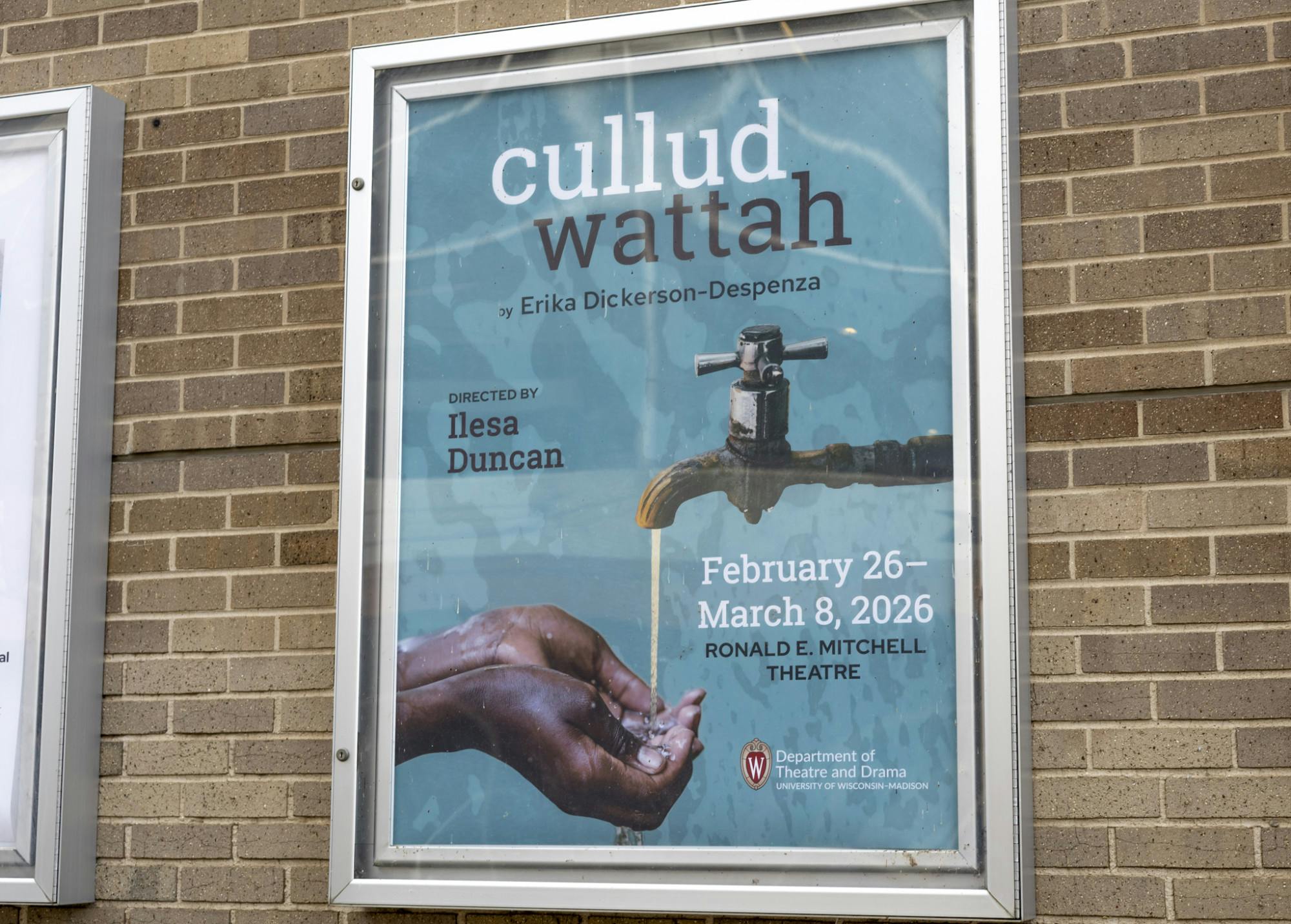
In Mitchell Theatre, a swarm of plastic bottles filled with dirty water has invaded the stage. “cullud wattah,” the University Theatre production running through March 8, transports audiences to a household in Flint, Michigan, where three generations of women desperately seek control over their own lives amidst the crushing effects of the Flint water crisis.
The play, written by Erika Dickerson-Despenza, begins on day 936 of the city’s loss of clean water. Marion (Olani Aboro) struggles to hold on to her identity as a mother, daughter and sister while the unclean water leaves a growing stain on her life, family, skin and sanity.
Around her, the household’s sense of normalcy slips away with every drop of dirty water that runs through their pipes. Plum (Jayda Smith), the youngest, struggles to return to school after her Leukemia treatments. Her older sister, Reesee (Jnya Smith), struggles with spirituality, desperately searching for a deity who can repair the crisis. The pair brings the powerful perspective of the younger generation by portraying the fragile hope of youth with heartbreaking conviction.
Plum is the first character visible to the audience, as she enters before the play begins, sitting down with a marker in front of a bathtub. For several straight minutes, Plum draws tally marks on the bathtub’s edge — a powerful reminder before the unfolding of the play’s events of the longevity of the crisis.
Marion’s sister, Ainee (Jnae Thompson), is a determined woman who seeks justice for all the damage that the crisis has caused. Having battled addiction for years and faced six failed pregnancies, she clashes with Marion as the two cannot align their priorities. Her seventh pregnancy — a lucky number, as Reesee tells her — brings her renewed hope, which she channels into supporting class-action efforts.
Thompson’s performance is powerfully vulnerable. Her pain, determination and love radiate strongly. Even in moments of silence or minimal action, Thompson held the energy, always filling the space with Ainee’s strength.
This story relies on realism, portraying the everyday reality of a family’s household affairs during times of unimaginable crisis to drive home the brutal reality of these women’s lives. However, occasional moments of broken reality rope the audience in with their haunting intensity. In these gut-punching, poetic moments, Dickerson-Despenza bypasses realistic portrayal to dig directly into the audience’s souls.
Dickerson-Despenza is a University of Wisconsin-Madison alum, having been a member of the third cohort of the First Wave multicultural arts program. Her writing is compelling on all levels, triggering intense moments of collective shock and emotion that reverberate through the entire audience.
Just as the script weaves together realism and poetry, the production’s set design effectively unites elements of the realistic household with more abstract designs. Bottles of water hang down in long ropes behind the set, alongside the many water bottles littering the home, creating the sense of entrapment the family feels. They truly cannot escape the water invading every aspect of their lives.
Along with this, water-reminiscent lighting and a haunting pre-show projection of Plum’s tally marks create an environment that holds a threatening energy, drowning the space in the immense weight of 936 days without clean water.
Marion also feels the immense weight of responsibility constantly falling onto her shoulders. As the financial provider for her daughters and sister, as well as her mother Big Ma (Dana Pellebon), Marion balances carefully under the stress of the crumbling world around her, fearing that everything could collapse in an instant.
Aboro’s interpretation of Marion is nuanced, unfolding the many layers of Marion’s character throughout the story’s progression. Her stress is palpable. Watching Marion’s soul be repeatedly torn by conflicting priorities and repeated tragedy makes the emotional impact of her character’s journey memorable.
As the matriarch of the family, Big Ma’s greatest responsibility is keeping her family together. She is a constant in each individual woman’s life. She is nearly always present in scenes of tension or emotion, silently commanding the emotions of the home.
Pellebon thrives in these quiet moments. While others communicate their characters’ story through action and dialogue, Pellebon tells an entire story right beside them without speaking or moving her body. Her facial expressions and body language are not to be overlooked in any scene, regardless of her character’s verbal or physical involvement.
As a whole, “cullud wattah” is a collection of five stories woven together through the webs of family and collective struggle. The struggle and defeat that the women constantly face is a painful glimpse into the suffering that infests every aspect of life when clean water is out of reach.
However, the moments of laughter, love and connection throughout the story are a reminder of the enduring spirit of humanity, showing the stubborn resilience of happiness even in the face of devastation.