A domino of leadership exits have shaken the University of Wisconsin System as of late.
Former Provost Charles Isbell Jr. announced he would depart the University of Wisconsin-Madison to become the chancellor of the University of Illinois Urbana-Champaign last July. Six months later, Chancellor Jennifer Mnookin shared that she too would depart UW-Madison to become president of Columbia University. Then, in early April, UW System President Jay Rothman was fired by the Board of Regents. And just last week, UW-Madison announced Athletic Director Chris McIntosh would depart to take a role with the Big Ten Conference.
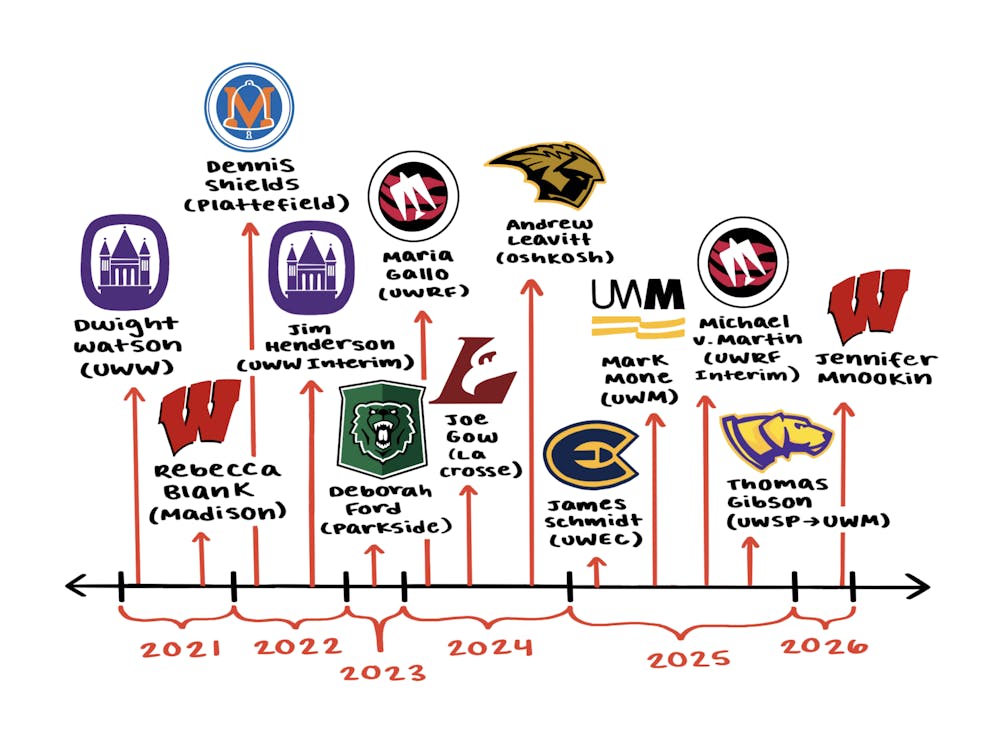
While the situations are not wholly congruent, the UW System and UW-Madison are facing a serious problem. They have lost 12 chancellors in the last five years, with ten of those coming during Rothman’s tenure, a fact cited by Board of Regents President Amy Bogost in an April 9 hearing on Rothman’s firing.
“For various reasons, we've lost ten chancellors,” Bogost said at the hearing. “We don't want that. We want stability.”
An April 2023 survey from the American Council on Education revealed that the typical tenure of a university president has been steadily decreasing for the past 20 years. In 2006, the average tenure was 8.5 years, but in 2023, it had fallen to just 5.9 years.
While being a university leader anywhere is getting harder with federal scrutiny from the Trump administration and increased visibility on social media, UW System chancellors occupy a difficult place, sandwiched between political pressure from the GOP-led legislature and lagging pay.
UW System chancellors are paid significantly less than their peers at other systems. Regional chancellors have a base pay of $287,061, according to a 2024 analysis by the Milwaukee Journal Sentinel. The national median pay for chancellors, however, stands around $350,000.
“We have a scenario in the state where there are decades of underfunding and where you have a legislature that's kind of openly hostile,” AFT-Wisconsin president Jon Shelton said. “You know, that's a scenario where it's difficult to be a chancellor.”
Wisconsin ranks 44th in the country in public funding for four-year universities, according to a 2025 national study.
“Wisconsin is renowned for its affordable and accessible public universities,” Rothman said at the time. “We can’t languish at the bottom anymore without seriously jeopardizing Wisconsin’s economic vibrancy.”
Two years ago, in the last budget cycle, the UW System and legislators were locked in a standoff. Some lawmakers characterized this process as the legislature holding UW employees and their salaries “hostage” in order to pass a deal that ultimately froze DEI positions across the system.
And, following the most recent cycle last year, the UW System was saddled with a highly unpopular budget compromise that increased teacher workloads. Rothman, and individual chancellors, have been heavily criticized by faculty over Act 15.
Shelton says he, and AFT-Wisconsin, will lobby for a UW System President that works with faculty and the faculty unions throughout their tenure.
“I'll be pushing the regents to hire somebody who'll truly be collaborative,” he said, “and really, who is not just doing damage control [over Act 15], but healing the real fracture that exists between administration and faculty and staff on our campuses.”
Constrained chancellors
While low pay and political pressure may be significant factors in the UW System’s high administrative turnover rate, others have suggested the system itself is to blame.
“The conversations I've had with really highly effective chancellors who leave is just feeling that the system is too constraining for them to act as creatively as they could in the context they're in,” former Regent Robert Atwell told the Cardinal.
In April 2022, UW-Whitewater interim chancellor Jim Henderson abruptly resigned from his post, citing a lack of support from the UW System.
“I felt like I could not in good conscience encourage any of my friends, colleagues to apply for a chancellor job at UW-Whitewater, or in the UW System as a whole, because of the lack of support from UW system leadership,” Henderson told the Chronicle of Higher Education at the time. “Unless that leadership is really focused on supporting the campuses and doing what’s right as determined by the campus leadership, it’s not going to be a successful system.”
At the time, signs seemed to point to Henderson’s resignation being over a free speech survey that interim UW President Michael Falbo, who served as interim before Rothman’s appointment, had promised not to participate in and later reneged on.
“I acknowledge that some chancellors were disappointed in that decision, and it regrettably led to a resignation,” Falbo said in a statement.
Four years later, in Jennifer Mnookin’s farewell address to the Board of Regents this past February meeting, she, too, alluded to tensions and a lack of prioritization of UW-Madison in system-level decision-making.
“Please make UW-Madison's long term strength and excellence one of your North Stars,” she told the regents. “As you engage with future challenges and changes, please continue to ask explicitly and consistently, how will this impact our flagship campus, UW-Madison? And if the answer is, well, it might be not so great for UW-Madison, please think about whether there might be another path forward.”
Atwell characterized the relationship between Madison and the UW System as necessary but strained at times.
“I think it's this relationship of necessity,” he said, “but not one of affection and desire.”
The future of the system
Shelton said a lack of internal candidates in leadership searches may lead to chancellors less tied to their individual institutions.
“I think one of the biggest problems we have in higher ed is that our administrators no longer are people who come out of the faculty for a temporary period of time and go back into the faculty,” Shelton said. “They're people who decide that that's their career. And so by definition, they're kind of in the world that executive leaders are in every private sector industry, which is like constantly seeking to find a better job at a different institution and to leverage the position they have to get another position.”
When Bogost and Regent Timothy Nixon testified in early April, they said they were now in search of a “visionary” to lead the system.
“Change is not Mr. Rothman's strongsuit,” Nixon said, “yet change is what we desperately need.”
UW-River Falls political science professor Neil Kraus has been a vocal critic of austerity measures within the UW System. But after the April 9 hearing, he said he’s still worried about the future of the system.
“When Regents Nixon and Bogost talk emphatically about hiring a transformational leader, that really only means one thing in higher ed, and that means more technology, nothing but tech,” Kraus said. “To be innovative means only one thing in higher ed, and that means more tech, fewer campuses, fewer employees, more platforms and more tech majors. Innovative is a business word, and it means nothing but more tech and less public contribution.”
River Falls underwent cost-saving measures back in 2024, implementing a hiring freeze and merging the College of Business and Economics and the College of Education and Professional Studies.
Former UW-Oshkosh Chancellor Andrew Leavitt faced similar problems in 2024 when decreasing enrollment and a $15.1 million structural deficit, the largest of any UW school, forced the school to lay off hundreds and close two branch locations, resulting in a vote of no confidence from the school’s faculty senate. Leavitt stepped down just a year later.
And, the regents may be eager to fill Rothman’s position before the November midterm elections due to 10 of the 18 of them being unconfirmed in their appointments.
Historically, the system has been able to hire new presidents quickly. Falbo served for only two months between March and May 2022, and Richard Telfer was an interim president from January to February 2014. Tommy Thompson was the longest-serving interim president, serving for almost two years, though he became the president after his interim term ended.
“We've got to have somebody to lead the UW System who is willing to put faculty, staff and student voice prominently in their public-facing efforts,” Shelton said, “and to make sure that the people of Wisconsin know what makes the UW System so great, and to fight for it.”
Annika Bereny is the campus news editor for The Daily Cardinal. She previously served as the special pages editor. As a staff writer, she's written in-depth on campus news specializing in protest policy, free speech and historical analysis. She has also written for state and city news. She is a History and Journalism major. Follow her on Twitter at @annikabereny.