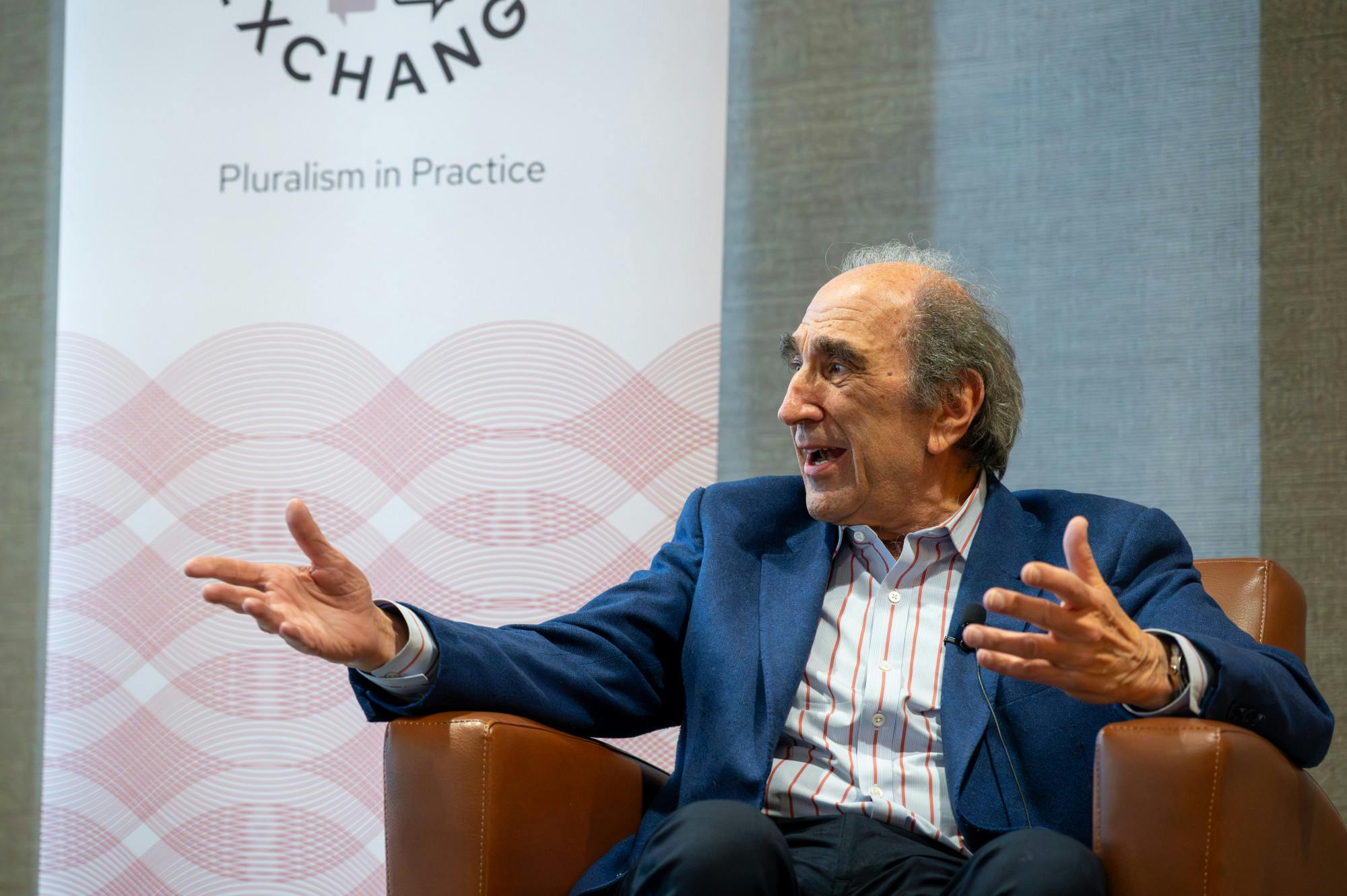
Former Chairman and CEO of NBC News Andy Lack spoke with The Daily Cardinal ahead of his campus talk on journalism’s role in pluralistic societies for the first event of “The Wisconsin Exchange: Pluralism in Practice” initiative Thursday.
The Wisconsin's Exchange, launched in October, is a privately funded, campus-wide attempt to encourage civil debate by providing workshops and inviting speakers to the University of Wisconsin-Madison.
Lack has worked on major news programs such as 60 Minutes and CBS Reports, and is the founder and executive chairman of Mississippi Today and Deep South Today, a non-profit news organization aiming to address local news deserts. Additionally, he is a producer of PBS’ “Breaking the Deadlock,” a program inviting experts with diverse viewpoints to debate controversial topics in a civil way.
Lack was ousted from NBC News in 2020, where he served as CEO and chairman for 13 years. His NBC tenure was marred by several scandals, including NBC News’ 2017 decision to not air Ronan Farrow’s #MeToo report regarding Harvey Weinstein, the network’s mishandling of sexual misconduct allegations against Today Show host Matt Lauer and Lack’s decision to hire Fox News host Megyn Kelly — who was let go just two years later after she defended wearing Blackface for Halloween.
The Daily Cardinal spoke with Lack about his experience pursuing journalism and the future of the industry before his appearance at the Pyle Center.
The interview has been edited for clarity and brevity.
There have been multiple incidents of President Donald Trump publicly insulting journalists and calling mainstream news outlets “fake news.” Do you think there are unique challenges to working news media, specifically political reporting today?
It’s challenging, just the example you cite, but long ago when I was starting as a young journalist, I was fortunate enough to be at CBS News at the time. Walter Cronkite was the most trusted man in America, and he was the anchor man of the CBS Evening News, and he famously said, “We do this line of work without fear of consequences or controversy. We do the job.” That was the ethos that I was raised in at CBS.
What has changed that may go to the heart of your question, is the world of social media. The world of social media has challenged and raised the question that you're asking. Its impact has been revolutionary. Who do you trust? Where do you get your news from? What are the facts? Can we agree on the facts? I don't think that was quite as complicated when I was coming of age in journalism.
Going back to the topic of the fourth estate, can you describe, in your own definition, what it is?
For me, the fourth estate is assembling every day all over the world and this country. What are the facts pertaining to the biggest stories or the important stories? Every story for that matter, with discipline, honesty, sharpness, thoughtfulness and with respect.
Respect is really important. Respect your audience, beyond the craft and beyond the enterprise and discipline of the fourth estate. I think at this moment in time it's almost a patriotic responsibility to get it right. What is the truth? What really happened? Those are the simplest three word sentences that it doesn't take much to keep in mind when you're going about your work every day. If you adhere to answering those questions responsibly, it's as exciting as work can be.
What is your opinion on artificial intelligence being used in the journalism field?
We have to use them. We have to make them. We have to build them, and we have to be transparent about how we use them. That's all. I'm hopeful that it will prove to be an asset for all of us, but we sure can see the downside of it, and technology has a downside. It's up to us to manage it, to deal with it thoughtfully, creatively, smartly, and I think we'll have fun doing it. It'll be hard. I think you guys are gonna do it. We all got to do it.
What initially drew you into the journalism industry, and why did you stick with it?
Well for me it was fun. You meet interesting people. Intellectually, it was a free education. It requires a lot of homework, and I always liked homework with subjects that I liked. I was never very good with science and math at all, but with history and current events, I had all day for that. I like to write, read, talk and interview people. I like asking them questions, and then I like making it a story.
Can you tell us about your sustainable models for local journalism? Do you hope this will expand into other news deserts beyond the Deep South?
I believe there are sustainable models, but that's the toughest part of the problem right now of nonprofit journalism and this year — we see some slippage in the environment for nonprofit journalism.
Foundations have pulled back a little bit. There are affordability questions and sustainability questions. So starting a nonprofit right now is tough — tougher. It's never easy, but in this we're in a period of time where it's harder. Why? I think we're just in a tougher time. The climate is tougher.
There's a lot of emotionalism around: what is the truth? What are the facts? What's propaganda and what's fact based journalism and truth? That emotionalism makes it more tense — makes it more difficult. It's angrier, it's more divisive, and I didn't feel that when I started Mississippi Today in a news desert. I wasn't in a news desert for holding power to account.
I grew up fortunate in a city that had four newspapers that were holding power to account, but I've never been in a period where it's so emotional and intense, and we know the reasons for that. And it's in state government. It's in local government. It's at the lowest levels in the roots of local news. I see it everywhere. Who are you? Who are your people? We say that in the South a lot. What are you doing here? Why should I trust you?
You are here for a pluralism speaking series which was sparked in part by critiques that the university lacks ideological diversity. Do you think recent critiques of higher education and media being ideologically slanted are legitimate, and if not why?
Definitely in my lifetime, this hasn't changed either, but there was always a progressive point of view and a conservative point of view. There were always newspapers whose opinion page was clearly conservative or liberal. So there's nothing new in the lines that are drawn between people who have different political points of view and vote differently, that's not new.
What is new is the polarization of that difference, that we're really isolating ourselves from each other in ways that are undermining our democratic values. We should be able to talk to each other. Yes of course we disagree with each other — I vehemently disagree with you. In fact, I don't even really want to read your newspaper or your opinion page in the newspaper, but I think you're a decent person. I think you're a good guy or good person. You care deeply about the work you're doing, and I respect that.
Is that what inspired you to make “Breaking the Deadlock?”
Yes, it actually came from an idea that is near and dear I think to the University of Wisconsin-Madison’s journalism school. It was an idea that was a program from the late 80s called “Ethics in America.” The program explored the topic, ‘can we talk to each other?’ What and why do you believe this topic? What is the right thing to do, even though we deeply disagree with each other? How do we go forward in democracy?
Do you think journalism has a responsibility to give equal weight to more controversial opinions, even if they might bring about harm? I’m imagining a situation where you have a binary between an LGBTQ activist and someone who is vehemently anti-LGBTQ. Is that something journalists have a responsibility to give equal balance, or where is that line drawn?
Journalists have been struggling with that one for a long, long, long, long, long time. I’m a moderate about this.
Ben Bradley of The Washington Post, who was the Watergate editor, told me once, personally, that he doesn't vote. Well, it's un-American not to vote. And he said, “Yeah, I know. I know it's un-American not to vote, but in the line of work that I have as a journalist, I think I can get away with my vote not being counted, and it's easier for me to go about my job.”
I have voted, not always, and there were long periods when I didn't for the Ben Bradley reason. I just felt I was a better journalist for doing so — just cutting off. But then there were times when I thought, ‘No, I want to vote, and I can do this, and I was not a practicing journalist when I was at Sony. That was easier for me. But I've always given that question a lot of thought, and my answer is — and this is the hardest thing that the left and right people struggle with — building up the center and getting things done. That was really the principles of the founding fathers. We can't get things done as Franklin said unless we find paths to each other and sometimes our politics doesn't want that at all.
I think as journalists, I believe in the level of democracy that's employed when you try to respect each other's points of view and share them. But there are times when you draw a line and you go “no, I'm not going there.”
I want to talk a little bit about NBC and your time there. You hired Megyn Kelly in 2017 in an effort to bring alternative voices to your network. Given that—
I wouldn’t call her an alternative voice. I would call her a conservative voice. She worked for Fox News. That was the assumption. I also thought that she was — as did all my colleagues, particularly the most liberal on MS NOW in their opinions — were pleased to have her in the company. But I talked to them about it, walking in the door, and yes, because of Fox News.
I guess my question on that is just with CBS now, and the Bari Weiss change in philosophy there, and the leadership changes—
I’m not close enough to it to say there’s a change in philosophy.
I think she would argue she's bringing in a change of philosophy at CBS. I'm just wondering what your take is on outlets like that. With her and [David] Ellison, the Paramount guy who bought—
I don’t necessarily agree with you, and I haven’t read enough of what you’re reading about. I don't buy that about Bari. I don't know her personally. I haven’t observed the work. So I don't have any comments.
You came up in a more traditional media pipeline, going from reporting, producing, all the way up to running a news organization. What can aspiring journalists do today to have successful careers in journalism when it seems like a lot fewer pipelines exist to make it into national or state-level media?
I would probably avoid the abstract outlets, but it's a challenge, again, going back to digital media and journalism and social media in particular. Go where you trust as a reader yourself, who you'd like to work with, whose work you admire, and then go to that platform and try to work on it.
For me, it was an easy call to try to get to CBS News. There were only three: CBS, NBC and ABC. ABC was actually even not yet in the big three, but CBS and NBC News were the most celebrated. ABC came along and has a great run at being a great news organization, but they're legacy, broadcast networks and streaming is going to move their size of their audience and their influence in journalism particularly is going to reduce it. And to your point, there are many other outlets, but as a young or new journalist, I'd just go to the outlets that I think are important that I like, read, trust, and raise my hand.
What is a piece of advice you would give to aspiring journalists?
It’s hard work, so don’t show up unless you're ready to give yourself to it. It’s almost a calling to those who really love it and are successful at it.
By success I mean do good work, love it and appreciate who they are and what the work does to satisfy them. I’d also say understand the importance of what you’re doing. That First Amendment of freedom of the press, and being a “press person,” that’s the work you’re doing as your life’s work. Embrace the importance and challenge of that. Keep learning and choose the platforms of the places you respect the most and work there.