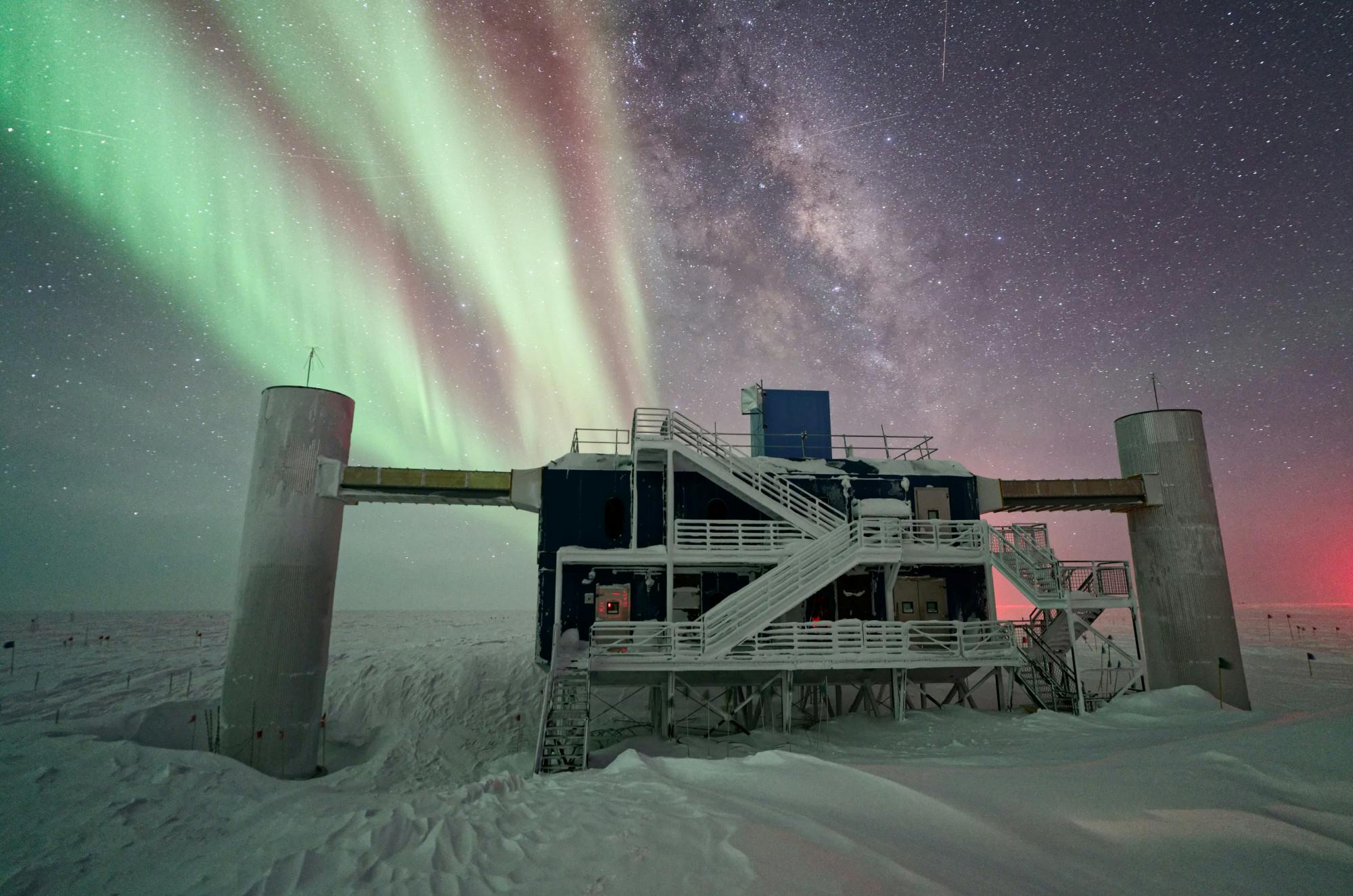
The freezing winds of Antarctica whip across the interior of the continent, kicking up snow into cold, bustling gales of frost. But miles under the surface, inside ice first formed millions of years ago, a different storm is brewing. Zaps of thin blue light, invisible to the naked eye dance through the crystalline sheets, each one a product of the cosmos.
Deep within the ice, so dense its purity is unmatched by anything fabricated in a lab, thousands of electronic spheres are buried. Each is preserved and drilled in the ice, a monolith to scientific research. Their only goal: observe the thin blue zaps — cosmic neutrinos — of our universe.
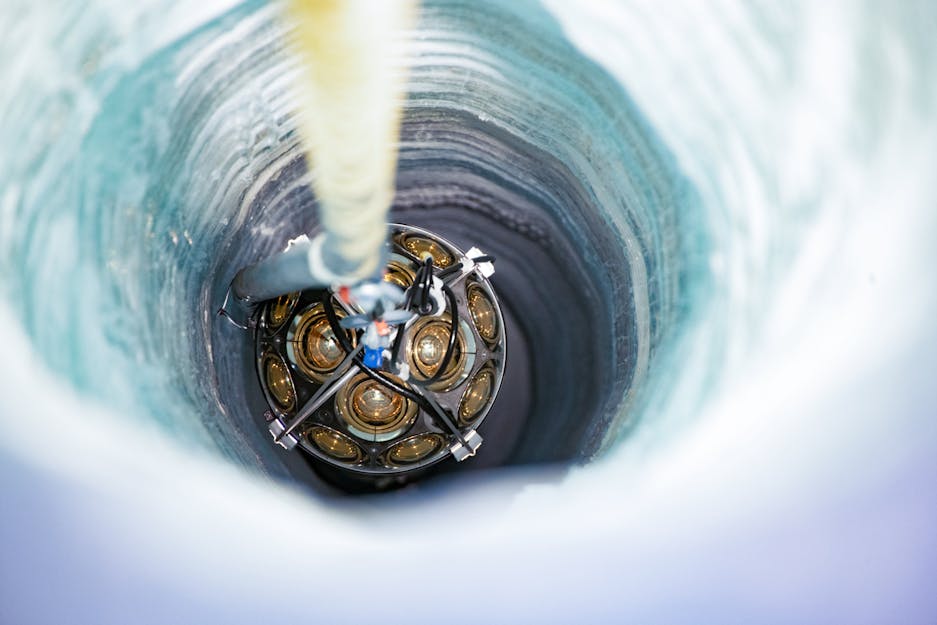
More than 5,000 of these detectors — called Digital Optical Modules (DOMs) — cover a stretch of ice over a kilometer wide, taking in over 275 million cosmic rays a day for a project headed by the University of Wisconsin-Madison called IceCube. The project, started in 1993, has largely stalled construction since 2010, a monolithic symbol to science trapped in the Antarctic ice. That is, until last year.
After years of planning and negotiation, IceCube has upgraded its equipment for the first time in nearly a decade and a half, keeping what was already a one-of-a-kind detector on the forefront of scientific research by advancing its ability to detect neutrinos.
Neutrinos: the ‘fingerprints’ of black holes
Neutrinos, nearly massless subatomic particles that rarely react with matter, act as markers for high-energy events which occur everywhere, from right here on Earth to galaxies thousands of light years away. At IceCube, over 70 billion neutrinos per year interact with the detector.
“When the neutrino interacts in the ice, it shatters an atom and the splinters from that direction are a lot of energetic subatomic particles,” UW-Madison professor of physics and astronomy — and frequent IceCube collaborator — Justin Vandenbroucke told The Daily Cardinal. “A fraction of those have electric charge, and they make a flash of blue light.”
That blue light is Cherenkov radiation, the same pale blue that nuclear reactors emit when operational. While the radiation produced might come from the same phenomena, the energy involved is on a completely different scale.
“Neutrinos originate in some of the most violent and least understood events in the universe,” reads IceCube’s FAQ page. Events like supernovas and objects like active galactic nuclei and black holes are just a few possible sources for these subatomic particles which act like “fingerprints,” according to the FAQ page, helping researchers understand more about some of the most enigmatic objects in our universe.
While the high-energy events required to create Cherenkov radiation are exceedingly rare, they have become the driving core of IceCube. They propelled the station’s research into the mainstream when between 2010 and 2012, IceCube discovered the first ever neutrinos from a “cosmic accelerator.”
Cosmic accelerators can be thought of much like the particle accelerators scientists build here on earth, only the particles inside galactic accelerators can reach up to 10 million times the energy of humanity’s best particle accelerator.
The discovered cosmic accelerator ended up being the supermassive black hole at the center of a galaxy known as M77, an object that has been identifiable from our solar system since the late 1700’s as a small dot visible with a telescope.
A new grant and a new life
In December 2025, almost 15 years to the date since he watched IceCube’s last DOM lower into the ice, Albrecht Karle stepped off the station’s workhorse military plane into the deceptive chill of the Antarctic summer.
The goal this time? Install seven new strings of over 600 upgraded DOMs, sensors and calibration tools to equip the detector for astronomy and particle physics measurements.
Returning to the same facility and drilling equipment his team used more than a decade ago, Karle, IceCube’s co-principal investigator and a UW-Madison physics professor, quickly realized his first task was refurbishing the ice drills to a working state.
“It was like in one of those movies where they’re bringing in an old battleship and making it operational again,” Karle said. But because of the drill’s ailing hardware, paired with newly designed programs and a team unused to the complexities of drilling in the Antarctic ice, the first string of sensors took almost 95 hours to drill.
“It was way longer than it should have taken,” Karle said.
After squashing bugs and training an almost entirely new team to drill, work slowly started to progress on what would become IceCube’s first addition in over a decade.
With the harsh cold of the Antarctic and ever-creeping threat of their drilling holes freezing over, Karle’s crew had to work non-stop for days at a time, with researchers picking up night shifts and taking emergency calls to help manage the drilling and stringing of the station’s DOMs.
“At the South Pole, it’s high-intensity, almost every day,” Karle said. “You don’t have time to think about [the pressure] too much.”
Despite a series of setbacks and a close call with the team’s drilling equipment, six of seven strings were installed over the course of three months. Both IceCube and its primary funding source, the National Science Foundation, saw the project as a success.
New sensors can bring the Milky Way’s mysteries to light
These new DOMs will increase localized neutrino samples by a factor of ten and are able to detect the highest energy particles physically possible.
Researchers at IceCube hope the new equipment can transition the station from one that works primarily to identify sources of extragalactic neutrinos, to one that can measure the neutrinos’ properties, chart the cosmos and even identify sources of high neutrinos in our own galaxy.
That might sound counterintuitive, but in reality, the Milky Way is only about one tenth as bright in neutrinos as the rest of the night sky, Vandenbroucke said.
“Just looking with your eyes, if you’re in a dark place, you see the Milky Way right across the sky,” Vandenbroucke said. “Like a giant, it outshines the other galaxies. And that’s similar in a lot of other parts of the electronic spectrum… It's not as obvious in neutrinos.”
Researchers like Vandenbroucke theorize this is because our galaxy’s supermassive black hole isn’t currently sucking up any stars, or in other words, is dormant.
“We think that every galaxy has a supermassive black hole, but only some are actively sucking in matter and therefore lighting up,” Vandenbroucke said.
Those active galaxies are what their detector has been spotting, with 10 of their extragalactic particles coming from one singular supermassive black hole.
But where are the neutrinos in our own galaxy coming from? While there are a whole host of possible candidates right now, researchers hope that IceCube, and its proposed Gen2 upgrade, can start giving definitive answers.
The UW physics professor who started it all
The concept of cosmic rays has been around since 1912, but it wasn’t until Francis Halzen, UW-Madison physics professor and co-principal investigator for IceCube, decided to put detectors in Greenland’s glaciers that the world discovered just how readily available they could be.
For years, researchers had known placing DOMs deep underwater allowed them to detect atmospheric neutrinos, but the costs were exorbitant, maintenance pricey and the land required to get usable readings even more extreme.
During the original test, Halzen put DOMs one kilometer deep into the earth with a test reflector to simulate Cherenkov radiation. Immediately after being pulsed, the whole detector lit up. “But that was it! Nobody had anticipated this,” Halzen said.
He said that while researchers from all over the world had expressed interest in his project, not many thought they’d be able to find anything — let alone neutrinos.
The Greenland experiment “was something of a miracle,” Halzen said.
“You can’t imagine what a ride this was. This was fun and games! We never really thought this would work,” he said. “But the idea was ‘if we make it work, this is fantastic. If we could build a particle detector this big, we’ll find something — it doesn’t matter what it is.’”
Halzen now spends much of his time managing the IceCube project. He joked that “in accelerated physics, we’re used to fighting for [particle accelerator] time, and I suddenly switched to fighting for beds at the South Pole.”
But as intensive as the project may be, Halzen and the other researchers interviewed all agree it’s still exciting to research Antarctica, even if some are on their 15th visit.
Karle recalled one particularly fun January at IceCube. His colleagues snuck a cake in their cargo to celebrate his birthday in the Antarctic, while Vandenbroucke learned how to cross-country ski and watched his colleagues participate in a costumed “race around the world” — a loop around both hemispheres is only about 5km — in his free time.
But for Halzen, the most enthralling part of the project is the interdisciplinary nature of their work, involving not only other particle physicists, but astrophysicists, engineers, astronomers and other researchers at the station.
“Discovering things happens never, or very occasionally,” Halzen said. “The real pleasure of doing science is to learn things.”
And IceCube has been nothing if not an experiment in learning, not only about the cosmos, but about what it takes to create such an extraordinary team.