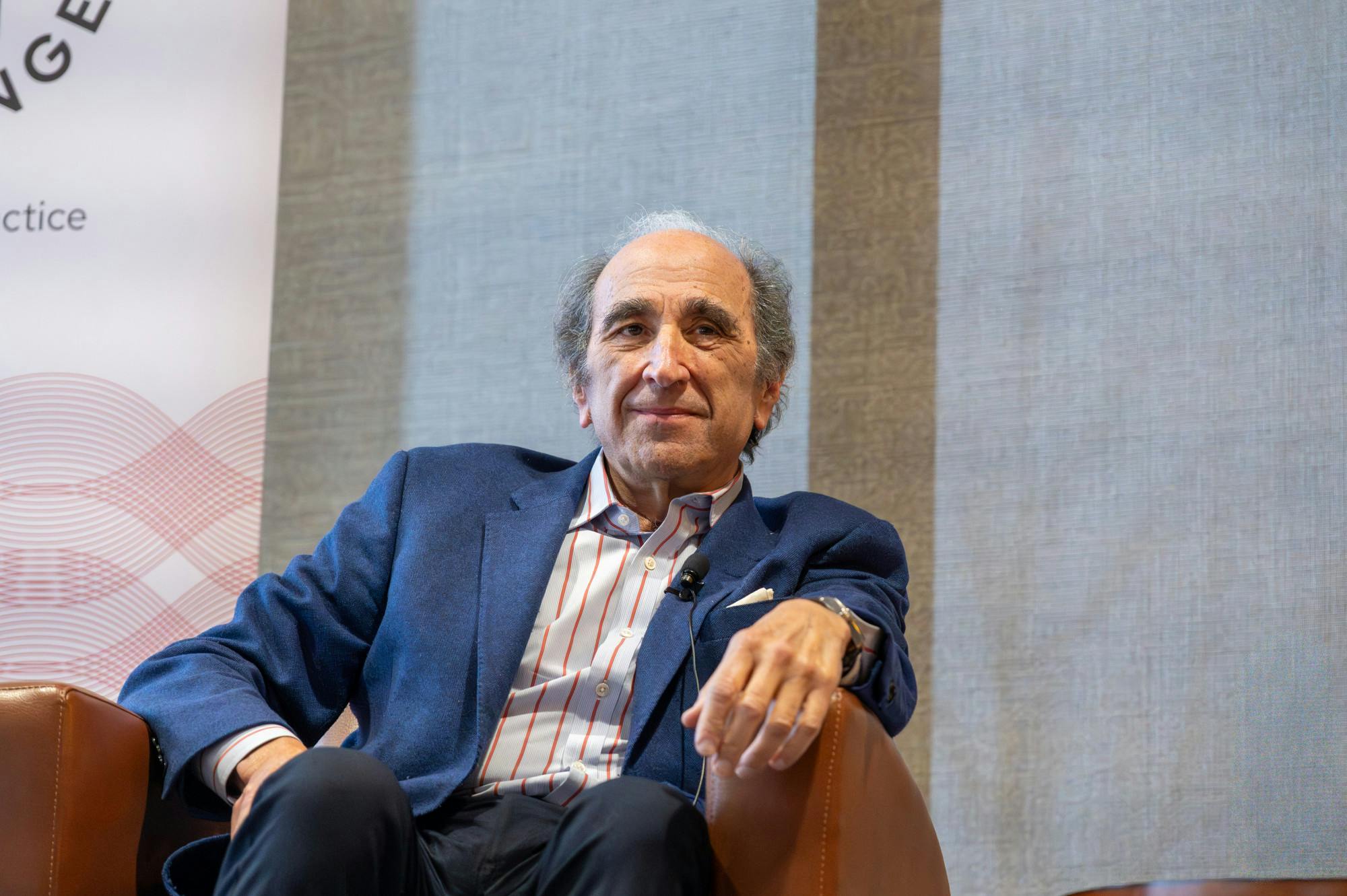
Former Chairman and CEO of NBC News Andy Lack joined Katy Culver, director of the University of Wisconsin-Madison School of Journalism and Mass Communication, to discuss journalism’s role as the “Fourth Estate” in pluralistic societies Thursday — the first event of the university’s Wisconsin Exchange initiative.
The privately-funded “Wisconsin Exchange: Pluralism in Practice” initiative aims to promote open dialogue and conversations among those with differing viewpoints.
Lack addressed his time at NBC News, changes at CBS under Bari Weiss, where he started his career in journalism and his work at Mississippi Today, a nonprofit newsroom he founded after he was ousted at NBC in 2020 following a broader reorganization of the network.
Lack’s time at the helm was marred in controversy. In 2017, NBC News chose not to air Ronan Farrow’s #MeToo report concerning Harvey Weinstein. Additionally, in November of that year, NBC fired Today Show host Matt Lauer because of sexual assault allegations. These allegations were kept secret for two years until Farrow’s book was published — which claimed Weinstein threatened to reveal Lauer’s allegations when NBC was deciding whether to air the piece on him.
During an audience Q&A, a member of the crowd asked what obligations media institutions have to ensure they uphold equitable and safe workplace standards. Lack stressed those standards must be recognized and followed, saying he sees it as an ethical and institutional obligation to ensure people are safe.
“I would feel I wasn’t doing my job if that question were raised to me as an issue for someone employed in the organization I was working in,” Lack said.
UW-Madison Chancellor Jennifer Mnookin kicked off Thursday’s event with a speech highlighting the decreasing trust and confidence the public has in both higher education and journalism.
“No one is necessarily born knowing how to communicate with each other or across differences. It's a muscle that we can help to build and strengthen, and that's part of why we created the Wisconsin Exchange here at UW-Madison,” she said. “It's designed to build opportunities to discuss, and sometimes to disagree, about important issues with care and to help carry those habits of engagement well beyond our campus.”
Culver asked Lack about the concept of truth in journalism when different perspectives can lead to different concepts of what the truth is. She used rain as an analogy, saying everyone can agree that it's raining, but whether there are enough efforts to protect people from the rain or whose most impacted by the rain are subjective questions.
Lack said the basis of disagreement lies in whether an issue is being presented fairly in a story, and not solely around its factual accuracy. He emphasized the word “different,” saying individuals will view, hear and interpret things differently — and it's a journalist's role to publicize these different perspectives.
“It's almost patriotic to try and talk to each other in a hard time for each other and take it as a responsibility to each other that we can do better with each other, and I think the founders envisioned that,” Lack said.
He said understanding compromise is critical, noting social media’s potential role in vilifying the term.
“Compromise is not a dirty word. It is a tough word to deal with, and it requires work, but I think it's been demonized a bit in ways that I don't think, as a country, we envisioned that we would be in this situation, and I think a lot of that's due to social media, but I think we're finding our way through,” Lack said.
Culver pointed to CBS News’ appointment of Bari Wiess and the idea that mainstream media should bring more “conservative voices” into the newsroom, asking Lack if he believes the news business is liberally slanted.
He answered the question by pointing to his decision to often not vote in elections, calling it “liberating.”
Lack pointed to local news outlets as key players in promoting journalism’s role in a democracy.
“It really starts at the community level — that buy-in to what good journalism is in your community,” Lack said. “There are a lot of arguments to be made about what animates local news. But all of the journalism that I care about deeply starts there…It starts with who is my neighbor.”
He said this idea was the “guiding line” behind former CBS News President Fred Friendly’s series “Ethics in America.” Lack and others were inspired to reboot the series in a modern version, “Breaking the Deadlock,” where people with differing opinions debate in front of an audience.
“[The audience] wants to see people disagree with each other… They're not afraid of that. They don't mind locking horns with each other, but they wanted to at the end of the day be respectful to each other, even affectionate with each other, and laugh about how difficult it is,” Lack said.
Lack said he believes there are forums in Wisconsin and Madison specifically, where people with opposing opinions can have civil dialogue, and that it is everyone's responsibility to participate.
“I think we have to be willing to really listen to people who we disagree with,” he said. “I have a different view of it as a journalist, I think we need to hear each other and even confront what we believe and know.”
Lack said that in a world full of people who say “I don't want to talk about politics with you,” especially during Donald Trump’s presidency, his role is to walk down the middle and get as many people as he can to talk to each other.
He emphasized closing the gap between media consumption, pointing to the divide between CNN and Fox News’ viewership.
“It is what it is from my perspective, and I don't disagree with those who dislike [Fox News]. I understand why they do, but I live in a world in which I think we need to deal with that,” Lack said.
Culver highlighted the ethical challenge of conflict as a value in news instead of focusing on common solutions. Furthering the conversation on ethics, the journalism director asked when it comes to ethics and journalism, if there is a decision Lack made that he would take back.
He turned to his prior coverage about the military and understanding the meaning of the word patriotism, especially to those who served.
“I made a documentary early on at CBS… about a legacy of lies in terms of the body count, of the losses of life for soldiers who went to Vietnam and their families and how they struggled with their sons and daughters when they came home… and how they were treated by their neighbors and what they saw on the news that hurt them,” Lack said.
Lack said the role journalists play during times of intense polarization is critical, but doesn’t differ from any other time in the country’s history.
“It hasn't changed from the time the founders decided the First Amendment ought to have a free press. The role is to be honest brokers of information, to tell the story, whatever that story is, fair, factually — Focus on the facts. Facts first. Facts matter,” Lack said.
He continued to highlight three key questions for journalists to answer in order to succeed.
“At the end of the day, it's pretty straightforward. Journalism is about getting the story right. What are the facts? What is the truth around those facts? What really happened? If you can answer those three questions clearly, you're a good journalist,” he said.
Zoey Elwood is the college news editor for The Daily Cardinal. She previously served as copy chief. As a staff writer, she's written in-depth on state and local budgets, protest coverage and Wisconsin politics. She has also written for state and city news. Follow her on X at @zoeyelwood.
Clara Strecker is the state news editor emeritus for The Daily Cardinal. She previously served as copy chief. Clara has written in-depth on the 2025 Wisconsin Supreme Court race, the 2024 presidential election and abortion rights. She currently works with WisPolitics and will spend the summer interning with The Milwaukee Journal Sentinel. Follow her on X at @clara_strecker.