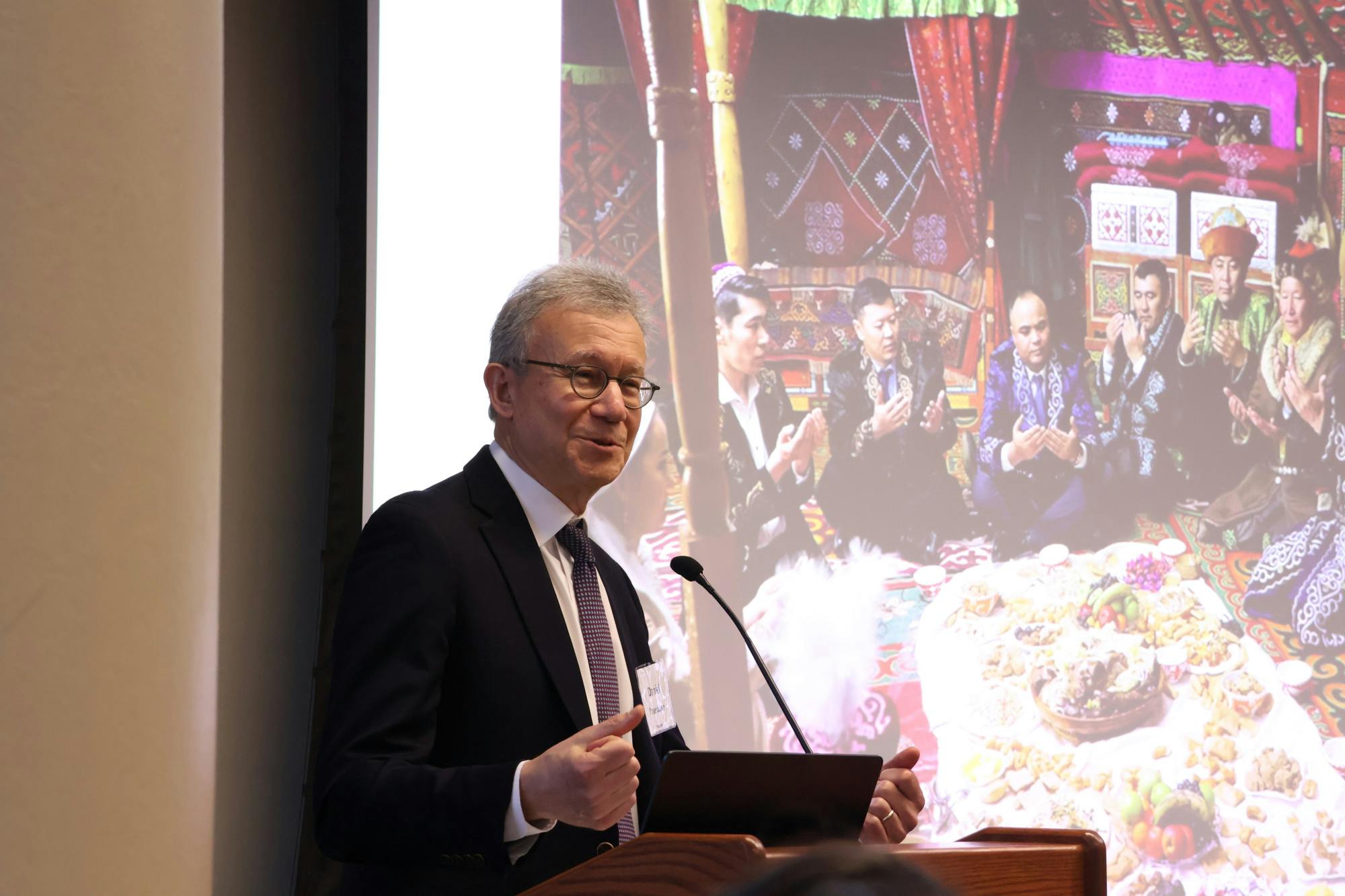
Former U.S. Ambassador to Uzbekistan and Kazakhstan Daniel Rosenblum spoke Tuesday at Union South, shining light on U.S. foreign policy in Central Asia in an ever-turbulent geopolitical landscape.
At the event hosted by the Madison Committee for Foreign Relations, Rosenblum said Central Asian countries like Kazakhstan, Uzbekistan, Turkmenistan, Tajikistan and Kyrgyzstan hold a uniquely challenging geography, balancing a “tightrope” between the geopolitical interests of powers like China, Russia, Iran and the U.S..
Rosenblum had an early interest in this corner of the globe even while at college. After completing his graduate program in Soviet Studies at Johns Hopkins University, he had the opportunity to work directly with coal miners in Kazakhstan, a newly independent state at the time.
“There’s something about the culture and art and the architecture that's really appealing to me,” he said. “[The culture was] distinct and different, and it got me interested in learning things that I didn’t learn when I was in college, when I was studying the region.”
Rosenblum joined the State Department in 1997, working in several different countries. He returned to Central Asia as the deputy assistant secretary of state under President Barack Obama in 2014. There, he began working directly with foreign ministers and managing policy. In 2019, President Donald Trump appointed him Ambassador to Uzbekistan. Then, in 2022, President Joe Biden made him the Ambassador to Kazakhstan.
During his 28-year career in the State Department, Rosenblum said he witnessed a gradual evolution of U.S. foreign policy.
“There was always a focus, since 1991, on stability,” he said. “[The U.S. wanted to help countries] transition from socialist planned economies and authoritarian governments to democracy and free markets.”
This included reinforcing democracy, creating non-proliferation agreements and applying institution-building aid. Each of the five Central Asian states adopted their own set of policies in response to growing American diplomacy.
“[Economic] efforts were mixed at best, depending on the country,” he said. “Some countries went much further. Kazakhstan was a leader in terms of adopting market reforms, although they were incomplete. Turkmenistan did nothing to change its economic model, almost. Uzbekistan did very little in the early years and then tried to catch up in the last 10 years.”
Interest in the region for logistical support increased throughout the 1990s and up to the present as U.S. military operations began in Afghanistan.
“Besides national security and geography, location is automatically going to make Central Asia significant to the United States,” he said.
Central Asian countries’ resources draw geopolitical competition. “Kazakhstan is a major target for U.S. companies,” Rosenblum said. “Chevron and Exxon Mobil have enormous investments in Kazakhstan.”
Additionally, critical minerals, which have become increasingly important for technology, are abundant in Central Asia, making them a target of geopolitical powers.
Throughout the 2000s, economic investment in the region has been a significant force behind U.S. policy. In 2015, the C5+1 program, an annual meeting of presidents from five Central Asian countries with the U.S., was launched to promote mutual interests.
In November, they met with President Trump to discuss investments and access to critical minerals. "The Trump administration has kind of taken that critical mineral focus a step further in terms of U.S. investment and engagement,” Rosenblum said.
“There were a lot of deals announced,” Rosenblum said, including purchases of U.S. goods, like Boeing aircrafts, by Central Asian countries, in addition to investments by Central Asian countries in the United States, which Rosenblum said the Trump administration has sought.
According to Rosenblum, Trump’s transactional approach can be divisive.
“I'm not saying it's bad. A lot of these deals will probably benefit American companies. They might even create some jobs in the U.S.,” he said, using the example of Boeing, an American company, selling aircrafts to Uzbekistan.
“What I fear is that this narrow focus, in the long run, will not be good for the bilateral relationships we have or the regional relationships,” he said. “I think that those relationships are much more solid if they’re grounded in this holistic approach that goes through security, partnerships, educational partnerships, and discussions about democracy and human rights.”
He added that while the current administration has not explicitly rejected those priorities, its emphasis on transactional diplomacy risks weakening them over time.
“I’m not saying the Trump administration has declared an end to all of those things,” he said, “but this focus at the high levels only on the transactions will, I think, undermine these broader efforts over time. Unless, at some point in the future, we go back to the broader approach, which I hope we will.”