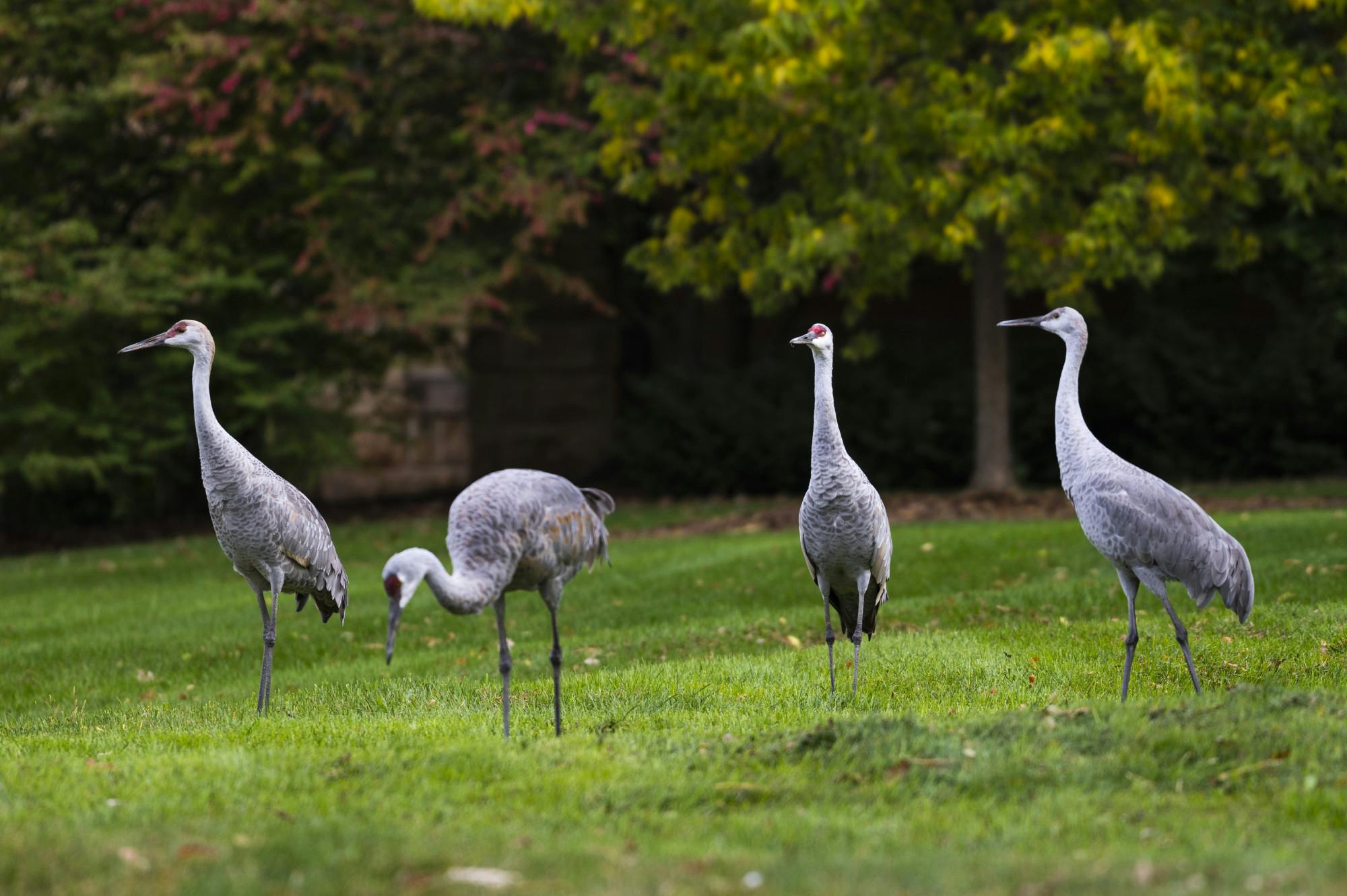
A bill to establish Wisconsin’s first regulated hunting season for sandhill cranes has reignited a long-running debate over how to manage one of the state’s most visible bird species.
The proposal, which heard public testimonies in November, follows other unsuccessful efforts in past legislative sessions. Supporters argue that a hunting season would help manage a rapidly growing population and fund wetland conservation efforts, while opponents say hunting poses unnecessary risks that outweigh benefits.
Economic tradeoffs
Economic arguments shape the debate over population management in Wisconsin, particularly around crop damage and conservation funding. While previous reporting and testimony have focused on economic considerations, pro- and anti-hunting advocates see these tradeoffs differently.
Bill advocates, including the Wisconsin Waterfowl Association, argue a regulated hunt would generate license revenue to support conservation efforts, provide necessary financial assistance to farmers and generate money for the existing damage abatement program.
Opponents cite conflicting estimates around administering a season and criticize the exclusion of aid for farmers. They also point to alternative management strategies, like depredation permits and seed coatings to deter the birds.
Populations and risk management
Brought back from a population of around 15 breeding pairs in the 1930s, the Eastern Flyway population of sandhill cranes now tops 90,000.
Sandhill cranes are federally managed under the Migratory Bird Treaty Act, which prohibits take without authorization. Any hunting in Wisconsin would require science-based management, federal approval and adherence with USFWS protocols.
A spokesperson for USFWS highlighted built-in safeguards like annual population surveys, recruitment monitoring, harvest tracking and adaptive frameworks set in the Federal Register to determine hunting sustainability and permissions.
“WWA advocates for complete, objective science to guide wildlife management decisions. That principle applies regardless of whether harvest allocations increase or decrease,” Brad Heidel, president of the Wisconsin Waterfowl Association, told The Daily Cardinal.
Heidel pointed to a 60-year history of federal crane management and hunters’ conservation contributions. “As long as the population remains above established thresholds, managed harvest remains consistent with federal conservation goals,” he said.
The International Crane Foundation argued that the federal minimum threshold set by USFWS of 30,000 birds does not fully capture risks.
“That’s the minimum number for intervention. Should the population get that low, we would need to step in and do something,” Ryan Michaelesko of ICF said. “We don’t have the information to make a good judgment on this, and neither do the groups that are calling for a hunt.”
The USWFS currently issues thousands of sandhill crane depredation permits a year in Wisconsin, allowing kills for special circumstances like crop damages.
Risk to endangered whooping cranes
Opponents also raised concerns over accidental shootings of whooping cranes, a critically endangered species. ICF currently researches and monitors an experimental population of whooping cranes in Wisconsin.
Anne Lacy, director of Eastern Flyway Programs for the ICF, said the proposal would threaten whooping cranes in Wisconsin if mistaken for sandhills during the November hearing. Lacy pointed to men in Oklahoma found guilty of killing whooping cranes in 2021.
Heidel of WWA said the Oklahoma was the first documented misidentification instance involving legal sandhill crane hunters and noted identification training was not required at the time.
“No ethical hunter wants to inadvertently shoot a whooping crane,” Heidel said.
Heidel added that identification training would be required under both the proposed legislation and USFWS protocols. “It ultimately doesn’t matter what WWA thinks on this issue,” he said, though WWA officially supports a required identification test.
A USFWS spokesperson said the agency, working with ICF and state agencies, has documented “essentially zero cases of whooping cranes mistakenly shot by legal sandhill crane hunters during open seasons nationwide.” They added that known incidents tied to sandhill hunting involved illegal take.
“The loss of any one whooping crane in this population is more than devastating, and it only takes one bad actor or low-light misidentification to set whooping crane recovery back,” Lacy of ICF said in her November testimony.
Wisconsin as a special case
A spokesperson for the USFWS told the Cardinal that Wisconsin plays a unique role in the Eastern Population that “could warrant additional considerations.” Wisconsin supports the largest share of breeding habitat and fall pre-migration staging concentrations for the Eastern Population of sandhill cranes, one of six populations in the United States.
Lacy and other opponents raise concerns about disease vulnerability. Ryan Michaelesko of ICF referenced Eurasian crane populations that experienced “consistently large, unprecedented outbreaks of Highly Pathogenic Avian Influenza.” He argued that decreasing crane populations through a hunt would risk Wisconsin’s population being completely wiped out by a similar disease outbreak.
Supporters counter that Wisconsin is not biologically isolated.
“It is not the only state or province with breeding cranes, and hunting is successfully managed in other breeding jurisdictions under USFWS oversight,” Heidel said.
Ethics and conservation philosophy
The debate reflects deeper differences in conservation philosophy and ethics.
“There may be reasons to oppose a crane hunting season here, such as a strong emotional connection to the crane or the optics of adopting a crane hunt in the ‘backyard’ of the International Crane Foundation,” Heidel said. “But an objective scientific basis is not one of them.”
Heidel said opponents rely on what he described as “misinformed, emotion-based public opinion.”
“Passion-blinded wildlife decisions which discount science-based management will tie wildlife managers’ hands and disproportionately impose expanding costs on farmers,” Heidel added.
ICF rejects the framing that hunting is the only population management strategy to help farmers, and Michaelesko said the bill “has been stripped back to where this is pretty much only a hunt.”
“The one thing we agree on is that farmers need support,” Michalesko told the Cardinal. “Rather than pushing for a disingenuous hunting season that will be extremely costly, risk population stability, further endanger whooping cranes and do nothing to resolve crop damage, let's work together to get funding to farmers.”
All sides say they share the same goal of a sustainable crane population.
“Wisconsin conservationists of any flavor should not be divided on this topic. We share a fundamental commitment to a healthy crane population,” Heidel said.
Where they diverge is how much uncertainty and risks are acceptable in pursuing it.