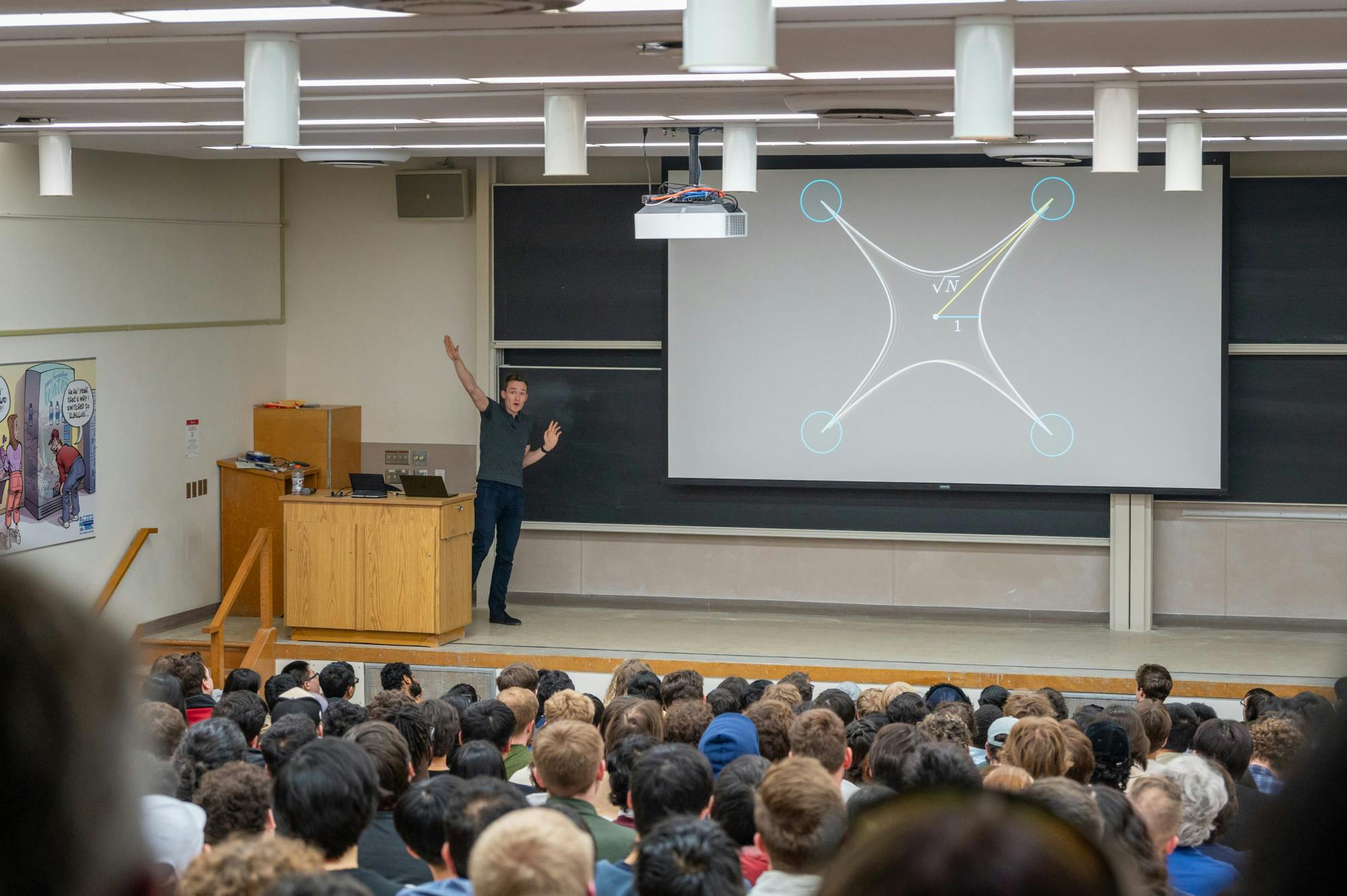
A crowd of over 400 gathered in Van Vleck Hall to hear Grant Sanderson, a STEM content creator known by his YouTube handle 3Blue1Brown, talk about high-dimensional spheres in a Feb. 13 event hosted by the University of Wisconsin-Madison Math Club.
Sanderson’s UW-Madison talk was titled: “Who cares about high-dimensional spheres?” Enough people, a UW-Madison math club member joked, to “outdraw the Harry Styles pre-album release listening party.”
With over 9 million followers across multiple platforms, Sanderson is known for his educational videos on topics ranging from neural networks to topology, animated with self-made Python graphics. Sanderson, a Stanford graduate and former Khan Academy employee, said he aims to make mathematics and related fields accessible and interesting to a wide audience.
People of all ages, from undergraduates to professors, filled the Van Vleck lecture hall, with students even sitting on the ground in the front of the room and overflowing into the hallway in the back.
High-dimensional spheres exist in 4-D and higher dimensions, Sanderson said. All points in 3-D spheres are the same distance from the center in the x, y and z directions, and multidimensional spheres follow that same mathematical behavior, just in more directions than three.
The same principle of extending figures into dimensions higher than three can be applied to other geometric shapes, such as cubes, which as Sanderson joked, are even more “messed up” than high-dimensional spheres.
His talk began with a puzzle to get the crowd warmed up, gaining excited reactions and responses from the audience as students tried solving his puzzle on the nature of regular geometric shapes and their relationship with probability.
He posed the question: If you picked two numbers x and y between -1 and 1, what is the probability of their sum being less than 1?
If you think of each combination of x and y as being points on a plane, you can treat the pair (x, y) as a random point on a square with corners at (-1, 1) and (1, 1). Since the original inequality resembles the equation of a circle, you can treat the points inside the area of the circle as being equivalent to satisfying the inequality. Therefore, Sanderson said, you can use the formulas of the area of a circle inside a square to calculate the probability, and you’ll find that around 78.5% of the time, a random (x, y) in the square will land inside the circle.
Using a cube and a sphere, the same problem can be extended to three numbers.
“If you have more than three numbers, you could do the same move, even though it's going to take us beyond the space that we're comfortable with,” Sanderson said.
The simple illustration was useful in demonstrating how high-dimensional geometry can be adapted as a tool to solve probability problems, and how it's a much better alternative for dealing with large lists of numbers and data than just doing many integrals. This is the basis of how high-dimensional geometry has many practical applications in quantum computing, machine learning, physics, mathematics and more fields.
“When we talk about high dimensional geometry, sometimes it can feel like the mathematicians have just made something up for the sake of studying something that seems confusing,” Sanderson said. “But really, any time that you're dealing with something that can be encoded with a large set of numbers, it can be helpful, as a problem solving tactic, to turn that into a geometric question.”
After the initial puzzle, Sanderson discussed Archimedes and the derivation of the equations of a circle, setting the stage for the rest of the lecture’s focus on mind-bending spheres.
He then began his exploration of the volume and area of spheres that go beyond the second and third dimensions, with beautiful accompanying graphics.
Sanderson derived an equation to relate the area and volume of each consecutive dimensional sphere, and he explained that it might seem counterintuitive, but as you start adding dimensions to these spheres, the factorial in the denominator eventually grows much faster than the power of pi in the numerator. This means that for spheres in high dimensional space, their volumes are getting smaller and smaller, and a 100 dimension sphere will have a volume of nearly 0.
High-dimensional geometries are useful for researching artificial intelligence models like ChatGPT. A large language model “takes the text that you put in, subdivides all that text, and turns those pieces into a massive vector — a big list of numbers, tens of thousands or hundreds of thousands of them,” Sanderson said.
“When people research these models, it's actually really helpful to conceive of those massive lists of numbers… as a point in a really high dimensional space,” he said. “You don't have to do that. You can just create a computation with a big list of numbers, but there's a lot more insight geometrically.”
Sanderson’s unmistakable passion for sharing the beauty and art of mathematics, apparent to viewers of his videos, was even more captivating live.
“Sometimes the most beautiful facts about the familiar objects you see… are only ever seen when you broaden your view enough,” Sanderson said.