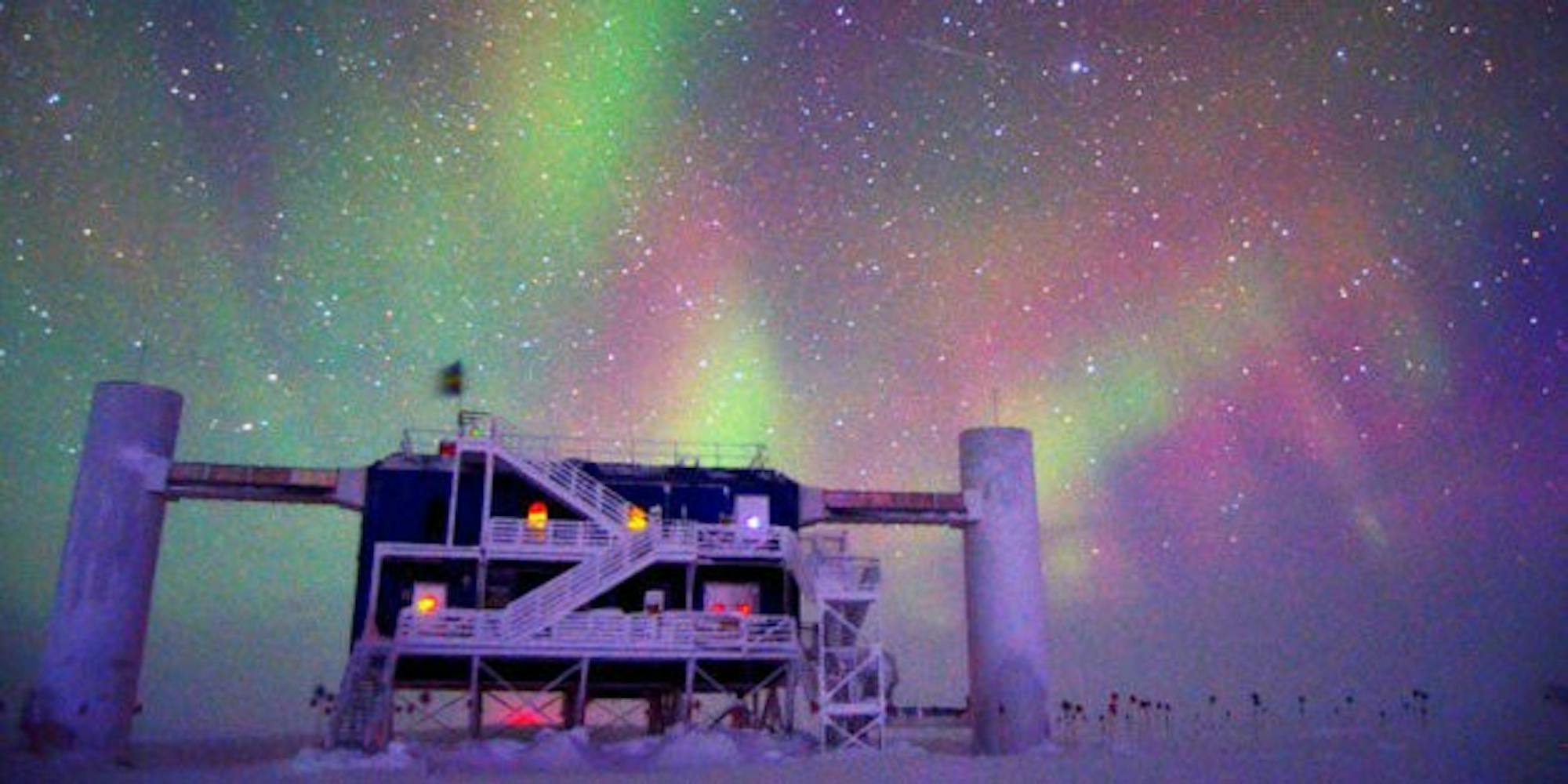
The U.S. National Science Foundation (NSF) renewed its agreement with the University of Wisconsin-Madison to run the IceCube Neutrino Observatory, committing $53 million over the next five years to running the particle detector located at the center of Antarctica, according to an IceCube news release.
The funding covers continued operation and maintenance of IceCube for 2026-2031, according to the report.
UW-Madison has led IceCube since its establishment and contributed to its construction. UW-Madison physics professor Francis Halzen now acts as IceCube’s principal investigator, and the Wisconsin IceCube Particle Astrophysics Center is primarily responsible for operating IceCube.
IceCube observes neutrinos, nearly massless subatomic particles that rarely interact with matter, letting them travel across the cosmos undisturbed and carry information about some of its most violent events. IceCube uses Digital Optical Modules (DOM), electronic detectors buried in the ice, to detect these signals.
The funding follows the IceCube Upgrade, the facility's first major upgrade since its completion in 2010. Albrecht Karle, IceCube’s co-principal investigator and a UW-Madison physics professor, led a team to install six of seven strings of upgraded DOM sensors over three months in December 2025, The Daily Cardinal reported in March.
With the upgrades, IceCube will operate more than 5,500 optical sensors, while they currently operate 5,160.
Simulations suggest the upgrades could make IceCube up to a factor of ten more sensitive to short bursts of lower-energy neutrinos from short-lived events like supernovae and gamma-ray bursts, according to a study submitted to the journal Physical Review D. The first data from the new sensors are expected later this year.
The upgrades to IceCube allow it to detect lower-energy, short-lived neutrino bursts better than before. For steady sources, the improvement is smaller, as IceCube already has a large amount of existing data for them.
With this upgrade, scientists will be able to better characterize the surrounding ice, improving neutrino reconstruction, according to the IceCube release. The upgrade will also allow a reanalysis of 15 years of archived data.
Over the next five years, the funding will also support new software development for advanced artificial intelligence and machine learning methods. The update also supports upgraded hardware, including replacing IceCube’s 20-year-old surface data acquisition electronics, according to the IceCube release.