Trust in journalism comes down to questions reporters face every day: What should be covered? What should be left out? And how can journalists show readers their decisions are based on reporting rather than an agenda?
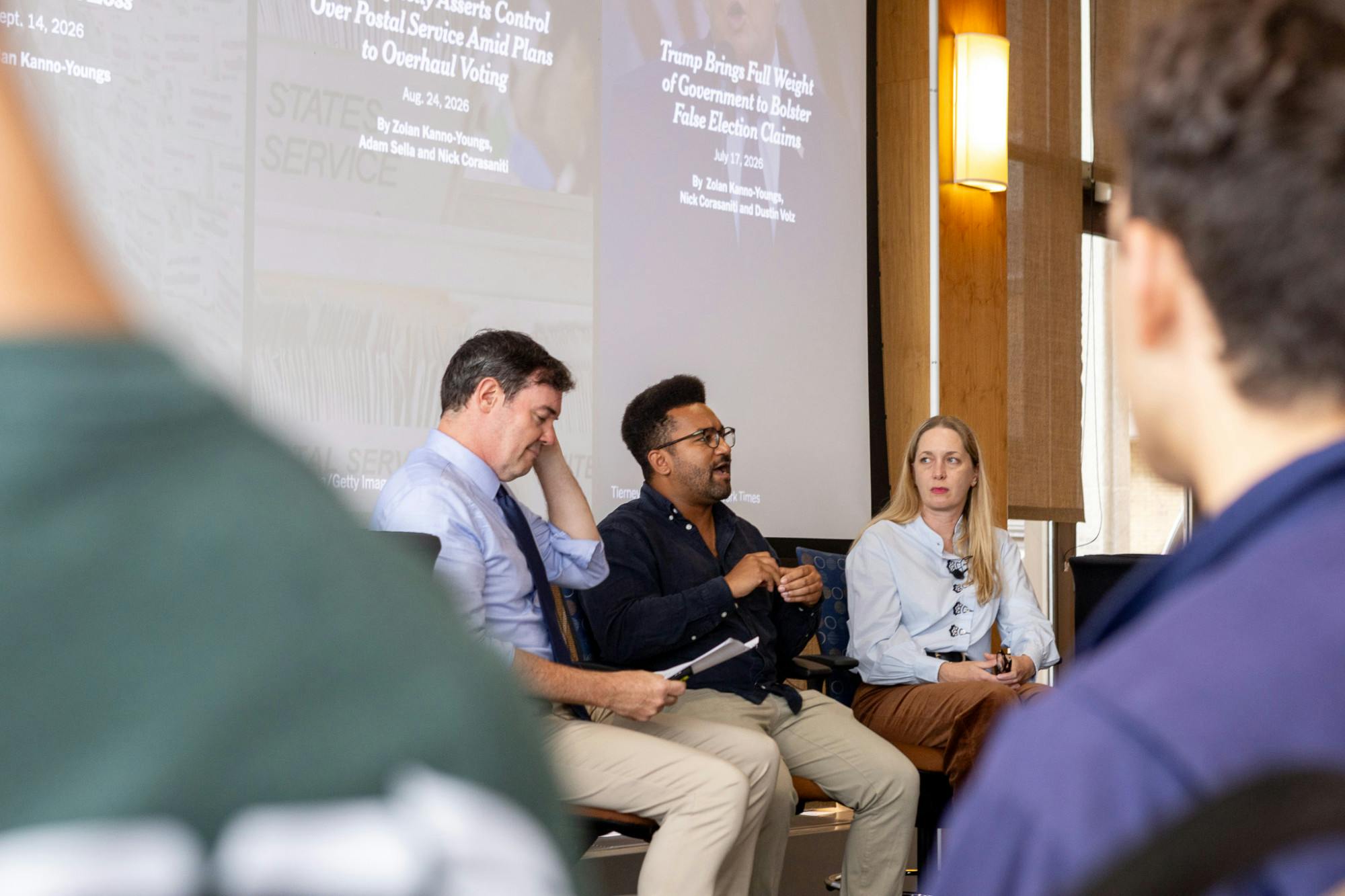
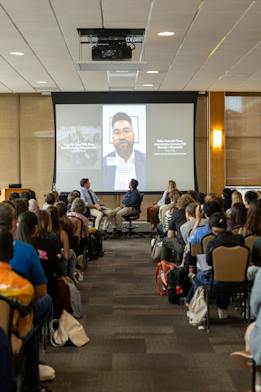
Three New York Times (NYT) reporters and editors sat down with University of Wisconsin-Madison students and faculty in a panel discussing their approach to independent journalism, reporting on the White House and the challenges of covering elections amid record-high levels of media distrust.
The panel was part of the New York Times’s 175th anniversary celebration and featured Assistant Managing Editor for Standards and Trust Patrick Healy, who moderated the discussion, and White House correspondent Zolan Kanno-Youngs and Chicago Bureau Chief Julie Bosman, who is also a UW-Madison alumna.
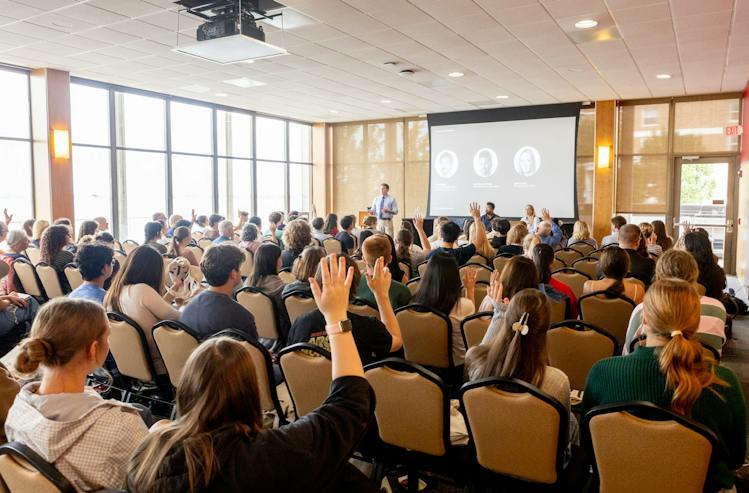
Healy opened the panel by asking the audience whether they trusted the news media. Most hands went up when he asked who was “on the fence.”
“Trust is at a real low in the news media,” Healy said. “The single biggest driver that erodes trust that we found in the Times and in the news media is the perception of bias: people think we have an agenda, that we're putting our thumb on the scale, that we're taking sides in stories.”
Independence and transparency

Healy said the New York Times’s approach to journalism has changed significantly in the past 50 years ago, joking the newspaper had a “bit of an attitude” back then about being the only source determining which news was real news. Their philosophy has since changed.
Since the Times published their first print edition in 1851, the news landscape has changed considerably. The 24-hour news cycle and new forms of digital journalism, like short-form videos and live-feed updates, have changed the way readers encounter the news.
Kanno-Youngs pointed to coverage as an example.
“The way you might initially consume [news of a court decision] is through a live briefing on the website where you have our Supreme Court reporters giving you line-by-line analysis,” Kanno-Youngs said.
But greater engagement with audiences also creates difficult editorial decisions. The journalists said they still struggle with deciding what to or what not to report. Observing what readers talk about on social media, the journalists try to write about what their audiences want to see while making sure the story is contextualized.
“Our North Star, something we really think about and live every day, is this idea of independent journalism: that nobody's going to tell us what to write,” Healy said. “We are applying our news judgment to events. We cannot write about everything. We cannot cover everything. We are making choices.”
Those choices, the panelists said, are part of what makes transparency important to building trust. Readers may disagree with what a newsroom chooses to emphasize, but journalists must be able to explain why they made those decisions.
Healy said the NYT will be publishing articles later this week about their coverage amid their 175th anniversary, including their Civil War coverage.
“We were kind of an eyewitness to events from the 19th century to Afghanistan, Iraq, Iran, Israel [and] Gaza, where we've been pushing the Israeli government on letting journalists go in independently into Gaza to tell those stories,” he said.
Reader feedback and reflecting on human civility
The panelists also discussed how they interact with readers in an increasingly hostile online environment.
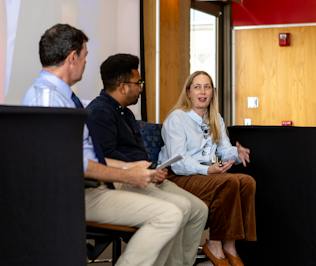
Bosman said while she’s noticed a public “coarsening” of discourse, the NYT aims to uphold civility in part through choosing not to publish all of the profanity political figures, including President Donald Trump, use on social media and enforcing a moderated comments section.
“It does feel like there's a certain waning of norms around civility,” Bosman told The Daily Cardinal. “I think that people feel much more free to attack people in personal ways in the context of them doing their jobs.”
Trump previously called New York Times reporter Katie Rogers “ugly” and recently referred to NYT reporter Maggie Haberman as a “maggot” in an Aug. 28 TruthSocial post.
Healy added when readers come to them with feedback, the language used is often negative.
“It's the most racist, sexist, anti-Semitic, Islamophobic, vulgar-like [comments]. It's just, what point are you making?” he said. “It's just to attack.”
“I don't study this or anything, but some of this has to do with maybe forgetting that there's humans behind these social media accounts and bylines,” Kanno-Youngs added. “It's imperfect, but there's people behind this.”
Bosman said despite this, she tries to read and respond to most of the emails she receives critiquing her work. Kanno-Youngs agreed.
“I find that I get a lot of emails from readers,” Bosman said. “I usually read all of my emails, and you never know what people are going to say — Maybe they'll have an interesting tip or comment or information that would be useful.”
Biden’s Press Office was more hostile than Trump’s, editor says
Healy described former President Biden’s White House Press Office as more hostile than President Trump’s or any other White House press office in his 21 years of experience at the Times.
“I have to say, [of] the anger that I've received and heard from White House press offices, the greatest in my time has been from the Biden White House press office,” Healy said. “Just enormous anger at the Times for asking these questions, whether it was the withdrawal from Afghanistan [or] some of the congressional legislation but especially around the health and age [reporting] and a sense that we were holding him to a different standard — a double standard.”
The NYT has also faced challenges covering Trump’s administration, particularly as the White House has produced a high volume of news.
Kanno-Youngs said the Trump Administration has sought to “flood the zone” with court cases, public statements and media coverage, creating a constant stream of information for journalists and readers.
“There's a lot coming at people,” Kanno-Youngs said.
He said the NYT has frequently covered Trump’s 2020 election fraud claims: “[Trump] continues to be obsessed over that [2020] election.”
Kanno-Youngs described spending two hours in the White House asking Trump questions about Renee Good, just hours after U.S. Immigration Customs Enforcement agents shot and killed her. Kanno-Youngs experienced Trump’s misinformation tendency in real time when the president stated that Good’s car had run over a police officer, a claim disputed by local officials. Trump then viewed the footage and backed away from his statement, Kanno-Youngs said.
During the same interview, Kanno-Youngs asked Trump if part of his immigration agenda aimed to change the racial makeup of this country, making it whiter. Trump said no, but Kanno-Youngs followed up with more pointed questions on Trump’s refugee bans on many Muslim-majority countries.
“Sometimes in an interview you don't just ask a question based off of what the answer will be,” he said. “It's important to put that question to the subject and have people hear that and hear how he'll respond.”
Kanno-Youngs also recalled asking Trump several months ago if he was “concerned that his social media posts effectively amounted to war crimes.”
According to Kanno-Youngs, Trump became angry and responded by asking who Kanno-Youngs was with. After he identified with the NYT, Trump told him the newspaper’s subscriber count was down and “No one's reading you.”
Kanno-Youngs said he repeated the war crimes question.
The exchange illustrated another challenge for reporters covering public officials: maintaining the focus of an interview when the subject attempts to redirect the conversation.
Covering the Wisconsin Democratic primary
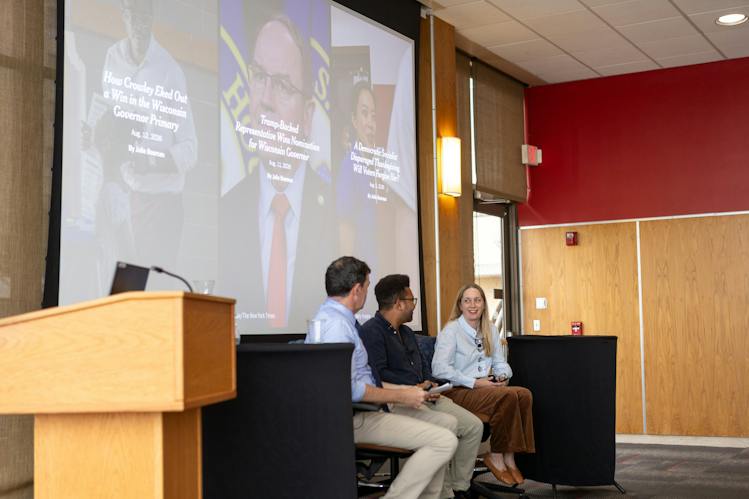
Bosman reflected on her reporting on the Wisconsin Democratic primary election this summer, noting how there “were a ton of undecided voters fairly close to the primary,” and little voter interest for a large election.
Ultimately, the NYT politics desk chose to write a profile about Hong breaking down her campaign for readers.
“They went all over the state [and took] a deep look at what her policies are and how voters, both Democrat and Republican, were responding to them, and I thought it was really revealing,” Bosman said. “So many of the things in that race were: should we cover this? Should we not cover this?”
Bosman noted how leading Democratic candidate Francesa Hong expressing disapproval of the Thanksgiving holiday in a 2020 tweet became a huge topic of contention for citizens.
Bosman said she chose to report on the subject after hearing the issue actually mattered from voters in Platteville.
“Do they actually care about whether [Hong] likes Thanksgiving or not? And I think they really did,” Bosman said. “I would go up to people and say, ‘I'm a New York Times reporter; I'm writing about the Democratic primary; Can you talk to me about the race?; What matters to you?’ And very often people were like, ‘Oh, the Thanksgiving thing… it's a little off, no?’”
Healy compared it to the “chicken and the egg” paradox.
“The media is writing all about what Hong said about Thanksgiving because voters care about it, but voters are caring about it because the media is writing so much about it,” he said. “We hear from readers all the time saying, ‘This has become an issue because the media is making it an issue. My concern is really about, can I pay my monthly rent? Why aren't you writing far more about that than what someone said about a holiday?’”
Healy said there’s a responsibility in terms of covering something of “an organic issue” but also something the media keeps writing about.
Alaina Walsh and Avery Chheda contributed to this report.
Sonia Bendre is the campus news editor for The Daily Cardinal. You can reach her at sonia.bendre@dailycardinal.com.