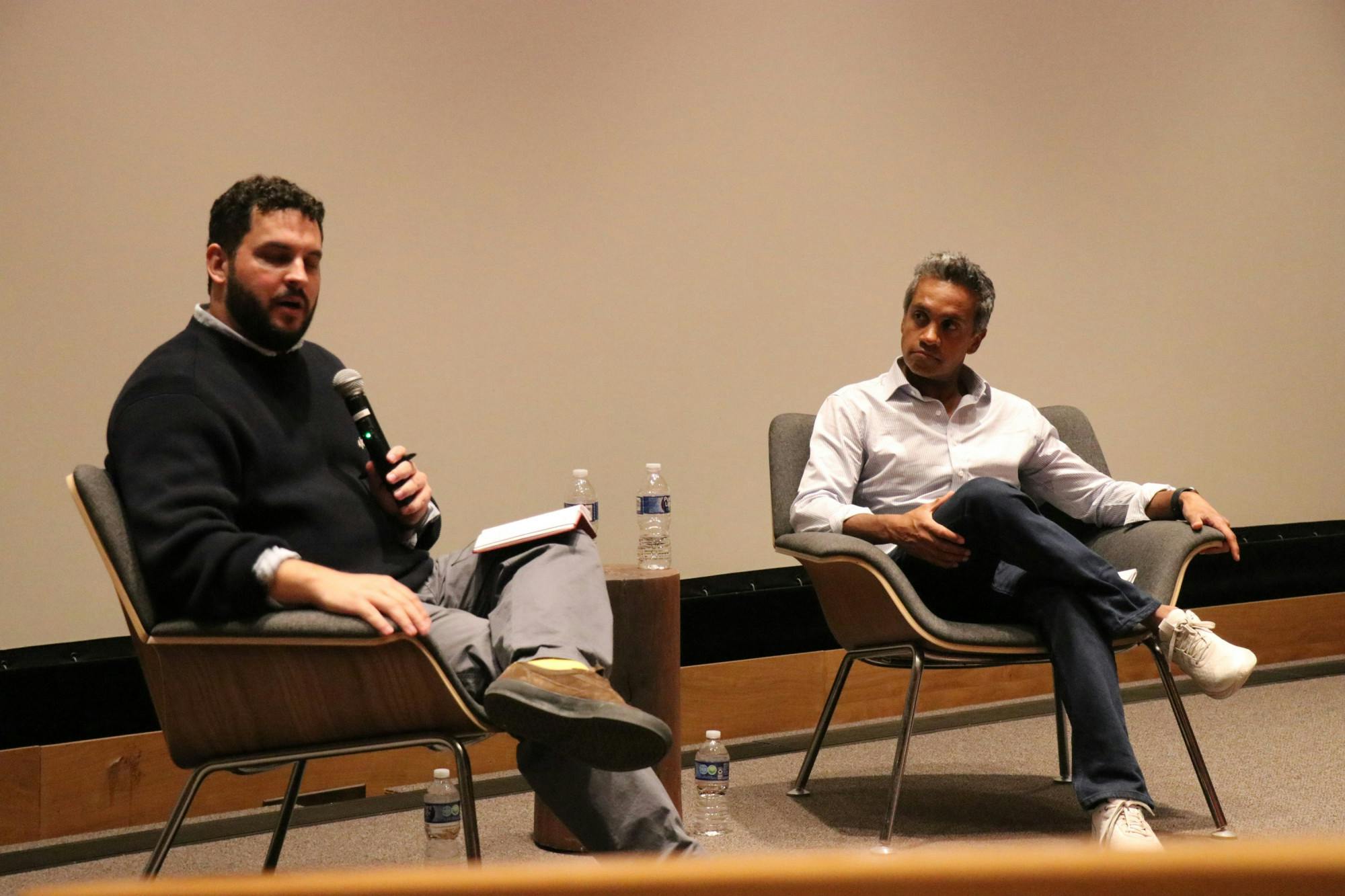
CNN’s Chief Congressional Correspondent Manu Raju spoke about the role of artificial intelligence (AI) in newsrooms at a Center for the Humanities event at the University of Wisconsin-Madison on Sept. 17.
The chat, moderated by Tomás Dodds, director of the Public Media Lab and assistant professor at the UW-Madison School of Journalism and Mass Communication, sought to discuss journalism as a truth-seeking practice from Dodds’ perspective.
Dodds is also an academic researcher who has recently co-authored a book about AI in journalism, and Raju is a top national journalist who has won numerous awards and served as a veteran reporter on Capitol Hill for decades.
Part of the Center for the Humanities’ Civics Lab initiative, the event is part of a broader effort to understand contemporary factors impeding civic engagement and dialogue across a variety of nuanced perspectives.
Dodds began the event by noting the increased pressure journalists are facing to accelerate their story output with the advent of AI tools.
“We are creating this idea that we need to publish 30 stories per day rather than three because artificial intelligence is there,” Dodds said.
Raju championed the uniquely human component of investigative reporting, stating that a “journalist's job is not to make a powerful person comfortable; journalism makes sure someone is there to ask the question in the first place.”
As the event transitioned into a fireside chat between Dodds and Raju, a humorous video displaying a montage of various times Raju has been brushed off by U.S. Rep. Mike Johnson (R-LA), U.S. Rep.Nancy Pelosi (D-CA) and others played, affirming Raju’s ironclad belief that pressing authoritative figures for the truth is something AI simply cannot accomplish.
“Technology cannot replace the most important part of this job: human judgment,” Raju said.
In terms of CNN’s journalistic ethics in the age of AI, Raju said “you can ask [AI] ‘what do you think of this headline’ ... but there are redlines in copying and pasting AI.”
When “a story generated by AI content, [people] hate it, but they use it and they need it,” causing an inherent tension,” Raju said.
Dodds disagreed with Raju’s statement, as he doesn’t believe we need AI.
“I don't think we need AI. I think, to some degree, AI needs journalism more than journalism needs AI,” Dodds said.
Once the fireside chat convened, the moderator opened the floor to questions from the audience.
A student journalist opened his question by stating he has “never used ChatGPT or Gemini or any AI tool,” leading him to seek advice for those who “love writing in all of its capacity, even the part that a lot of people would say is boring.” Raju responded by encouraging the student journalist to “keep writing, develop your own voice, because your voice is uniquely yours and AI can’t replace that voice.”
Dodds shared similar thoughts regarding the process of writing.
“I actually think that not using artificial intelligence might be in the future something that makes you more valuable. It might make you slower, it might make you less productive, so you're not going to publish 30 articles per day,” Dodds said.
Yet in highlighting his recent research in which participants were presented with a news article that was fully generated by AI but were not told in advance, Dodds gave reason to believe that journalism devoid of AI might help both newsrooms and readers alike, explaining that “when [Dodds] did these focus groups with people in Wisconsin and asked them why they don't like AI, they told us … if I know that my newsroom is using AI, I wouldn't donate money to them.”
“Only two people in the entire focus group of 40 people [could tell the image in the article was AI-generated] because the numbers of the jerseys and the numbers of the helmets are different in some of the players, but nobody noticed,” he said.
A final audience member reacted to the rise in short-form content and the literacy crisis which has grown since the pandemic, by asking the panelists how they would encourage critical thinking skills.
Raju highlighted short-form content’s ability, saying “a smart way of presenting the news” because of its high speed.
Dodds said the Public Media Labs’ focus groups provided a lot of insight about the future of short-form content in journalism.
“They told us because that's what Facebook is kind of favoring,” Dodds said. “The reason why you have that feeling that journalists might be dumbing down their articles is not because people are dumber. It's because when we ask journalists why they were doing it, they say it's because that's what the platforms want.”
Returning to something he said at the onset of the event, the panel closed with Dodds reminding the audience that “the wheel can’t keep running without humans in it.”