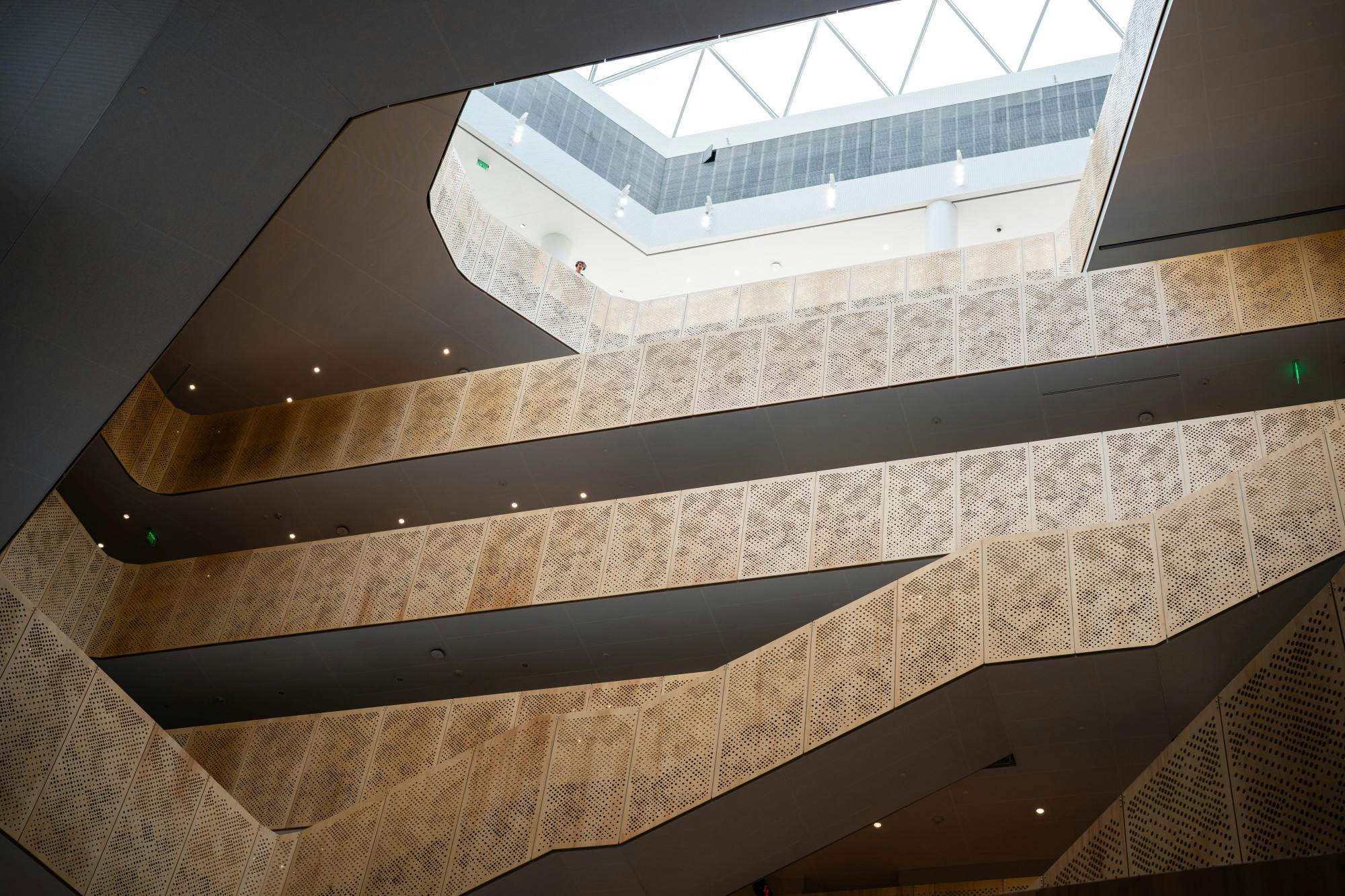
Amidst the clanking and clanging of the new Phillip A. Levy Engineering Center construction, a new engineering idea is emerging at the University of Wisconsin-Madison.
Evan Liu, a rising junior majoring in electrical engineering, presented his ambitions for his Agentic AI UW club on August 20 at the Forward Fest — a multi-day conference held in Madison centered around technology and entrepreneurship — to a crowd filled with entrepreneurs, startup owners and developers.
Agentic AI, semi- or fully autonomous AI systems that can complete tasks with little human oversight, are poised to be the “next generation of generative AI,” according to the Massachusetts Institute of Technology.
Agentic AI builds on top of Large Language Models (LLMs) with AI “agents” harnessing digital tools and software to complete lengthier tasks on a self-directed basis, not just respond when prompted by a human.
The club’s first major project includes a network of AI agents called “Hivemind.” The project plans to connect individuals with a personal network of AI agents on a centralized server. Each agent will understand important contextual information as well as users’ preferences.
Part of the project includes creating a wearable pendant — like having a version of Amazon’s Alexa with you at all times — that would connect users through voice and cellular data to their email or work platforms.
Liu, who founded the club last semester, believes Agentic AI has the potential to improve every industry.
Liu said Agentic AI can revolutionize time-intensive research and mundane tasks such as figuring out finances or planning out a trip. The agents’ ability to understand user preferences and interests will separate this technology from current LLMs, he said.
He’s not alone in his belief: In a recent virtual address to alumni, founding College of Computing and Artificial Intelligence (CAI) dean Remzi Arpaci-Dusseau told listeners they should expect to hear a lot more “people talking about working with agents, and doing certain intellectual work almost in tandem.”
Managing these repetitive tasks will help to “lower the barrier of entry for people using digital tools,” Liu said.
In the alumni address, Arpaci-Dusseau said Agentic AI has already revolutionized software.
“How we build software has changed significantly, and that's because of AI and agentic software coding tools,” Arpaci-Dusseau said.
Liu said while “agentic AI will definitely change your job,” human oversight and agency will still be key components of these processes.
“Agents help complete tasks for you,” he said. “But you give it human judgments: your preferences, your taste, your creativity.”
Ryan Khalili, an engineering physics and math student and founding member of Agentic AI UW, told The Daily Cardinal that the club’s early involvement in the agentic AI scene is crucial to building a sense of trust between developers and users — especially those who might be wary of the inclusion of AI agents in the workplace.
“I would rather be at the forefront of this field to help shape it around my ethics — however futile that may be — than be someone who just hopes for the best or prays that those who are at the forefront of this field will have my best interest in mind,” Khalili said.
Compared to other engineering clubs, Liu hopes Agentic AI UW serves as a source for “consumer-facing” projects that are designed with the Madison community in mind.
At Forward Fest, Liu described himself as a “builder, learner, generalist and techno-optimist.”
He said he sees Agentic AI UW as a place for like-minded students to connect with each other as well as faculty, laboratories, the government and the startup industry as a whole.
“[Agentic AI UW] is like a hub where we incubate entrepreneurs and then once they have these networks, have these experiences and these resources, they go out and they go found companies in Madison or maybe elsewhere to help boost the entrepreneurship scenes in Wisconsin,” Liu said.
Staff writer