Interim chancellor Eric Wilcots and founding dean of University of Wisconsin-Madison’s new College of Computing and Artificial Intelligence (CAI) Remzi Arpaci-Dusseau presented a measured view of artificial intelligence in higher education at a Wisconsin Foundation and Alumni Association (WFAA) virtual panel on August 18.
Wilcots and Arpaci-Dusseau both said students should be AI competent when they graduate, but that UW-Madison needs to handle AI’s pervasiveness in college life: cracking down on take-home assessments while navigating emptier classrooms and a “silent spring” on Piazza, a popular classroom forum and social networking tool, as students increasingly turn to chatbots.
“Over the course of 120 credits that a student might spend at UW-Madison, there's going to be some fraction of that where they're doing a deep dive into AI,” Wilcots said. “There's [also] got to be a set of [courses] where it really is the blue book, the writing in class, the unaccompanied learning.”
Both Wilcots and Arpaci-Dusseau are long-time UW-Madison faculty: Wilcots, formerly the Dean of the College of Letters and Science before succeeding Jennifer Mnookin as Chancellor on May 17, has been an astronomy professor since 1995 and Arpaci-Dusseau joined the computer science department in 2000.
As they lead the university into its “Year of AI Readiness and Competency,” they want to amplify the university’s existing strengths with AI while retaining college fundamentals like learning and mentorship.
“It's one of those times when there could be some reordering of who the best institutions are, and of course, we want to come out on top,” Mike Knetter, the panel’s moderator, said.
Not just a computer science college
Wilcots and Arpaci-Dusseau want CAI to underpin and “amplify” all existing colleges, rather than existing as its own silo.
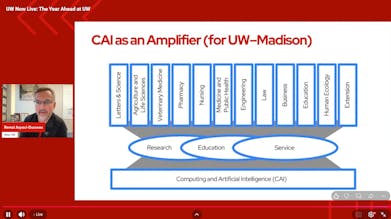
“[AI] is a huge opportunity to accelerate research, to accelerate innovation, to build new companies, and that's happening all around us,” Arpaci-Dusseau said. “Because we have such a breadth of excellence on this campus, we're going to be able to see that innovation in every domain.”
CAI grew out of the School of Computer, Data and Information Sciences (CDIS), which started in 2019 in reaction to a "changing economy" following the dot-com boom. Internal to the College of Letters and Science, CDIS bridged three departments: computer science, the information school and statistics, which launched a data science major that is now the second largest major on campus.
“AI is a significant and transformative technological force,” Arpaci-Dusseau said. “The biggest industries in the world are participating in a race to be the leaders in this space… but a counterbalance needs to be there somewhere, and the university is a perfect place to give a clear-eyed, balanced view and help shape AI for the public good.”
Arpaci-Dusseau highlighted Piazza as a casualty of AI reliance. He said before AI, Piazza allowed students to receive timely, accurate answers to course questions from professors and teaching assistants, and that student questions on Piazza helped instructors understand where people were getting confused.
“It was a lot of fun and actually very useful — and then suddenly in many classes, it went silent,” Arpaci-Dusseau said. “Because suddenly, instead of posting a question to a social network to get an answer, you can just ask ChatGPT.”
He envisioned an AI-resilient curriculum where all UW-Madison students learn the fundamentals of their fields alongside core AI competencies. In some fields, ensuring that students learn fundamentals would include a return to in-class work and blue-book exams.
“It’s not a panacea,” Arpaci-Dusseau said. “It's a piece of software that does certain things well and certain things poorly, and we should just treat it as such… no AI agent is going to replace a really great textbook, and I feel very confident about that.”
Arpaci-Dusseau said ethics will be “front and center” of CAI’s offerings.
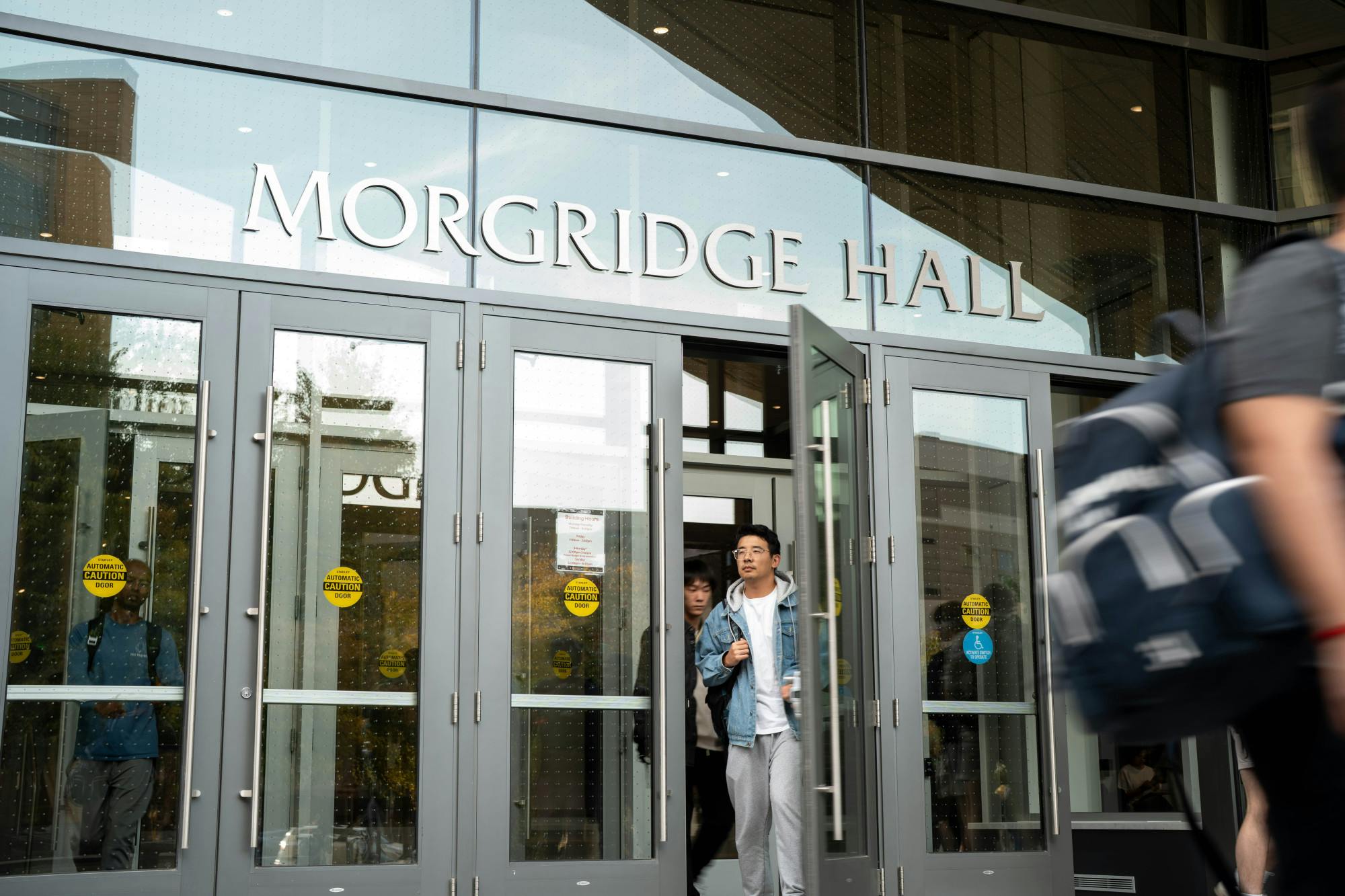
“The walls of Morgridge Hall are permeable,” Wilcots said. “[CAI] could be, and should be, deeply collaborative with the breadth of what we have on campus.”
Another record-setting admissions year
UW-Madison’s breadth and professional colleges lend it an edge over peers like the University of California-Berkeley, Wilcots said. The interdisciplinary RISE-AI, RISE-THRIVE and RISE-EARTH hiring initiatives aim to capitalize on that.
“I usually use Berkeley as an example of another great institution in this country,” Wilcots said. “Berkeley does not have a medical school, or a vet school, or a nursing school, or a pharmacy school, or that agricultural college that we do. The breadth of UW-Madison is one of the things that sets us apart.”
UW-Madison received over 75,000 applicants this admissions cycle, breaking its record for the seventh consecutive year, according to Wilcots. The university saw an increased number of applications from southern states like Mississippi, Louisiana and Maine and rural northern Wisconsin counties, including Iron County and Ashland County. At the same time, 41% of applicants — a record low — were accepted in 2025.
Wilcots said admissions officers are relying more heavily on high school reputation and coursework as AI increasingly devalues admissions essays.
This year, UW-Madison will welcome around 80 new faculty within about 60 departments, Wilcots said. The university expects to enroll between 150 and 200 students into its new aerospace engineering major. Wilcots also highlighted a new public policy major, the first major in The La Follette School of Public Affairs.
Wilcots called UW-Madison’s new BadgerWay strategic framework and the Wisconsin Exchange, a pluralism initiative started in 2025, touchstones in the year ahead. He highlighted experiential learning, like internships and research projects, as increasingly valuable indicators of “real learning” in the age of AI.
“At convocation, I will be asking the students to do two things simultaneously… to be intellectually courageous, to dive into things they don't know much about, but also to bring an intellectual humility: to recognize that there are things that they can learn, not just from the courses that they take but from all the people around them,” Wilcots said.
Sonia Bendre is the campus news editor for The Daily Cardinal. You can reach her at sonia.bendre@dailycardinal.com.