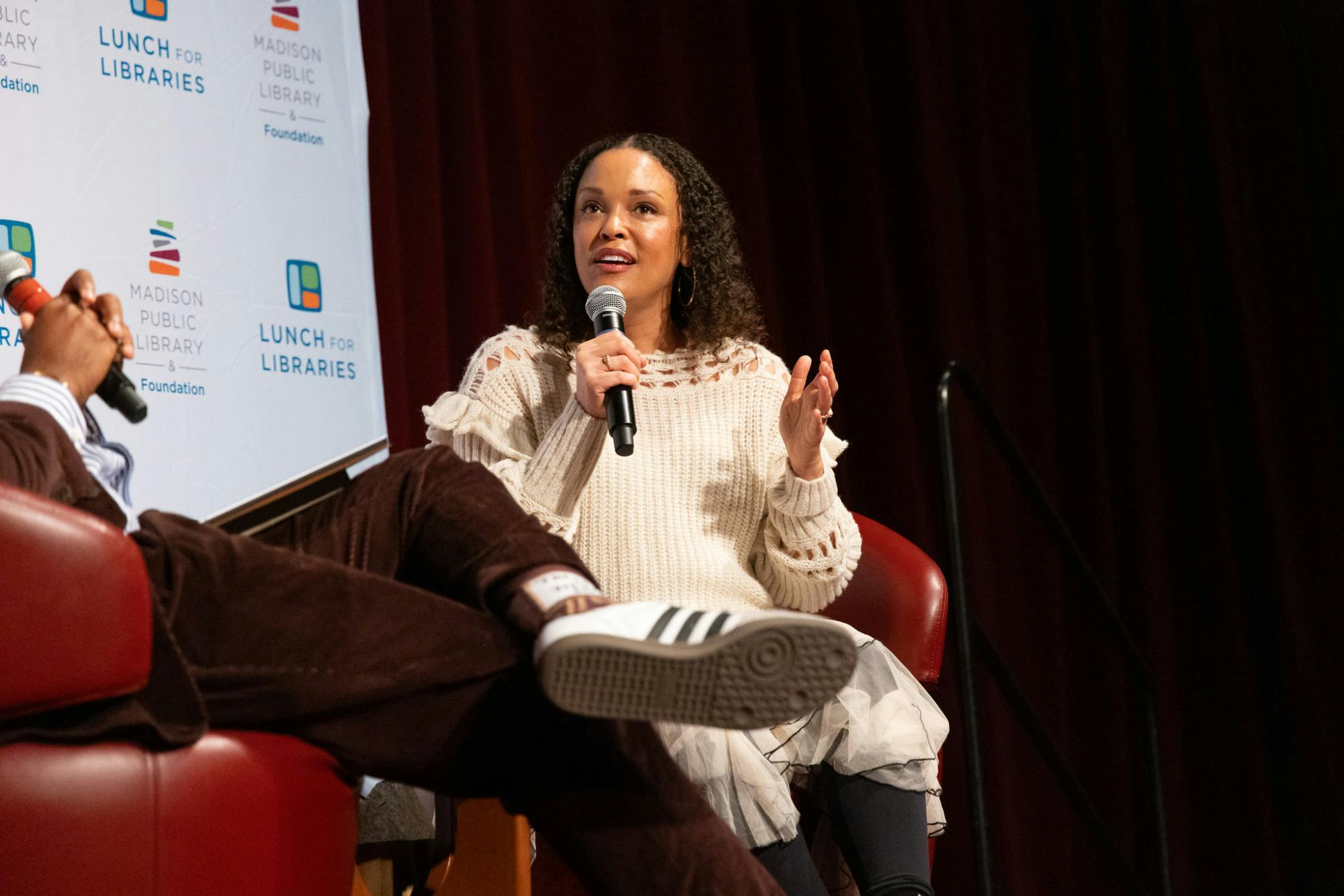
The Madison Public Library Foundation hosted its 15th annual Lunch for Libraries event with author Jesmyn Ward on May 5, which raised $164,000 for the annual Wisconsin Book Festival.
Lunch for Libraries is one of the Foundation’s biggest fundraising events and this year brought in over 850 attendees. Ward, a New York Times best-selling author and conversation partner Nate Marshall, a poet and University of Wisconsin-Madison creative writing professor, took center stage.
Ward discussed her upcoming book, “On Witness and Respair,” a collection of essays written at different times in her life, which is set to be released May 19.
Ward shared that she learned the importance of oral storytelling and the written word through her grandmother, whom she lost to Alzheimer's. During her talk, she recalled a time when her grandmother didn’t want to tell her the story of how she met her grandfather.
“I'll hear that story sometime, right? And then she never told it to me,” Ward said. “And so I think about that. I think about all the stories she knew and slowly lost, over the years.”
Ward also said the collection of essays came as a coincidence, a collection of moments written down throughout the years. She learned the skill from her grandmother, who taught her the importance of setting stories down on the page when she has them.
“Sometimes I'll write just so that I can set the memory down with the particular details, because I know how fickle memory is, even when you aren't dealing with a degenerative condition,” Ward said.
Many of the essays in “On Witness and Respair” center around Ward’s life growing up and her decision to return to Mississippi after leaving — a return Ward attributes to being inspired by the people who still live in her hometown.
“I've always been connected to the place that I'm from, but I wanted to deepen that connection,” Ward said. “And I think part of me really understood that in returning home, that being in that place was going to keep me honest about the people that I wrote about and about the community that I write about.”
Another major theme of “On Witness and Respair” is Ward’s experience as a Black woman in Mississippi and her adolescent years spent in private school.
“For years, I was the only, definitely the only black girl in the school, and there were some years where I was the only black person and person of color in the school,” Ward said. “So that was difficult. Some of the kids I attended school with were racist.”
She said she persevered with strength, which she learned from her dad, a member of an unofficial Black Panther Party organization.
“I think that experience, I think that sort of informed his ideas about community, about how political action in some of its forms, can be very personal, intimate and nurturing,” Ward said.
Ward said she most often compares herself to Toni Morrison, but she draws inspiration from other authors. Most notably, she looks up to authors Alice Walker, Ntozake Shange, Gabriel Garcia Marquez, William Faulkner and Carson McCuller.
“I love [Carson McCuller’s] prose, right? Like, as I'm reading it, I'm thinking, just how lyrical it is, and the power of imagery, and I just love it so much,” Ward said. “But then again, there's that uncomfortable sense. When there's a Black character on the page and I feel like they're flat. They're not as well developed as the rest of the characters in the book.”
Ward said she has plans for future novels, including a young adult book she is currently working on and a post-apocalyptic story set on the 1960s Mississippi Gulf Coast.
“I've always wanted to write a post-apocalyptic novel on the day after Hurricane Camille, which was the last big hurricane that killed [259] people,” Ward said. “And then I was thinking about the country as a whole. Everything that had been happening throughout the '60s, they probably felt like the world had ended, living in this post-apocalyptic reality.”
Ward plans to capture those feelings in a later novel, but those were the only two ideas she was willing to share at this time.