State leaders, scientists and nuclear fusion industry members gathered at the Wisconsin Institute for Discovery on May 5 to discuss how Wisconsin could position itself as a national hub for nuclear fusion, an emerging energy technology experts say could provide nearly limitless carbon-free power.
Hosted by 5 Lakes Institute, the third annual summit drew Gov. Tony Evers, engineers, lawmakers, supply chain companies and startup founders for lab tours and panel discussions on research, workforce development and legislation surrounding the growing industry. The event was significantly bigger this year, drawing around 400 people and signaling a desire to make Wisconsin an industry model for collaboration, research and fusion legislation.
Nuclear fusion, the reaction that powers the sun, happens when the positively charged nuclei of light atoms are forced together by hot, dense conditions. Fusion depends on a mechanism called quantum tunneling, where instead of actually overcoming the activation energy needed for the reaction, particles can infrequently “tunnel” through the energy barrier, University of Wisconsin-Madison physicist Cary Forest said at the summit.
Evers called fusion research a priority for his administration.
“In labs here in Wisconsin and facilities across the Midwest, we're getting closer every day to making fusion power not just a reality, but a commercially viable source of energy,” Evers said. “It excites me to think that we are engaging in groundbreaking research and applying it to real-life problems to revolutionize how the entire world is powered.”
UW-Madison ranked third in the nation in the 2025 U.S. News and World Report’s Best Nuclear Engineering Programs. Four fusion companies spun out of the university — Xantho Technologies, SHINE Technologies, Type One Energy and Realta Fusion — and nearly 600 plasma physics PhD students have graduated from UW-Madison since its founding, interim chancellor Eric Wilcots said in opening remarks.
Julia Marshall, a second-year PhD student at UW-Madison’s Helically Symmetric Experiment (HSX), told The Daily Cardinal she enjoys her collaborative laboratory environment, learning how her labmates’ experiments work and being near plasmas — the highly heated, ionized gases essential for fusion.
“There's always been this part of me, the little kid who wanted to be an astronaut,” Marshall said. “This is the same type of thing that goes on in our sun, that fuels all of the reactions and the energy that gives us life. There’s no way to not say that's cool.”
Fusion could meet data center energy demand, panelists say
Realta CEO and co-founder Kieran Furlong, a panelist at the event, suggested placing off-the-grid fusion reactors next to data centers to limit their impact on consumer electricity prices.
5 Lakes Institute Chair Mark Ehrmann agreed, telling the Cardinal that setting up nuclear reactors next to data centers could offset data centers’ heavy demand on the electrical grid.
“A data center could eventually have its own little fusion reactor... associated with [it],” Ehrmann said. “[Data centers] are very expensive for power, but if you can develop a source of energy that's separate from the grid, you can use that for the power itself.”
Ehrmann said Wisconsin is well positioned to lead the fusion industry because of its manufacturing base, access to water and strong nuclear research foundation.
“The thought would be you could create an alliance in the state for [fusion],” Ehrmann said. “I think the success so far is in coordinating efforts, trying to get companies that are going to be involved in the space talking to each other.”
Because of a partnership formed at the summit, Realta Fusion is exploring converting an old Oscar Meyer building on Madison’s East Side into a fusion facility, Ehrmann said.
Ehrmann added that companies don’t need to wait for fusion to fully develop to begin collaborating. Many of the parts needed for a fusion reactor, like capacitors, coils and metal alloys, already exist.
“There’s a lot of opportunity for current companies that are already making things to be involved in the [fusion] space,” Ehrmann said. “They just have to get to the point where they get orders to do it, and then they can make it.”
Furlong said he wished fusion attracted as much attention as artificial intelligence.
“We want to power humanity. We want to figure out how to lift the standard of living for everyone on the face of the Earth,” he said. “And instead, the best brains are going to work on some agentic AI agent to order Domino's pizza faster.”
How state legislature has powered fusion research
Wisconsin’s state legislature passed bills this past session aimed at attracting nuclear fusion talent, including Assembly Bill 657, which creates a sales and use tax exemption for fusion-related projects. At a mixer following the summit, the 5 Lakes Institute awarded two of the bill’s sponsors, both Republicans, awards for their legislative work on fusion.
Jennifer Bacon, a spokesperson for the Department of Internal Revenue, told the Cardinal the exemption holds not only for nuclear fusion companies themselves but also for contractors purchasing items like machinery and equipment “exclusively and directly used for a nuclear fusion technology project and used solely at the nuclear fusion technology project’s location.”
The state legislature approved a $2 million nuclear siting study for a Wisconsin reactor which “will encompass traditional nuclear power, small modular reactors and advanced technologies like fusion,” Evers said at the summit.
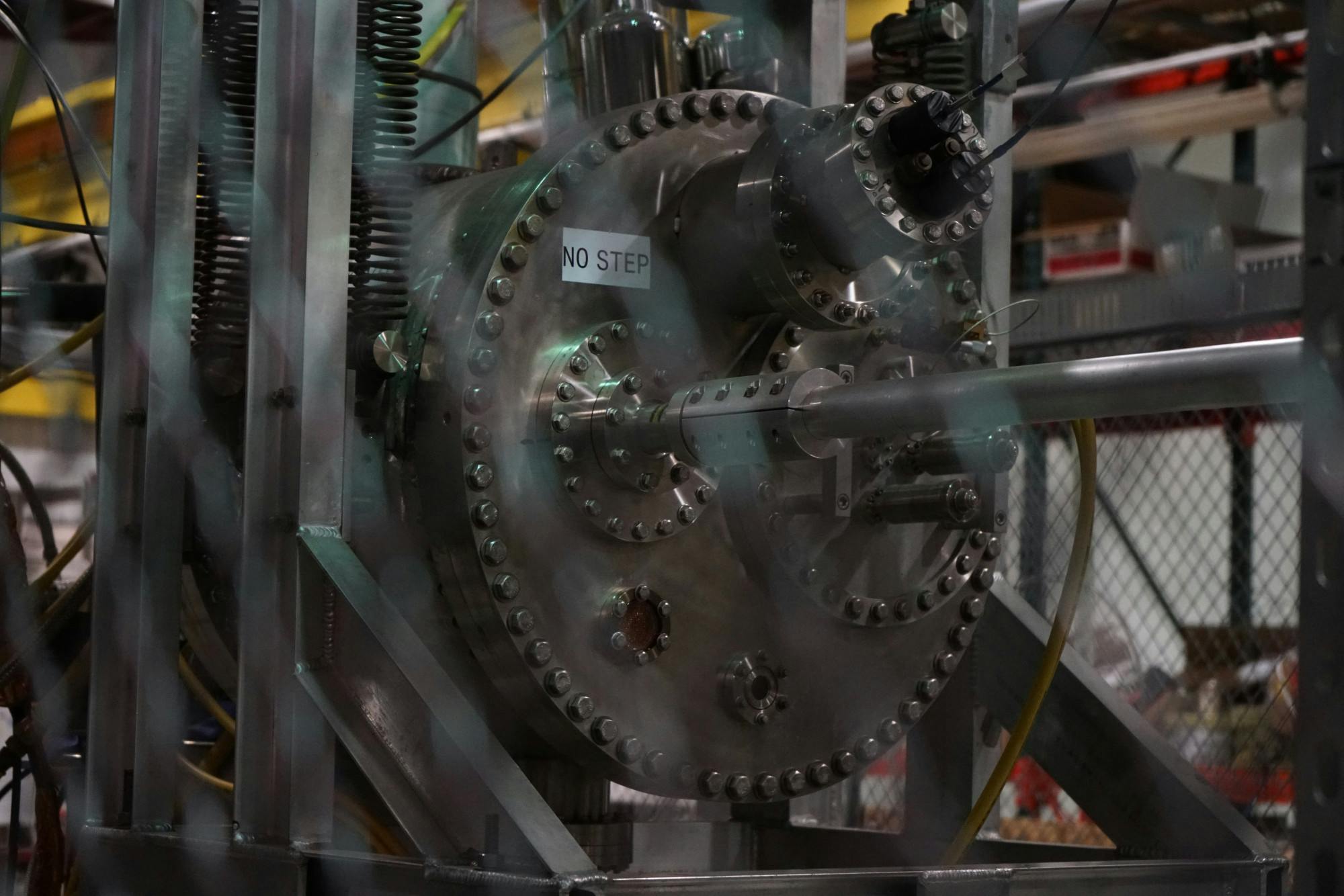
Steffi Diem, a professor in the Department of Nuclear Engineering and Engineering Physics, works on the Pegasus-III Experiment, a spherical tokamak. She told the Cardinal experiments on Pegasus-III are intended to simplify the cost and complexity of fusion devices.
“I'm excited about the research that's coming out [of Pegasus-III],” Diem said. “A lot of the research that we do is driven by graduate students and undergraduate students, and I love the creativity that they bring to the program.”
Diem said UW-Madison’s “depth and breadth” of fusion knowledge positions the university well for leading the commercialization of fusion.
“It’s been really exciting to see [the summit] grow every year,” Diem said. “I think that speaks to not only what we're trying to build in the state of Wisconsin by bringing in the Great Lakes Fusion Energy Alliance — the manufacturing, supply chains, universities and private companies — but also broadly in the United States on embracing this next phase of fusion energy commercialization.”
Sonia Bendre is the campus news editor for The Daily Cardinal. You can reach her at sonia.bendre@dailycardinal.com.