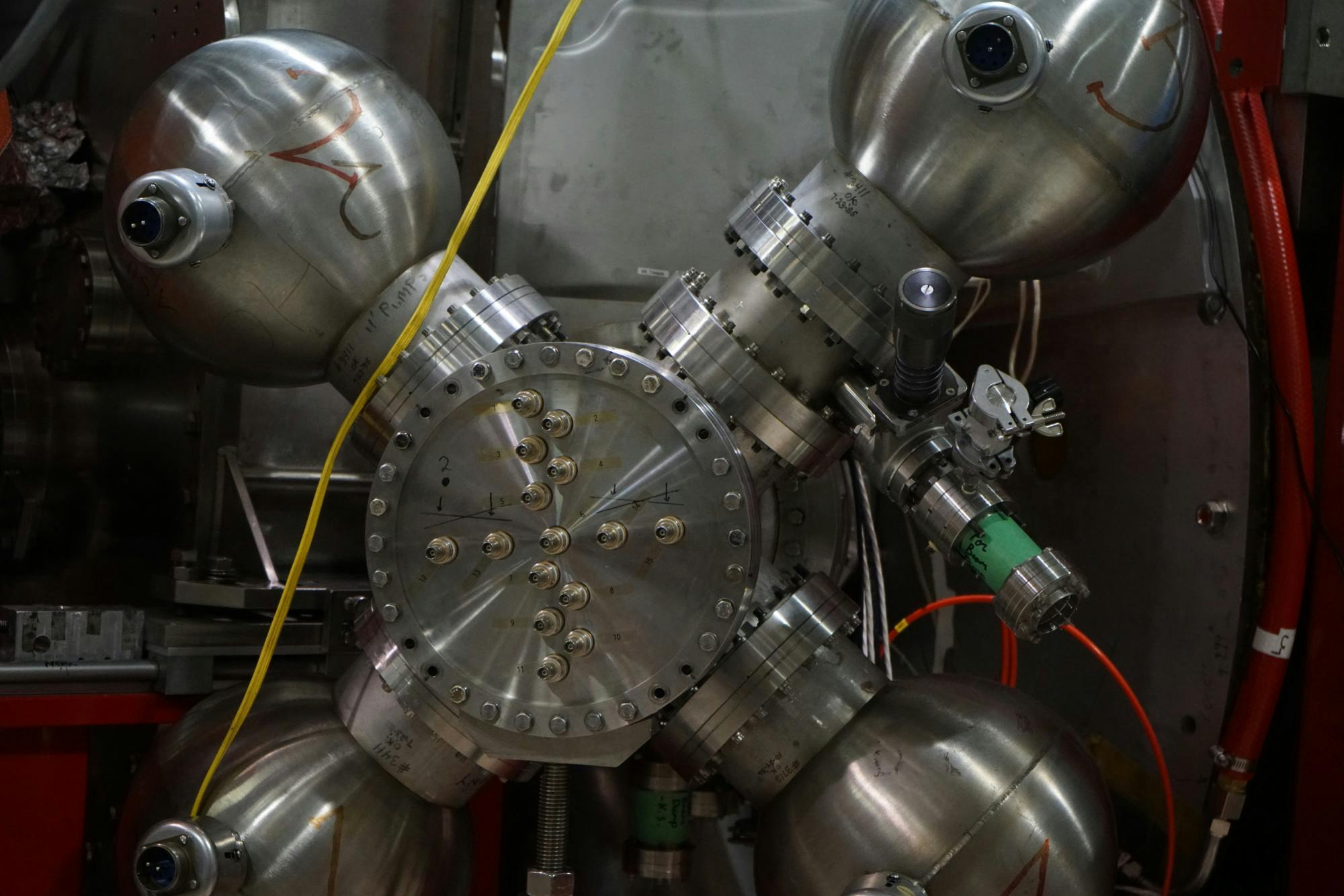
University of Wisconsin-Madison spinoff Realta Fusion is partnering abroad as Wisconsin fusion innovation explodes with renewed investment from the state Legislature.
Realta announced a partnership with Japanese company Kyoto Fusioneering along with other international agreements from Wisconsin-based fusion companies and the state Legislature funded fusion tax breaks, scholarships and entrepreneurship positions.
These recent developments signal Wisconsin is increasingly looking to fusion plants as opportunities for international recognition — and revenue.
Realta Fusion’s partnership with Kyoto Fusioneering
Japan is a market ripe for fusion as an advanced, industrialized economy that imports most of its energy. Realta Fusion CEO and Co-Founder Kieran Furlong told The Daily Cardinal he knew a domestic partner would be invaluable from his experience working with Japanese companies as a chemical engineer.
Realta, headquartered in Stoughton, is commissioning Kyoto Fusioneering to develop custom, top-grade fusion products like gyrotrons — plasma heating systems that are essentially “giant microwaves” — and external fuel loops called tritium breeding systems that self-recycle fuel for fusion reactions.
Eventually, Realta hopes to leverage that partnership to build their fusion reactors in Japan.
“We're in an uncertain world when it comes to where we're headed with international trade, globalization and so on,” Furlong said. “[But] the reality is the fusion industry is global by nature and almost by design.”
Many of fusion’s first discoveries were made by international teams of researchers on the ITER project, a nuclear reactor in France. Additionally, some of the technologies pioneered on UW-Madison's HSX reactor now run at the larger W7-X reactor in Germany, overseen by a team of U.S. and German researchers. Type One Energy, a UW-Madison fusion spinoff, employs several W7-X researchers.
“[Fusion] expertise developed all around the world in places like Germany, Italy, Korea, Japan, as well as here in the U.S. Naturally, we'd also want to support U.S. manufacturing and U.S. technology, but in order for us to move fast, that's not always available. Not yet, anyway,” Furlong said.
All of UW-Madison's three fusion spinoff companies — Realta Fusion, SHINE Technologies and Type One Energy — draw from and contribute to fusion’s international database of information to conduct their research. The Trump administration has encouraged bilateral agreements between two countries, rather than larger multinational agreements, Furlong said.
“If we are entering into a world where international trade is a little more difficult, having local partners in those target markets is even more important. Japan is of interest to us ultimately as a market for… the fusion power plants that we'll be building at Realta Fusion,” Furlong said.
Furlong first met Kyoto Fusioneering representatives at a Department of Energy Milestone program event shortly after Realta’s founding in September 2022.
Since then, the two companies have conducted engineering work together, providing letters of support to each other for proposals to public agencies.
“It’s been a gradually increasing relationship to the point where we said, ‘Let's formalize this. We're doing a lot of stuff together. We absolutely see the complementarity of the two companies in our respective home countries and we want to leverage that in a more full manner,” Furlong said.
Realta Fusion also recently announced a partnership with Commonwealth Fusion Systems, another fusion company that produces the high-temperature-superconducting magnets necessary for Realta’s magnetic mirror fusion topology.
In addition to Realta’s partnership with Kyoto Fusioneering, UW-Madison fusion spinoff SHINE Technologies signed an exclusive distribution agreement for a particular radiopharmaceutical with Chinese company C-Ray in late March. Also in March, spinoff Type One Energy landed on a list of the world’s fastest-growing small companies.
Fusion scholarships and tax breaks
The state legislature recently passed several bills aimed at assisting local fusion companies and expanding fusion development in Wisconsin. Assembly Bill 657, excluding equipment for nuclear fusion energy projects approved by the Wisconsin Economic Development Corporation from sales and use tax, passed near-unanimously April 3, effective July 1.
The bill, authored by Rep. Benjamin Franklin, R-De Pere, and Sen. Dan Feyen, R-Fond du Lac, is “the first state-level legislation of its kind,” according to a press release by 5 Lakes Institute, the Midwest consortium that organized the Wisconsin Fusion Energy Coalition.
The bill exempts fusion-specific equipment like gyrotrons and neutral beam injectors from sales and use taxes, as well as general construction and power electronics equipment like ceiling-mounted cranes, high-voltage pulsed-power supplies and energy storage systems.
“It is critical for long term economic success to choose promising technologies and surround them with all available resources,” Kathleen Gallagher, Executive Director of 5 Lakes Institute, said in a press release. “Governor Evers and an overwhelming majority of our state legislators have made clear their vision for Wisconsin as a leader in this fast-emerging technology.”
In a Feb. 17 State of the State address, Tony Evers called a $778,000 grant to the Wisconsin Fusion Energy Coalition an investment in making the state a “national hub for commercializing fusion energy.”
State funding will establish an Fusion Early-Entrepreneur in Residence position within the UW-Madison College of Engineering and create two positions within Wisconsin fusion companies for in-residence entrepreneurs. State funding also previously established a nuclear fusion summit hosted by UW-Madison on May 5.
Sonia Bendre is the campus news editor for The Daily Cardinal. You can reach her at sonia.bendre@dailycardinal.com.