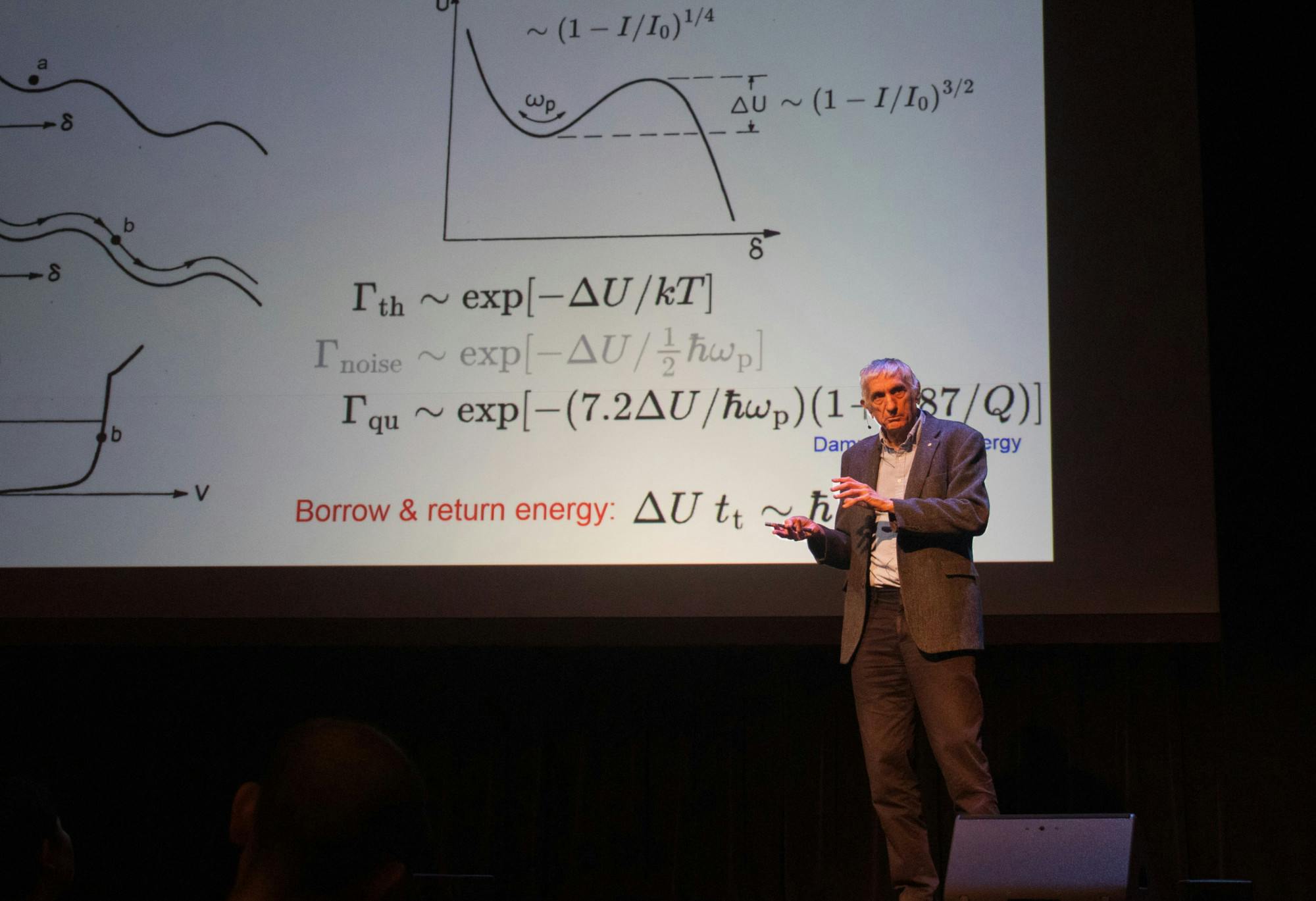
Nobel Laureate physicist John Martinis discussed his work in quantum mechanics, criticized a lack of transparency in his field and predicted his death would come earlier than useful quantum computers in a March 23 lecture.
In the hour-long lecture introduced by University of Wisconsin-Madison physicist Robert McDermott, Martinis offered students and community members a look at the complex science and evolving future of quantum computing as part of an event organized by The Wisconsin Union Directorate Distinguished Lecture Series, in collaboration with the College of Letters & Science.
Martinis’ search to answer questions about macroscopic quantum theory and quantum computing have led him from Nobel-winning experiments to recent breakthroughs in quantum computing.
From Schrödinger’s cat to Nobel Prize-winning experiments
Martinis and two colleagues won the 2025 Nobel Prize in Physics for their proof of macroscopic quantum tunneling. A macroscopic object refers to any object larger than atomic-scale.
To explain the principles behind his work, Martinis referenced the famous thought experiment known as Schrödinger's cat. In the experiment, a cat in a closed box is in an indeterminate state until observed.
“Before you open the box, you’re tempted to say the cat is in a superposition of dead and alive states because you haven't measured it yet,” Martinis said. “Of course, that seems very strange for a macroscopic object.”
Macroscopic objects, like circuits, behaving in a quantum manner forms the basis for quantum supercomputer technology. A ball behaving in a classical manner always hits a wall when thrown at it, but a ball behaving in a quantum manner has a chance of tunnelling or slipping through the wall.
“Do macroscopic variables evade quantum mechanics? That’s what we set out to deliberately answer,” Martinis said. “Physicists don’t like that there are two parts of a theory, they like only one part. So this has always been a little bit strange.”
He conducted his Nobel-winning research in the 1980s as a graduate student at University of California-Berkeley with professor John Clarke and postdoctoral student Michel H. Devoret. Their work consisted of experiments with an electronic circuit of superconductors, materials that can carry current with zero resistance at low temperatures.
When Clarke, Martinis and Devoret powered up two separated circuits that both utilized superconductors, they were able to induce quantum behavior in the circuits, allowing the team to study quantum mechanics in a way that was visible to the human eye. Previously, quantum behavior had only been observed in atoms, not entire circuits.
“The currents and voltages of that circuit obey quantum mechanics… that opened up a new playground for physicists to build these quantum devices,” Martinis told The Daily Cardinal.
“Normally, quantum mechanics is the physics of the small, but here we’re doing quantum mechanics with something you can actually see,” he added.
This work proved quantum mechanics could govern macroscopic systems and laid a foundation for superconducting qubits, the basis for modern quantum computers.
How quantum computing works
Classical computers process information in binary bits, either 0 or 1. By contrast, quantum computers use quantum bits (qubits) that can exist in multiple states at once. Like Schrödinger's cat being alive and dead simultaneously, a qubit can hold both 0 and 1. This allows a system to explore many possibilities at the same time, and in the case of a computer, hold a lot more memory.
“With three qubits, it’s eight states. Four is sixteen. Five is thirty-two… it grows really, really rapidly,” Martinis said about the exponential scale of qubits. “By the time you get to 300 qubits, that’s a number bigger than the number of atoms. So clearly you’re doing something different.”
Qubits can also be entangled so the state of one directly influences another, exponentially expanding computing power. But without careful design, entangling qubits can pose more problems than it solves, Martinis cautioned.
“You have to design very special-purpose algorithms… it’s hard to take advantage of that power,” he said.
Martinis’ career: From government labs to Google
Martinis spent 17 years at the National Institute of Standards and Technology developing instruments for precision measurements and materials characterization. In the early 2000s, he returned to quantum circuits to explore whether quantum mechanics could provide a computational advantage, first as a researcher at the University of California, Santa Barbara and later at Google.
At Google, he led the superconducting qubit hardware program, including a widely publicized 2019 quantum supremacy experiment where using a 53-qubit processor, Google’s scientists ran a calculation in 200 seconds that they estimated would take the best non-quantum computers 10,000 years.
“It really was a big moment for the field. It showed that a macroscopic quantum computation could outperform classical systems,” Martinis said.
Superconducting qubits rely on the same superconducting electronic circuits whose discovery won Martinis and his team the Nobel Prize.
“There wasn’t any new physics out there,” he added, emphasizing how the achievement validated existing theories rather than rewriting them.
Martinis on the future of quantum computing
Martinis now co-leads the startup Qolab, aiming to build scalable, reliable quantum computers using professional semiconductor foundries rather than small lab fabrication.
“No one in their right mind in the semiconductor industry makes complex devices the way we currently make qubits,” he said. “We want to scale it up, make it cheap and mass-produce it.”
He also acknowledged the long road ahead for quantum computing to reach a benchmark one million qubit computer.
“If I look at the current pace…by the time we get there, I will certainly be dead,” he said. “All the students in the audience, you should be worrying too.”
He highlighted the potential of quantum computing in chemistry and materials science, including creating more efficient materials and energy systems. Quantum computers have the potential to vastly accelerate computational science research — for example, when designing molecules and chemical reactions, Martinis said.
“You can map a quantum problem into a quantum computer and solve it more effectively,” he said.
Another application of quantum computers could be simulating operation of motors in electric vehicles, optimizing for cheap, effective motors with lower reliance on expensive, environmentally costly metals.
“If you could make these motors out of less rare earth [metals]… that would make a huge, huge deal,” he said.
Competition and a lack of transparency among researchers remain a challenge in the field.
“No one talks about what’s wrong with their qubit…I told you very explicitly what we have to fix,” he said.
When asked about alternative approaches by audience members, such as Microsoft’s Majorana project that promises to reach a million qubits, Martinis said, "It's not clear to the majority of the field how exactly that’s working in the lab…If they were going to get to a million qubits, we would have heard more results. It could be great, I don’t know.”
Despite these challenges, he underscored why quantum computing captivates scientists: “You’re not doing science just because your next-door neighbor is working on it. You’re trying to answer some fundamental questions.”