Members of the University of Wisconsin System Board of the Regents told legislators transparency issues, a lagging approach to artificial intelligence and a “top-down” leadership style lead to the decision to unanimously oust system President Jay Rothman.
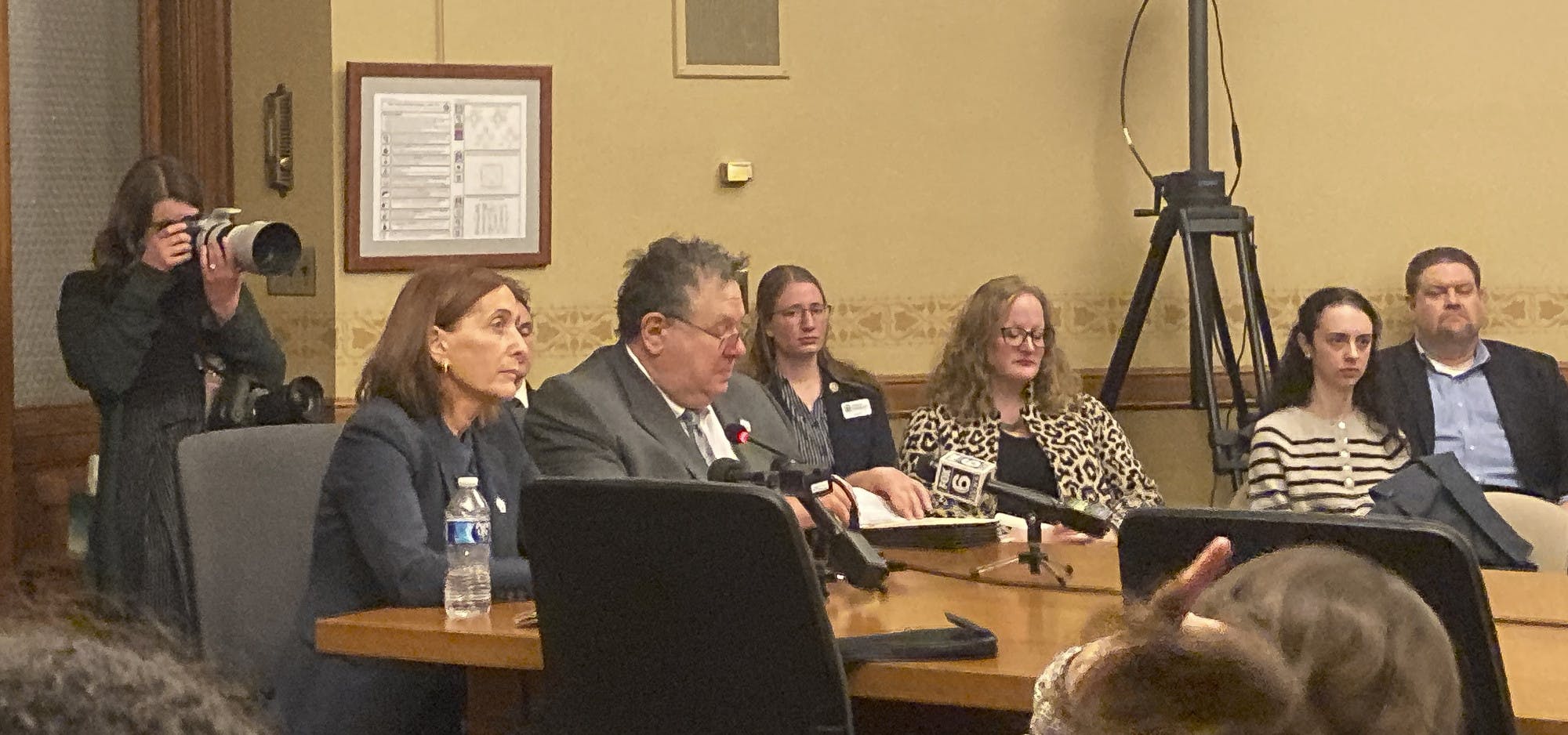
Board of Regents President Amy Bogost and Regent Timothy Nixon answered questions from legislators Thursday, offering the first public explanation of their decision in a hearing called by the State Senate Committee on Universities and Technical Colleges after outcry from Republican lawmakers.
“[Rothman’s firing] was not political, it was not retaliatory, it was unanimous," she said. “Boards of regents do not reach 17-0 decisions on a whim.”
Republican senators on the committee criticized the firing, previously labeling it as “secretive maneuvering” and politically charged, and said the hearing was necessary to shed light on the reasoning for Rothman’s termination.
Sen. Patrick Testin, R-Stevens Point, expressed outrage with the firing, calling for retributive firings of unconfirmed regents.
“Because the Board of Regents decided to remove President Rothman without just cause, I am calling on the Senate to reject every single one of their confirmations,” he wrote in a statement. “As they say, actions have consequences.”
Bogost pushed back, slamming Rothman’s handling of his ouster as “strategic,” “deliberately one-sided” and as causing “real harm” to the UW System.
Sen. Rob Hutton, R-Brookfield, the chair of the committee, questioned the regents’ decision Thursday, saying it raised concerns “not just about transparency, but about how prepared or serious they are about addressing the strategic direction of the University of the Wisconsin system.”
“Firing President Jay Rothman without a clear explanation to the public requires scrutiny,” he said in his opening remarks.
The committee requested testimony from all ten unconfirmed regents who can be dismissed by a state Senate vote. Regents are appointed to the board by the governor and can serve without confirmation. Bogost and Nixon were two of the three regents who were able to be in attendance and have been unconfirmed for six and two years, respectively.
“Republican lawmakers should resist their temptation to turn this into a political conversation, because it isn’t one,” Evers said in a statement lambasting the hearing. “The Regents are responsible for doing what’s best for our UW System, and they should be able to do their jobs without political interference from elected officials.”
Bogost and Nixon spoke broadly about the issues with Rothman’s tenure, chiefly Rothman’s sense of urgency around decisions and his reticence to conduct open meetings, but Bogost said personnel matters discussed in closed sessions are confidential and cannot be commented on unless Rothman chooses to waive the confidentiality of the discussion.
The hearing also allowed them to illuminate the public on the firing process, which Rothman had critiqued as sudden, saying Wednesday morning that he felt “blindsided” by the demand. Bogost said regents had “many discussions” in closed sessions prior to his eventual termination.
Artificial intelligence
One of the clearest reasons Bogost and Nixon gave for parting ways with Rothman was his slow approach to defining and adopting an artificial intelligence policy across the system.
“We need people that have critical thinking skills, that understand AI,” Bogost said, “because we as humans need to control the machine, not the other way around.”
Nixon echoed that sentiment, pointing to Rothman as the obstacle that stood in their way of addressing it.
“There are no regent guidelines or guardrails on AI,” he said. “President Rothman has blocked [creation of guidelines] since November… This has not been brought to us. We've been asking for it since November.”
During the Board of Regents’ February meeting at the University of Wisconsin-Madison, Rothman, having been tasked last November with developing a systemwide approach to AI, presented a 2 hour and 40 minute panel showcasing how various campuses were approaching the subject. The presentation, however, was critiqued by several regents who said it failed to offer actual policy about artificial intelligence.
“I still feel like there is a lack of a cohesive and all-encompassing approach to AI adoption,” Regent Desmond Adongo, one of the two student regents who sit on the board, said at the time. “The concerns that I have continued to raise around the two-tiered educational outcomes based on whether your campus or professor had the opportunity to learn about [AI] and incorporate it still feel unresolved even after seeing all of these great efforts.”
Regents said they wanted Rothman to urgently address AI after speaking to students who said they did not feel prepared by their universities for AI, but felt that Rothman did not share their urgency.
“I always sensed a lack of urgency on some of these issues,” Nixon told the committee. “The answer ‘a year from now,' or 'two years from now,’ is not going to be good enough.”
When dealing with pressing issues, such as AI or building new dormitories, Nixon said discussions were sidelined by the system and deemed ‘third-rail’ or too controversial priorities.
“We can ask for anything, but we can’t necessarily write them or do them or move them along,” Nixon said.
“[The Board of Regents] functionally are captives of the UW system administration and the president.”
While the Regents were brought in front of the committee for a lack of transparency in the firing process, they argued Rothman was equally opaque, overreliant on closed session meetings and often unwilling to converse over email or anywhere else that could leave a paper trail.
“Just because you can go into a closed session doesn't mean you have to,” Nixon said. “What [Rothman] used to tell me was ‘I don't want to agitate individual legislators. I don't want to agitate individual campuses by them hearing this.’”
Looking forward
When Rothman was hired in 2022, the UW System faced a massive structural deficit. In August 2023, 10 of the 13 UW universities had structural deficits ranging from $600,000 at UW-Superior to $15.1 million at UW-Oshkosh. UW-Stout, UW-Madison and the UW-Stevens Point main campus were the only universities not in a deficit.
In his March 26 letter to Bogost, Rothman highlighted that under his tenure, he had worked with chancellors across the UW System to eliminate structural deficits at all 13 universities two years ahead of schedule.
While the Regents acknowledged Rothman’s leadership in managing budgetary issues, they voiced a desire for a visionary leader who could address evolving issues in higher education like AI.
“In a leader, we want someone to see the future,” Bogost said.
What this would look like, she added, is someone who can gather resources for students, faculty and staff and make bold decisions.
The ramifications of this past budget cycle, while delivering an increase in funding for the system, also led to increased teacher workloads and core general education requirements, compromises which have led to a loss of faith in the system’s leadership from faculty.
“Good public policy is not made with last minute concessions behind closed doors,” UW-Madison Assistant Professor of Educational Policy Studies Taylor Odle told The Daily Cardinal in February.
To repair trust with individual campuses and faculty across the system, the next president will focus on the culture of the system, Bogost said.
“We're hoping that the next leader can really be transformative, energetic and work with the board closely so we can accomplish more,” Bogost said.
Despite the difficulties regents said they experienced with Rothman, they were asked by Hutton whether they would do it all again and hire him back in 2022.
For both, the answer was yes.
“I would stick with what we did,” Bogost said. “It's unfortunate we got to this point. I would rather not do this in public, and I apologize for that, but I would say yes, it was a wise decision at the time.”
Annika Bereny is the campus news editor for The Daily Cardinal. She previously served as the special pages editor. As a staff writer, she's written in-depth on campus news specializing in protest policy, free speech and historical analysis. She has also written for state and city news. She is a History and Journalism major. Follow her on Twitter at @annikabereny.