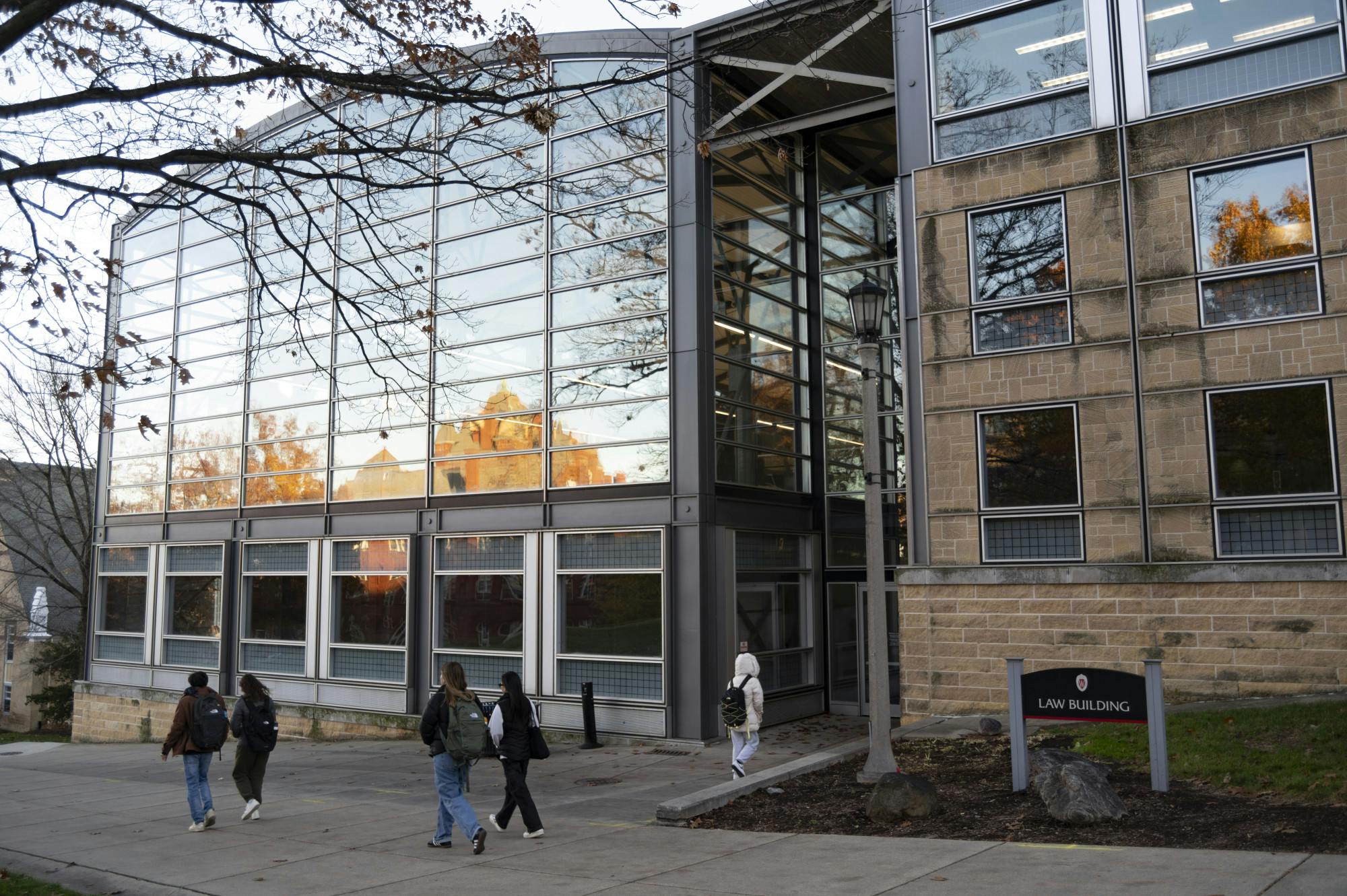
Election experts from across the country discussed why states like Wisconsin are considering redrawing congressional district lines ahead of the 2026 midterms at a panel in the University of Wisconsin-Madison Law School Friday.
The Election Resource Center and the State Democracy Research Initiative hosted the panel where researchers highlighted states with special elections or State Supreme Court decisions that permitted them to redraw congressional district lines ahead of the 2026 midterms.
“This is all truly unprecedented. It may be the most discretionary mid-decade redistricting that we've ever seen,” Nicholas Stephanopoulos, a professor at Harvard Law School, said.
Robert Yablon, a UW-Madison law professor, highlighted how both Republicans and Democrats have gerrymandered districts to help their party. Texas, California, Missouri, North Carolina, Ohio and Utah have already redrawn their maps in this way, and other states are considering changes to their maps. In California, Proposition 50, or the Election Rigging Response Act, was designed to cancel out the redistricting efforts of Texas Republicans and President Donald Trump. Prop 50 temporarily shifted the responsibility of drawing maps from California’s Independent Citizens Redistricting Commission to the State Legislature to allow for more Democratic leaning districts.
For the midterms, Stephanopoulos said the effect of those mid-decade redraws will likely be minimal, saying, “the new gerrymanders that have been adopted around the country have largely offset one another.”
Sara Sadhwani, a professor of politics at Pomona College, was a member of the redistricting commission in California where she said the most explicit offsetting gerrymander was done.
Sadhwani said she endorsed Prop 50 early on as a countermeasure to the actions taken by Texas, noting that she got behind it because “it was done in such a way that the voters of California had a say.”
Stephanopoulos, whose research focus is election and administrative law, said the Wisconsin congressional districts face a different kind of scrutiny from typical partisan gerrymandering accusations. He claimed the state’s congressional maps are uncompetitive. He also said the way the districts are drawn do not favor one party or the other, but rather make every district relatively “safe” for the incumbent party.
“If you ask a computer to spit out thousands of maps for Wisconsin for you, virtually none of those computer-produced maps are ever as uncompetitive as the enacted congressional plan,” Stephanopoulos said.
Stephanopoulos is an attorney for the plaintiffs of a lawsuit filed by Wisconsin Business Leaders for Democracy against the Wisconsin Election Commission. The lawsuit alleges Wisconsin’s maps are the result of an anti-competitive gerrymander, discouraging challengers from running for office and voters from voting in their elections.
Wisconsin Gov. Tony Evers signed new state legislative maps into law after they passed the state legislature in 2024 with bipartisan support following a Wisconsin Supreme Court ruling the old maps were unconstitutional. Experts considered the previous maps to be some of the most “gerrymandered” in the country.
Yablon highlighted Evers’ order to hold a special session next month to consider his proposed resolution amending the Wisconsin Constitution to ban partisan gerrymandering.
The resolution would add two sentences to the constitution’s section on legislative redistricting: “Districts shall not provide a disproportionate advantage or disadvantage to any political party. Partisan gerrymandering is prohibited.”
Michael Li, senior counsel for the Brennan Center for Justice, applauded Evers for raising the issue. However, Li and other panelists agreed the proposed amendment lacked necessary definition.
“It's not quite as robust as moving to a commission which requires, as in California, pan-partisan support. You have support from Democrats, Republicans and Independents,” Li said. “That virtually ensures that the map is not going to be terrible.”
Protecting voting rights
Li said current U.S. Supreme Court precedent allows race-based gerrymandering — drawing districts in a way that disenfranchises some racial or ethnic groups — to be litigated in federal courts under the Voting Rights Act, but not partisan gerrymandering. Li said that inside current federal courts, this distinction between political and racial gerrymandering is often disregarded as party politics because people of color tend to vote together.
Li highlighted the upcoming Louisiana v. Callais Supreme Court case. Phillip Callais is challenging the Louisiana congressional maps, stating their two majority-Black districts are an illegal, racial gerrymander. Li said this case is a critical test for whether Section 2 of the Voting Rights Act, which prohibits a state from weakening the voting power of a minority group, will survive.
“That [decision] could have a devastating impact for communities of color, especially in the South,” he said.
Future of redistricting
The panel agreed that the job of drawing legislative districts needed to be unilaterally taken away from the legislators themselves.
“To me, a very minimal reform is to use independent redistricting in all 50 states,” Sadhwani said.
Stephanopoulos agreed that whatever reform is made, it must be at the national level.
“There's really nothing to support the idea that you can fix a national legislative problem with regional reforms,” he said.
Ultimately, the panel did not have faith that Congress, the Trump administration or Supreme Court would have the capacity or desire to implement such reforms.
“The national unwillingness to deal with partisan gerrymandering impacts all of us, state and nationwide,” Alysa Steenport, a student at the UW-Madison Law School, told The Daily Cardinal after the panel.