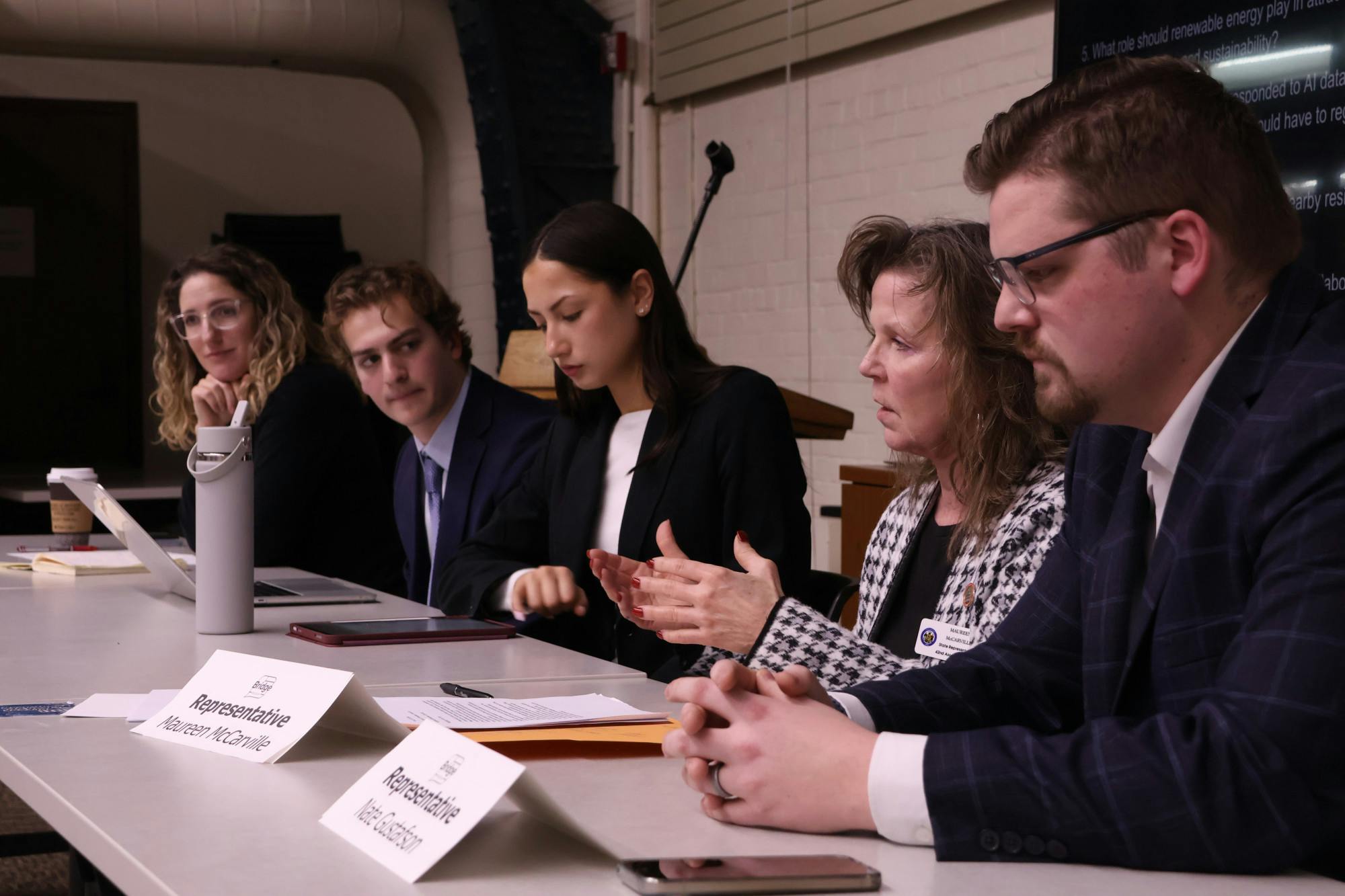
State legislators and an expert from the University of Wisconsin-Madison discussed the implications and future of data centers in Wisconsin at a panel Tuesday, highlighting career opportunities, energy costs and the need for community input.
Wisconsin is home to 51 data centers, with facilities currently being built in Beaver Dam and Mount Pleasant. According to the panelists, the state continues to attract major tech companies looking to build hyperscale data centers.
Rep. Maureen McCarville, D-DeForest, said the economic potential is significant, pointing to the 700 permanent jobs a proposed, and later rejected, data center campus in DeForest was projected to bring to the community. She also highlighted the opportunities these data centers open up for UW-Madison students.
“There are some other opportunities out there, but there are obviously jobs more pertinent within [hyperscale data centers] as well that hopefully some of you [students] are looking to pursue here in the future,” McCarville said. “We're going to need you.”
Rep. Nate Gustafson, R-Winnebago, discussed the importance of obtaining the origins of data used by data centers, stressing that data centers are about the information flowing through them, not just energy or economics.
“The biggest question I have is where the data is coming from and how it's being used,” Gustafson said. “I think that's a massive, massive question we need to continue to actually seek the answer to. We should be all seeking some sort of data privacy. We shouldn’t have a mosaic of our life out there that people can follow and track. That's a really, really big concern as we continue to promote these data centers.”
Even with those concerns, Gustafson said he still believes the projects offer advantages to local communities like jobs, land cleanup and money back into the community.
UW-Madison Data Science Institute associate professor Anna Haensch raised concerns with the potential electrical demands of data centers. In 2024, Wisconsin’s peak demand was 14.6 gigawatts, and the Wisconsin Policy Forum expects it to increase about 17 gigawatts by 2030.
While Wisconsin consumers have consumed less power over the last two decades, Haensch said the state may no longer have the production capacity needed to meet total electrical consumption.
Haensch pointed to Wisconsin’s regional grid operator Midcontinent Independent System Operator’s (MISO) energy preparedness model to emphasize the future of Wisconsin’s energy needs. She said the energy system will have 5% less energy, according to the Department of Energy’s forecast for MISO in 2030.
The panelists all agreed that nuclear energy, while not yet available for a number of years, is likely the answer to clean energy in data centers.
“Nuclear is going to be absolutely the cleanest option that we can get,” Gustafson said.
Additionally, Haensch emphasized the need to separate hyperscale data centers from the broader cultural narrative surrounding artificial intelligence.
“Connecting data centers so explicitly to AI has made these projects almost untenable,” Haensch said, noting that AI is often framed in apocalyptic terms.
She said she believes future scholars will view today’s data center situation as a failure of public communication as much as an infrastructure debate.
“It’s emotionally fraught,” Haensch said. “But that’s human…and I think that towns should get to decide whether they want data centers or not.”
As debates over AI and data center construction continue, Haensch said the most important question may become the simplest: “who gets to decide what Wisconsin becomes?” She said the future of data centers in Wisconsin shouldn’t be determined by kilowatts or job projects, but hinge on the voices of the communities they’re in.