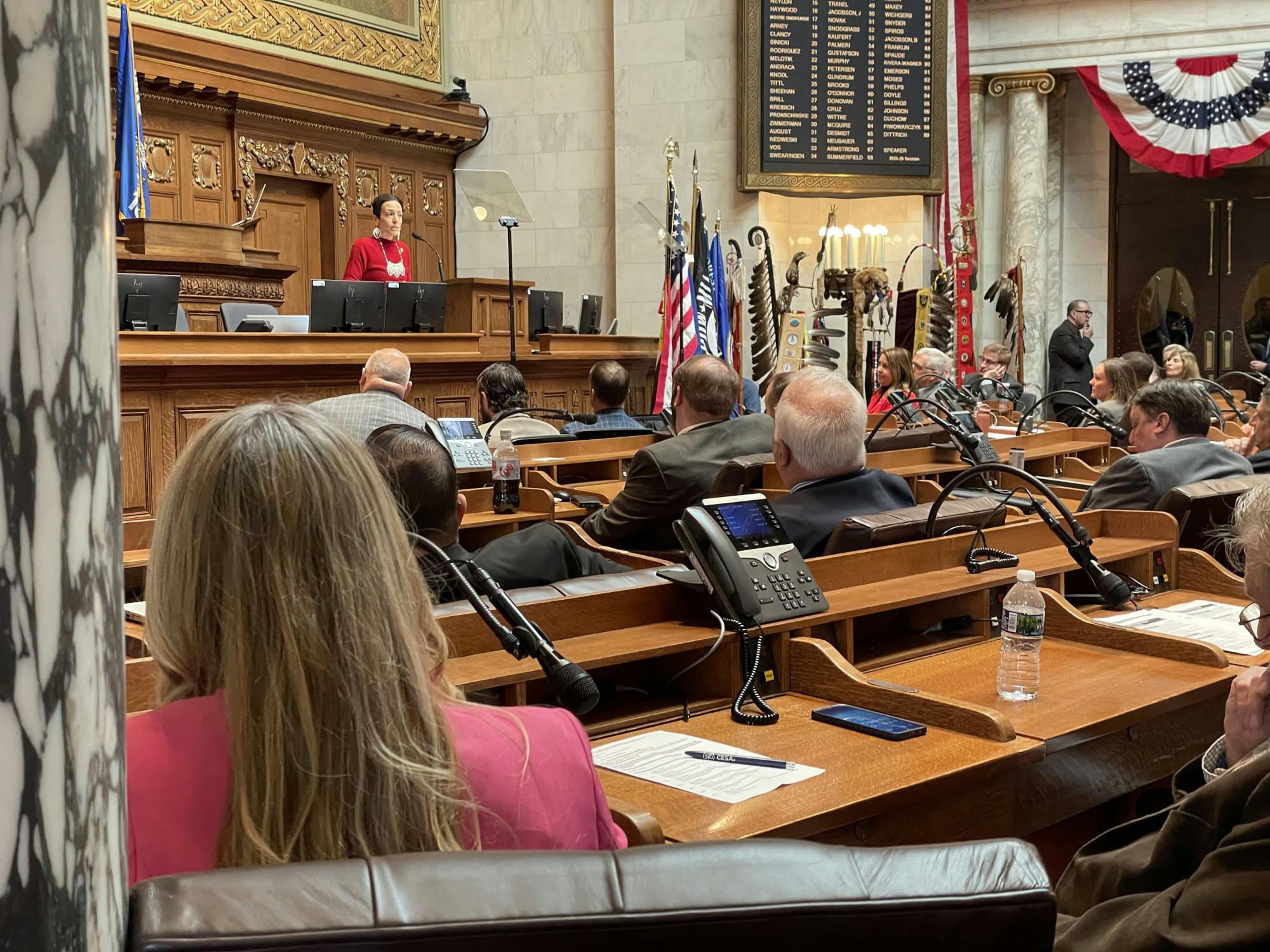
The leader of the Red Cliff Band of the Lake Superior Chippewa Indians highlighted education, environmental protections and health care access at the 22nd State of the Tribes address Tuesday at the state Capitol.
Chairperson Nicole Boyd spoke on behalf of the Great Lakes Inter-Tribal Council, a 501(c)(3) organization that advocates for the quality of life for Native people. Leaders from all 12 member tribes — 11 from Wisconsin and one from Michigan’s upper peninsula — presented to the state Assembly on how they can better assist the tribes.
Education
Boyd spoke on the need for equity across all levels of education, saying she believes education is “crucial for personal growth, wellness and transforming our society.”
23% of Wisconsin’s Native American population lives below the poverty line, compared to 9% of white residents. Boyd said this discrepancy is showing up in schools.
“For most tribal communities, we remain severely disadvantaged,” Boyd said. “Everyone should have equal access to quality education, and kids should have free school lunch.”
Democratic lawmakers sponsored a bill in 2021 which guaranteed free school lunch to all Wisconsin students regardless of income. The bill failed to pass in 2022. There are currently nine states with universal free lunch programs.
Boyd also pushed for deeper investment from higher education into tribal nations, calling for the expansion of the Wisconsin Tribal Educational Promise program throughout the University of Wisconsin System and to the Wisconsin Tribal College.
The Tribal Educational Promise program allows Wisconsin residents who are tribal members pursuing their first undergraduate degree to have their full cost of attendance met through scholarships and grants.
Currently, the program is only available at the University of Wisconsin-Madison. While Boyd applauded that initiative, she said expanding it would allow tribal members to go to school closer to home.
Comprehensive health care
Boyd celebrated the achievements of the tribal nations’ healthcare initiatives, including the Adolescent Recovery and Wellness Center, a 36-bed facility providing substance abuse treatment for Native American youth that opened in 2025. Boyd said the tribal nations have seen a decrease in drug-overdose related deaths.
“We achieved this by meeting people where they are, investing in culturally responsive systems of care and bringing awareness to the path of recovery,” she said, but stressed that while the tribal nations are happy with these successes, there remains an ongoing mental health crisis.
A 2024 report from the National Center for Health Statistics found Native Americans were 11% more likely to report having a mental illness, and in 2022, Native Americans were 91% more likely to die by suicide than the national average.
“We all know people suffering and grieving the loss of a loved one, and we can all do better to bring awareness and prevention efforts to the top of our priorities,” Boyd said.
Environmental advocacy
Boyd centered her environmental advocacy on the tribal nations’ responsibility as caretakers of their land and asked to be consulted on matters that potentially impact their ecological well-being.
She pointed to the relocation of Enbridge’s Line 5 pipeline. A federal judge ordered the pipeline — which currently runs through tribal lands — to either relocate or shut down by June of 2026. In late 2025, the Bad River Band of Lake Superior Chippewa sued Enbridge over the proposed relocation, citing alleged violations of environmental law and threats to their supply of clean water.
“Why is it wrong to expect that feasibility of projects of this magnitude be ecologically sound?” Boyd said. “We need water. As a mother, I beg you to join us in protecting the very resource that brought you, me, our children, our grandchildren and future generations into this world.”
Boyd gave praise to Gov. Tony Evers for his cooperation and advocacy for the tribal nations of Wisconsin, saying his “legacy of public education support will never be forgotten.”
In her closing remarks, Boyd advocated for continued partnership between tribal and state governments, while also standing in solidarity with the tribes of Wisconsin.
“This is the kind of unity that creates change,” Boyd said. “We have more in common than we know.”