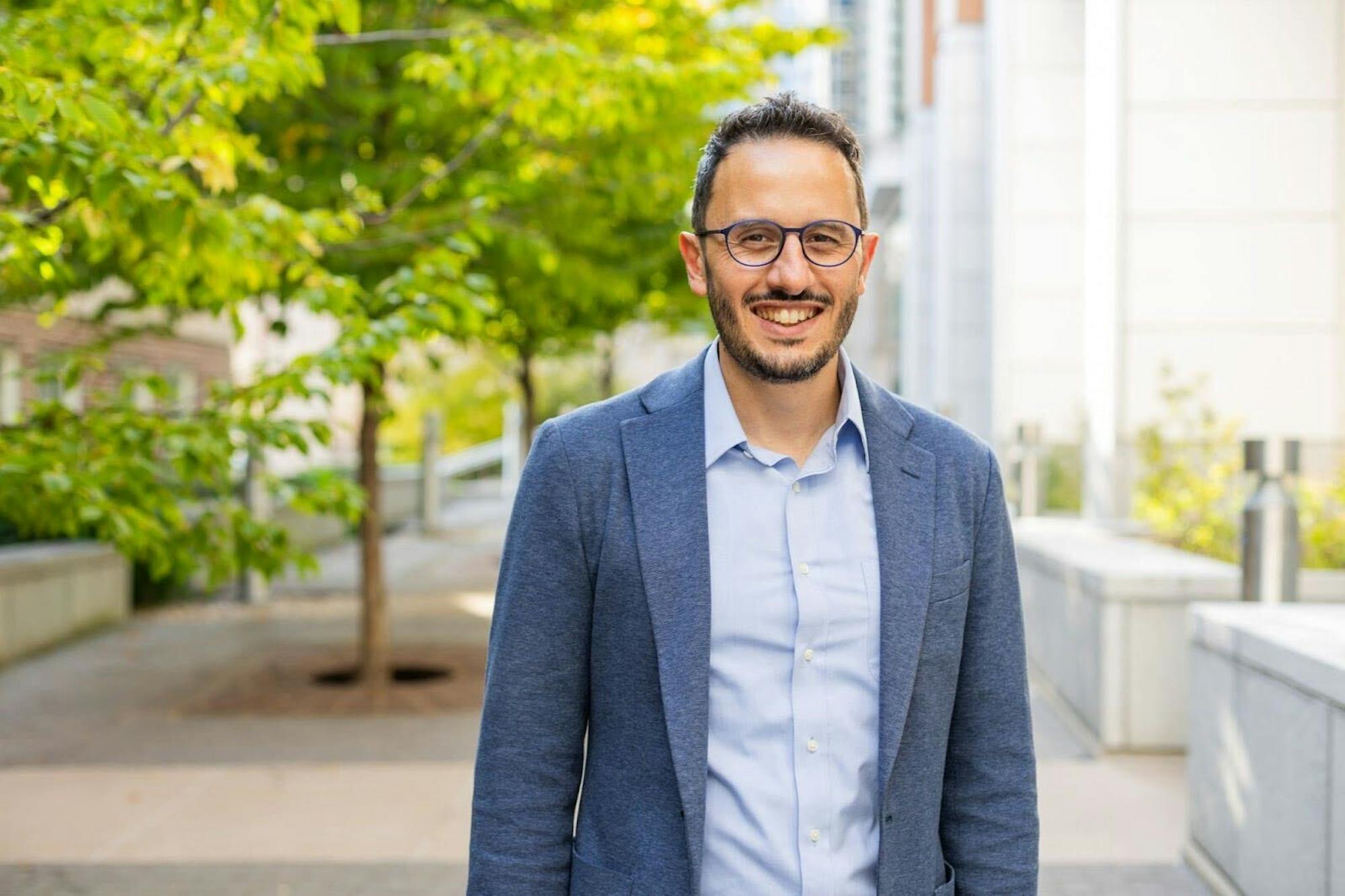
Sébastien Philippe, a 2025 MacArthur Fellow, spoke to The Daily Cardinal about designing simulations that evaluate nuclear fallout.
When he ran his first simulation mapping nuclear fallout across the United States in the case of a missile attack, the results were so large in scale and disturbed him so greatly that he couldn’t work for the rest of the day. Wisconsin residents would face significant risk in a nuclear attack, according to his simulations, with Madison residents specifically facing an average outdoor dose of 0.09 Grays across four days of nuclear fallout, almost double the annual limit for radiation workers.
‘The Missiles on Our Land’ project explores national nuclear fallout risk
Philippe, an advocate of non-proliferation, said the risk of nuclear war has returned “really seriously” since the Russian invasion of Ukraine. The only remaining nuclear arms control treaty between the United States and Russia, the New START Treaty, is set to expire in February 2026.
“After that, there is nothing planned,” Philippe said. “Nothing, at this point, to prevent a new arms race — the Chinese government is [also] developing more nuclear weapons. We're really entering a new era of arms racing and nuclear competition.”
Philippe’s recent project The Missiles on Our Land uses computational simulations to measure the risk to United States residents in the case of nuclear war, specifically studying the potential consequences of a nuclear attack on U.S. missile infrastructure. Philippe mapped the fallout across North America, finding nearly every state could be affected.
The average death toll of his 2021 simulations was 1.4 million and states affected varied widely per simulation, with wind direction as the major differing factor.
The U.S. currently stores 3,748 nuclear warheads, concentrating its 450 intercontinental ballistic missile launch facilities within five states in the rural Great Plains: North Dakota, Montana, Wyoming, Colorado and Nebraska.
“These [silos] are fixed targets, for which one of the only remaining arguments to keep them is for them to serve as a sponge, or as targets, in case of a nuclear war — they're meant to be attacked,” Philippe said.
Destroying the silos requires detonating other nuclear weapons nearby that are near or at ground level, spawning large, radioactive mushroom clouds. Philippe used “modern atmospheric transport techniques”, weather data and a mushroom cloud model to simulate the mushroom clouds’ radioactive fallout across North America.
Frequent attacks could spread radioactive material not just within the United States but also throughout Canada and Mexico, according to Philippe’s simulations.
“The levels of radiation could be so high that they would bring massive, massive destruction and harm to not only the U.S., but even Canada and Mexico,” Philippe said.
To reduce the risk of nuclear war, Philippe recommended eliminating the nuclear warheads entirely.
“I think these particular weapon systems are a relic of the Cold War, and they have little to no military and national security utility, so I think you should just scrap them and get rid of them,” Philippe said. “From a national security point of view, still to this day, the platform that is the least vulnerable is nuclear submarines.”
The U.S. plans to phase out the Minutemen warheads, but replace them with similar land-based Sentinel warheads starting in 2030 — a program Philippe described as troubled, with an “absolutely enormous” cost slowing progress. Philippe generated a cost estimate for the warhead replacement, finding that the Congressional estimate was lower, differing from his by “almost 100%”. He suggested submarines as an alternative to land-based nuclear weapons systems.
“If some people really want to keep the same number of weapons in the US arsenal, they can just… deploy more on submarines,” Philippe said. “So there is literally nothing that prevents that program from being canceled.”
To effectively convey his information, Philippe wrote an article in Scientific American and hosted a podcast with Princeton undergraduate Ella Weber, who is Native American, about the history of nuclear warheads on tribal lands.
Reconstructing nuclear fallout, verifying non-proliferation: Other highlights of Philippe’s career
All of Philippe’s degrees are in engineering: his most recent degree, in 2018, was a PhD in mechanical and aerospace engineering at Princeton University.
“I love science, physics, engineering,” Philippe told The Daily Cardinal. “I love designing things, and designing technologies, and [engineering] was a very natural path for me. I never really thought about, necessarily, where it would lead me.”
Philippe’s father served on a nuclear submarine in the French Navy. His proximity allowed Philippe to develop an interest in nuclear technology earlier than most.
“I knew how a nuclear reactor worked since I was in kindergarten,” Philippe said. “And same thing with nuclear weapons… I think the first time I was on nuclear submarines was probably five years old. So I carried this with me as a deep interest.”
During his undergraduate and master’s years in France, Philippe resolved to follow his interest in nuclear security “as far as [he] could.” He attended an international nuclear weapons and security conference hosted by the Union of Concerned Scientists in Massachusetts, which led him to an international non-proliferation conference, this time organized by the United Nations.
At the United Nations conference, he spoke to a group of researchers at Princeton’s Program of Science and Global Security: “I was mind blown by the work they were doing.” Philippe’s early work at Princeton included designing a non-proliferation verification method, which allows the United Nations to confirm the absence of nuclear warheads without the need for a country to compromise sensitive military information.
Now, Philippe has been appointed by the United Nations to serve as a nuclear security expert, producing a nuclear risk assessment report, the first in 40 years, in tandem with 20 other scientists. The report is set to be presented at the 2027 UN General Assembly.
“What I really hope to do is contribute to not only the content of the report, but also its delivery at the UN and more globally, to inform the public on nuclear risks today and eventually a potential path to address this risk internationally,” Philippe said.
Though non-proliferation efforts have had some success since the 1960s, reducing the number of nuclear weapons from over 60,000 to an estimated 12,241 in January 2025, it has by no means accomplished all of its goals. Across the globe, experts estimate over 2,000 nuclear weapons are on “high alert,” ready to be launched at any given moment.
“I think governments need to decide that it is not in their interest to go into arms races, and that our collective security would be better served if the number of nuclear weapons in the world was going down, not going up,” Philippe said.
Though Philippe plans to focus on nuclear war security, other professors in UW-Madison’s nuclear engineering department research nuclear energy and fusion applications. Philippe said the risk of nuclear reactors for energy is far lower than the risk incurred in the case of “thermonuclear war”, but suggested bolstering the U.S. Nuclear Regulatory Commission, which performs safety analyses before allowing companies to build nuclear technology.
“We’ve seen some erosion around regulations in this country right now, and the future of nuclear energy really depends also on having that strong and smart regulatory framework in place,” Philippe said.
Sonia Bendre is the campus news editor for The Daily Cardinal. You can reach her at sonia.bendre@dailycardinal.com.