The University of Wisconsin-Madison partnered with biotechnology company TAE Life Sciences to launch the first clinical site for Neutron Capture Therapy (NCT) in the United States, positioning the university as a national leader in cancer innovation.
Led by Dr. Zachary Morris, chair of the Department of Human Oncology, the initiative introduces a treatment that Morris says is faster, more precise and less invasive than traditional cancer therapies.
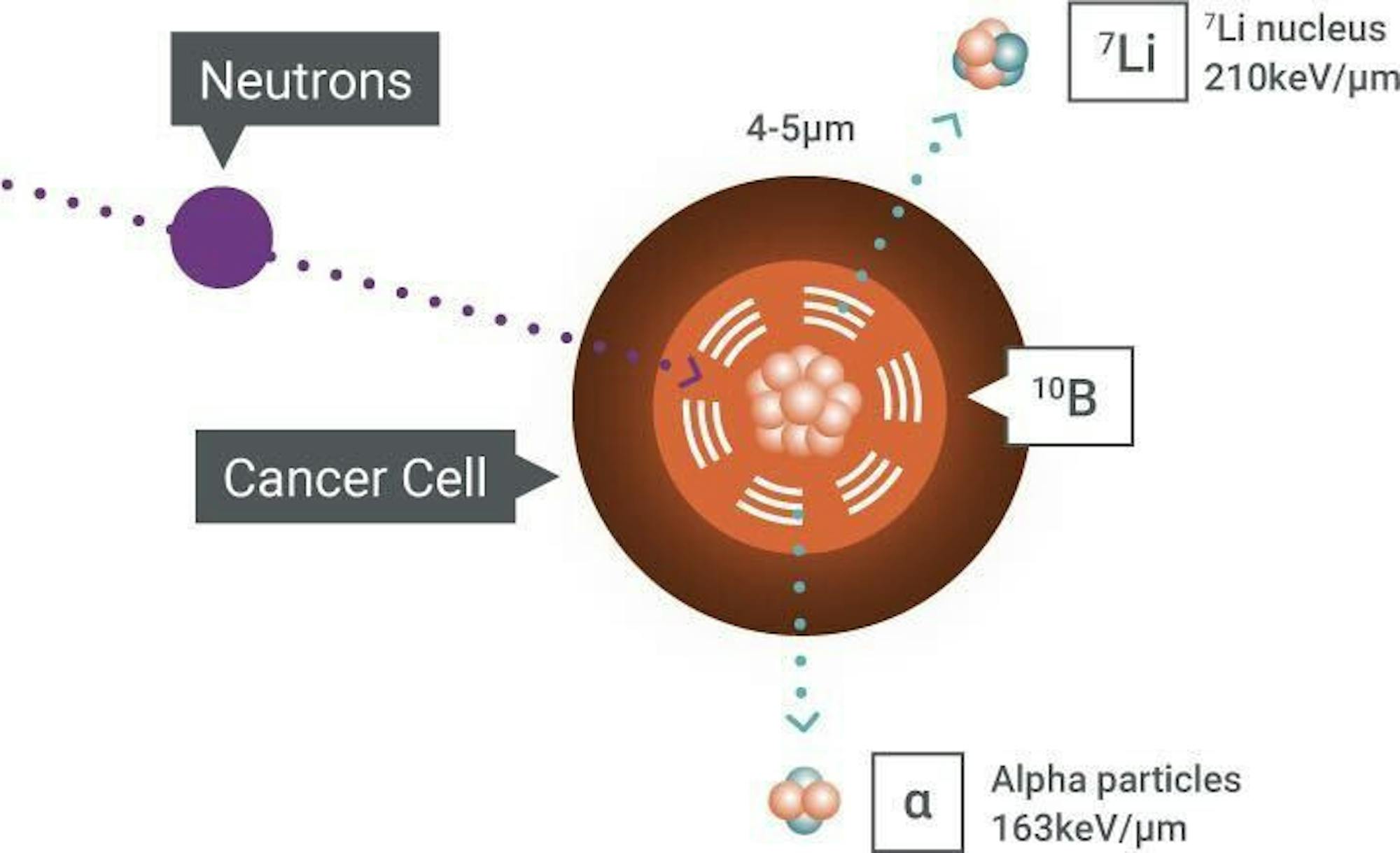
NCT is a targeted treatment that begins by generating a neutron beam using a particle accelerator. The patient is first given a drug containing atoms like boron-10, which accumulate in the tumor cells. When the neutron beam is directed at the tumor, the neutrons are absorbed by these atoms, triggering a reaction that releases high-energy particles. These particles then destroy nearby cancer cells with minimal damage to surrounding healthy tissue.
“When a neutron hits certain atoms, it can actually combine with that atom in a high-energy nuclear fusion reaction,” Morris said. NCT combines two advanced approaches: theranostics, which merges diagnostics and therapy and uses radioactive drugs that selectively bind to cancer cells, as well as particle beam radiation.
The process begins with the intravenous injection of a non-radioactive pre-drug containing boron-10, a stable isotope, that then accumulates in tumor cells. When the neutron beam is applied to the tumor, it interacts with the boron atoms, triggering a localized burst of radiation that destroys cancer cells while sparing healthy tissue.
“That’s what makes this so interesting,” Morris said. “You can take a small amount of radiation with a neutron beam, and when it hits a drug that might be concentrated in a cancer cell, it can emit a lot of additional radiation.”
Boron-10 is central to the therapy’s success
“Boron has what’s considered a fairly large cross section for a neutron,” Morris said. “As a neutron is traveling through material, certain atoms appear very small and the neutron’s going to miss them. But other atoms have a big cross section, which allows them to absorb a neutron more [commonly].”
He added, “Boron’s the one where we have the most clinical experience to date because of its cross section and its availability, and we can use it to label drugs using chemistry that is generally straightforward.”
Unlike chemotherapy or traditional radiation, NCT offers a targeted approach with minimal side effects. “With neutron capture therapy, boron is not radioactive — it’s not a chemotherapy,” Morris said. “So the drug will still go to those places, but it won’t cause damage in the kidney or the liver, because the drug only gets activated where the beam hits.”
This precision allows for a streamlined treatment experience. Once clinical trials are underway, patients can receive the boron-labeled drug and undergo neutron beam therapy within hours, completing the entire course in just one or two sessions.
“We could have a very effective drug at all these tumor sites without hitting the spots where the drug would normally cause side effects,” Morris said. “Because it’s a pre-drug when administered, and then when the beam activates it, it becomes a drug.”
With plans to install a new Alphabeam accelerator system small enough to be housed in a hospital setting, UW-Madison’s Midwest location and proximity to an airport make it a highly accessible destination for patients nationwide.
Now, with the university’s partnership with TAE Life Sciences, Morris said they are a giant leap closer to bringing this technology into Madison. The key steps left are funding, construction and receiving FDA approval for using the beam in clinical trials.