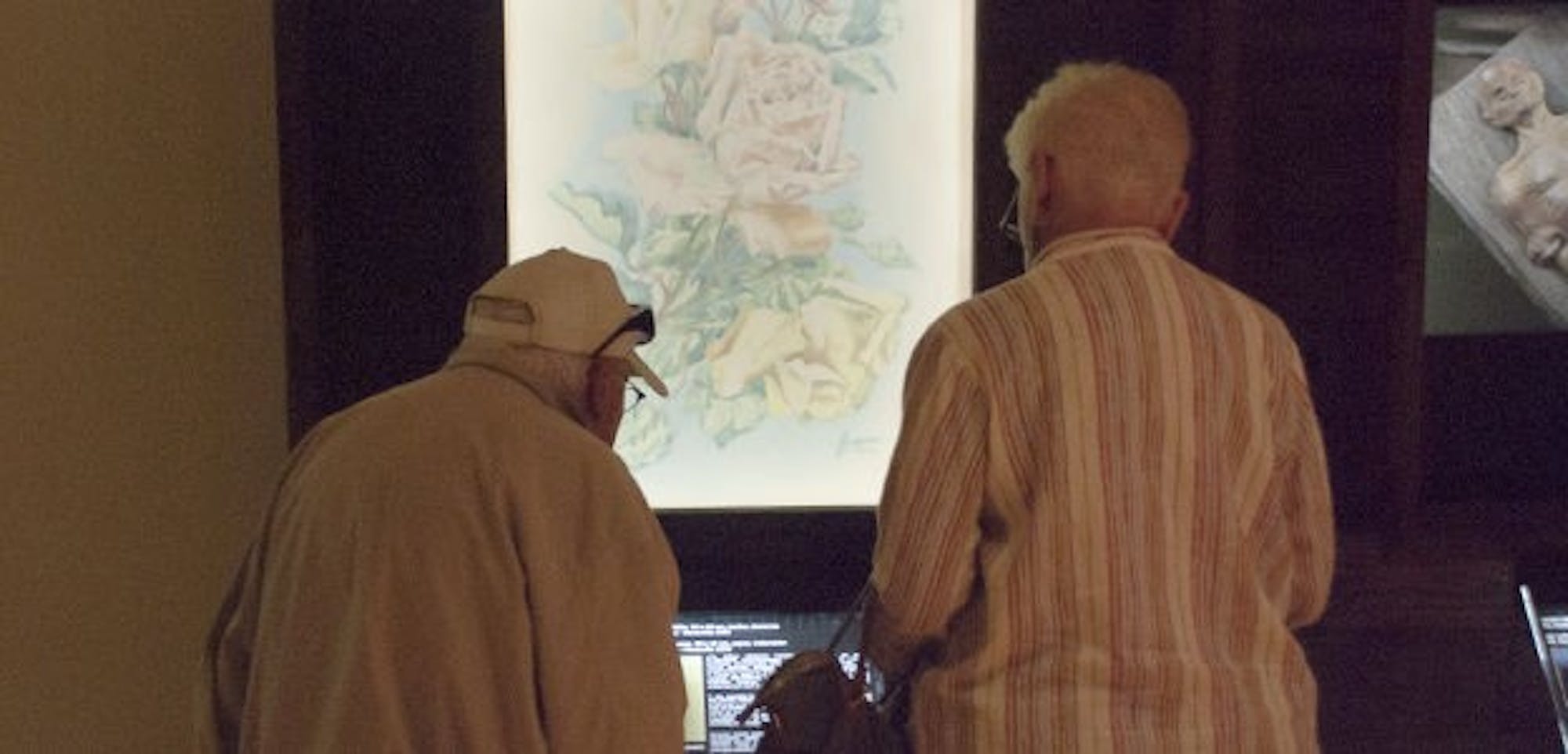
It’s weirdly affecting; it demands silent reverence as much as invested conversation, walled in by stained, hardwood frames, images of sketches and figures telling a story of humanity during one of history’s greatest tragedies. The space closes in around the exhibit, fostering intimacy with the portraits and figures as one makes their way around the room. Plaques tell their stories, while glass encases two recreations in the center of the room. A scroll faces the front room, messages of remembrance and reaction scrawled across it.
In the back, a sketched self-portrait of a man dressed in rags with a suited business man standing over his shoulder, is a fleeting reminder of a long-ago time. A gate in its background reveals where he is, its arch delivering stern philosophy: Arbeit Macht Frei—Work sets you free. With that, the room takes shape; its hardwood and orientation coming together into the confines of an empty barracks. The images take life, some as reflection and others as escape.
Tucked into the Porter Butts Gallery on the second floor of the Memorial Union, Forbidden Art showcases 20 images of artwork recovered from the land around Auschwitz-Birkenau, ranging from comedic caricatures of Nazi captors to a hand-crafted sarcophagus. The 20 pieces were selected to represent to full spectrum of art found at the concentration camp, part of a collection of roughly 2000 pieces currently kept at the Auschwitz-Birkenau State Museum.
Organizing Forbidden Art and bringing it to the United States was the work of the Polish Mission of Orchard Lakes Schools and the Auschwitz-Birkenau State Museum. The tour found a surprise home in Madison’s Memorial Union thanks to WUD Art and the Polish Heritage Club of Madison.
“The Polish Heritage Club of Madison reached out to us because they really wanted to bring this exhibit to Madison,” WUD Art Committee Director Kelsey Burnham said of the effort. “By happenstance, we had a gallery open because of the delay of a year of the Memorial Union renovations.”
The collaboration behind Forbidden Art’s stay in Madison underscores what Burnham describes as a great start to WUD Art’s year.
“We’re really focused on collaboration, and these are some pretty great people to collaborate with,” Burnham said of the exhibit. “It really sets the tone for what I want the committee to do this year.”
The exhibit opened with two speakers, both of whom praised Forbidden Art’s ability to speak for the unspeakable and preserve the history of one of humanity’s greatest crimes.
“[The artists] reveal the most intimate aspects of camp life,” J.J. Przewozniak, assistant to the Polish mission director and one of those responsible for Forbidden Art’s tour, said of the exhibit during his presentation.
Przewozniak specifically referenced a book of sketches from an artist known only by his initials “M. M.,” whose sketchbook provides some of the only glimpses of Nazi atrocities committed at the camp due to a ban on photography. In the exhibit’s excerpt of M. M.’s records, a family is being broken apart by a stoic-faced SS officer; a father reaches out to his child as they’re pulled apart.
“[Forbidden Art] speaks in voices we weren’t supposed to hear,” Dr. Rachel Brenner, professor of Hebrew and Semitic Studies at UW-Madison, said when she took to the podium after Przewozniak, praising those whom she called “chroniclers” that presented a terrible history that “transcends the powers of imagination.”
“It’s an extreme testament to humanity,” Przewozniak said after the reception. “When you see the artwork, you see a very rare glimpse into the prisoners themselves. Into a very personal and a very honest thing that’s just as real as you and I talking right now.”
Surrounded by the images of camp life and its escapes, a large scroll lies outstretched on a table. Written across it are emotion-rich reactions to Forbidden Art’s story, gathered as it has traveled the country. It’s to be presented at the United Nations when Forbidden Art stops there to commemorate the 70th anniversary of the camp’s liberation.
“I want everyone in Madison who comes to Forbidden Art to sign the scroll,” Przewoniak said of the centerpiece. “This scroll, it’s the voice of the United States, the voice of the people who have seen Forbidden Art. And I want people to contribute to that. I want people to make their mark and fill it up as much as possible.”
Forbidden Art will be in Madison until October 5, after which it’ll travel to the Polish Museum of America in Chicago and then the United Nations in New York City for its last American stop.