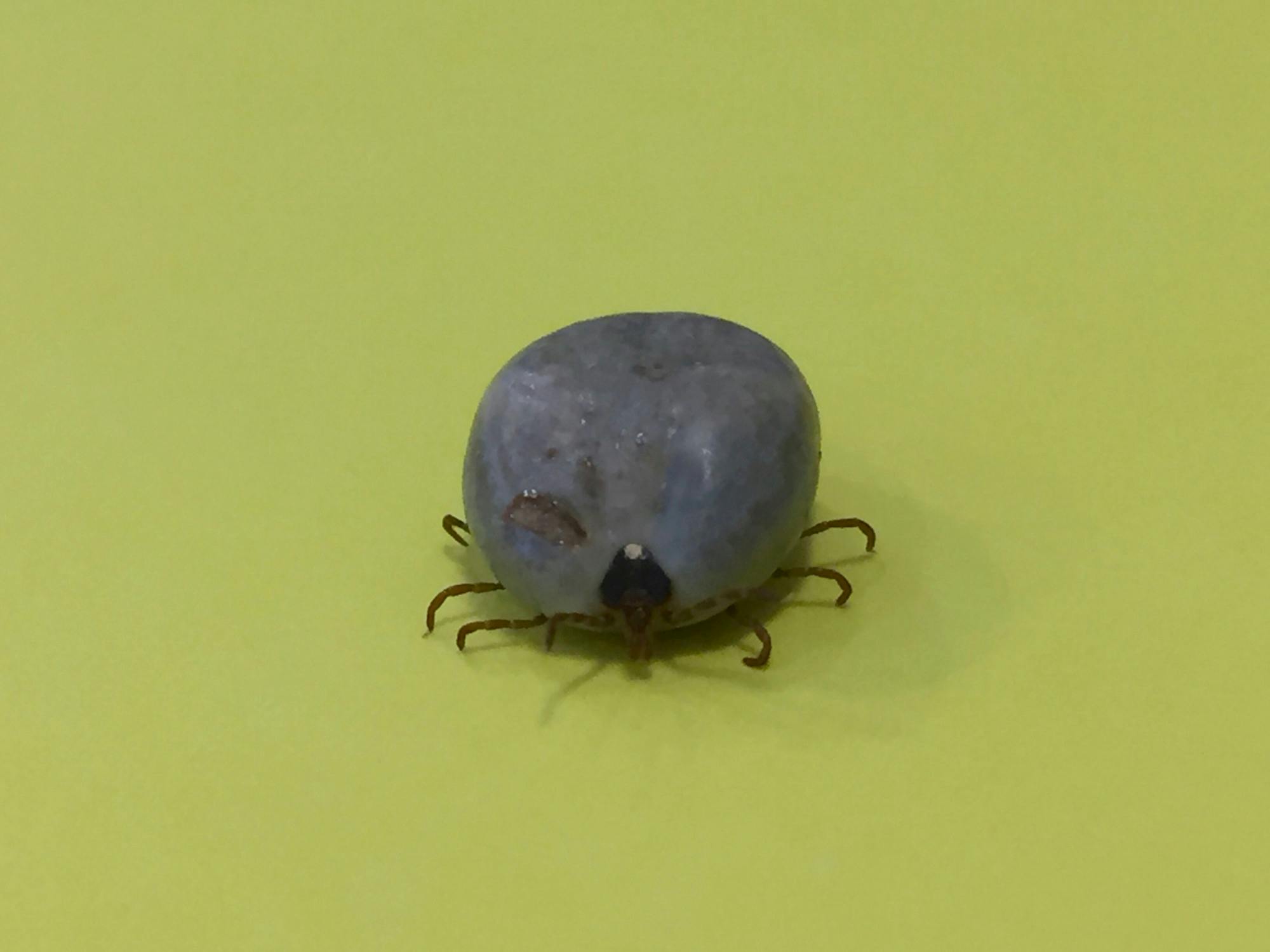
Nearly 6,000 ticks were collected annually in 2024 and 2025 from residents all over the state, representing almost every Wisconsin county. The ticks collected were sent in as part of Marshfield Clinic’s Tick Inventory via Citizen Science project.
Wisconsin recorded a record 8,929 cases of Lyme disease in 2025, and in the past two decades reported cases have increased by more than 400%. Researchers at the Marshfield Clinic Research Institute are turning to the public to help understand where the ticks carrying the disease are found and what other pathogens they may carry.
Through public tick donations, Marshfield researchers collect specimens from across Wisconsin and other states, hoping to gather enough ticks for a microbiome study, according to Alexandra Linz, associate research scientist at the Marshfield Clinic Research Institute.
“If I'm out tick dragging, I can only hit so many locations. It just takes a couple hours to do each one. But from citizen scientists, we get ticks from 13 or 14 different states. So it covers a lot more ground than we could cover by ourselves,” Linz told The Daily Cardinal.
Before Marshfield Clinic adopted a community approach, it collected ticks by “dragging,” which involved pulling a meter-square cloth along vegetation to see what grabbed on. Linz said this method can provide inconsistent results, as the number of ticks collected varied widely.
People can request collection kits by emailing tics@marshfieldclinic.org. After finding a tick, put it into the container and complete a short survey on where the tick was found, adding to a growing database.
Linz, a microbiologist by training, originally began the program to study the microbiome of ticks — the communities of microorganisms that live inside them which requires hundreds of ticks.
“I wanted to see if there were any characteristics of the non-pathogenic microbes in a tick that might influence whether or not it also carries a pathogen,” Linz said.
In 2025, Marshfield Clinic began pathogen testing and found Borrelia burgdorferi, the bacterium that causes Lyme disease, in more than 50% of the adult female deer ticks they tested.
Researchers also found geographic differences in the prevalence of Lyme-causing bacteria in the ticks. Among Wisconsin’s four ecoregions they analyzed, the Driftless region of southwestern Wisconsin had the highest proportion of bacteria-positive ticks at 62%, although most samples came from state parks that may not represent the entire ecoregion.
The statistic doesn’t mean a person has a 50% chance of developing Lyme after a tick bite; transmission depends on many factors, including how long the tick has been attached to skin, Linz said. The Centers for Disease Control said infected ticks usually need to be attached for more than 24 hours.
In addition to Lyme disease in deer ticks, researchers are monitoring Lone Star ticks who have increasing populations in southern Wisconsin. They are more commonly associated with southern states.
Lone Star ticks do not carry the bacteria that leads to Lyme disease but have been associated with alpha-gal syndrome, a condition that causes an allergy to red meat and can last for years, Linz said. New bites can reactivate the allergic reaction, according to the CDC.
Lone Star ticks have established populations in Illinois, raising concerns they could continue to move north. The ticks Marshfield researchers found are adults, Linz said.
Because they haven’t found younger Lone Star ticks, it’s impossible to determine yet if they’ve established a population or hitched a ride from the South.
Cold winters prevent Lone Star ticks from establishing permanent residence in Wisconsin, Linz said. But warmer winters could allow the ticks to survive and reproduce farther north.
Preventative measures against tick bites include regular tick checks and wearing pants tucked into your socks and long-sleeve clothing, according to Linz.
“It looks really dorky, but it means the ticks have to crawl all the way to your neck to find skin,” Linz said.
If you do find an attached tick, the best way to remove it is by using tweezers to grasp the tick close to the skin and pull it straight out without twisting. Afterward, the area should be cleaned with soap and water or alcohol, according to the CDC.
Linz said using tweezers is important to ensure you get the whole tick out, as using fingers or twisting can cause the tick’s mouthparts to break off and leave harmful bacteria behind.