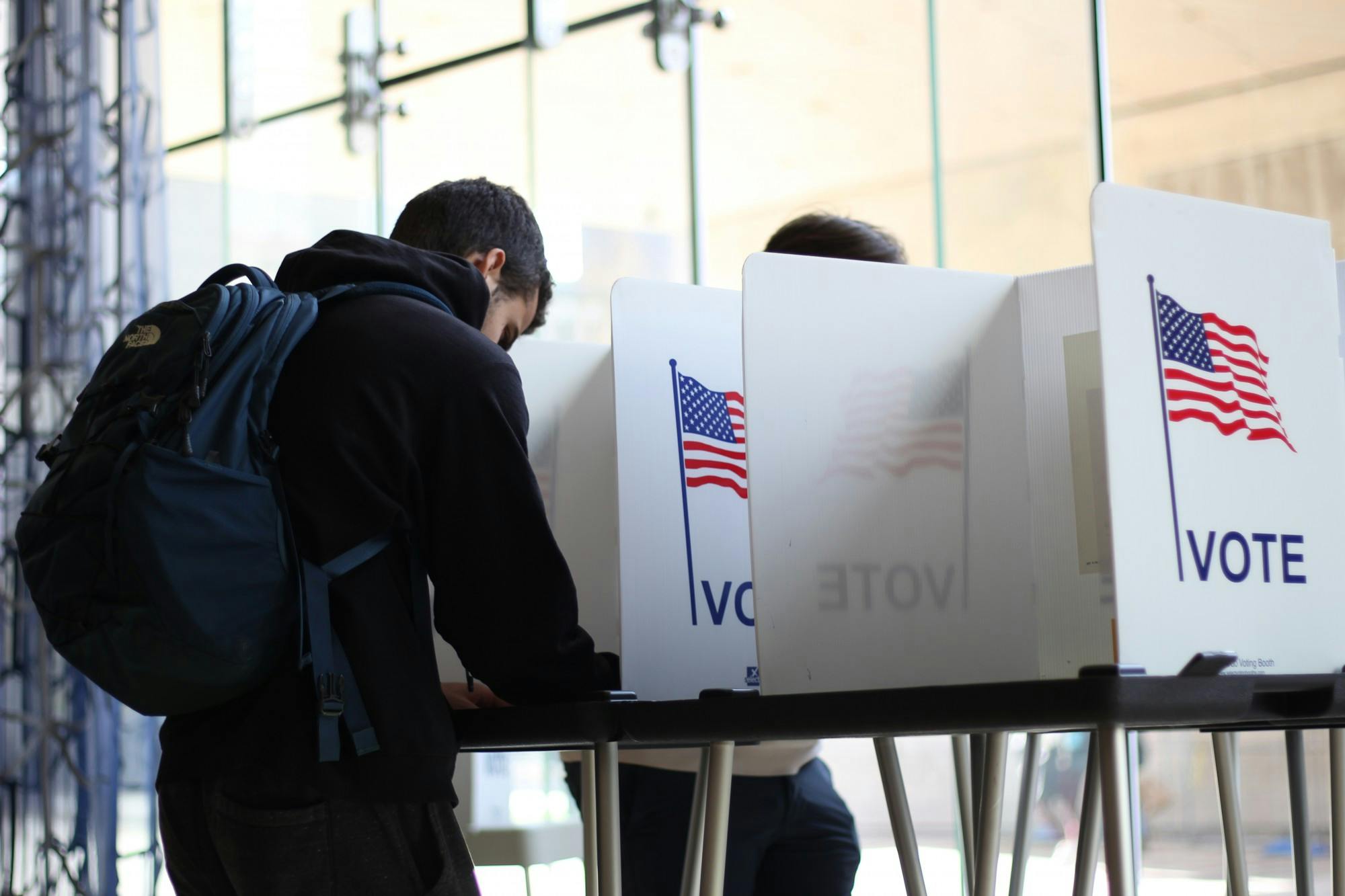
Wisconsin’s electorate has become increasingly polarized with fewer voters crossing party lines. Yet, the state remains one of the country’s most competitive political swing states.
That tension was central to the remarks from Craig Gilbert, a Wisconsin political reporter for the Milwaukee Journal Sentinel and former Washington Bureau Chief, who spoke at the Rotary Club of Milwaukee about the factors shaping the 2026 midterm elections on Sept. 29.
Drawing on historical voting patterns, polling and changes in the state’s political geography, Gilbert detailed that Wisconsin’s competitiveness has persisted throughout recent decades even as its electorate has become less likely to move between parties.
Gilbert also said Wisconsin voters have become more consistent in their partisan choices over time.
Ticket splitting, where voters choose candidates from different parties for different roles in the same election, has declined. Partisan divisions increasingly correspond with geography, particularly between urban and rural areas.
For decades, Wisconsin has been a swing state. However, political divides have become increasingly noticeable along county lines and voters have been changing positions from election to election. In recent elections, there has been deviation away from this.
“Some of the fault lines in the electorate are deeper than they used to be. There’s a much deeper urban-rural divide, a big education divide. Geographically we’re more polarized, people tend increasingly to live in politically like-minded places,” Gilbert said.
Such trends have made elections less likely to see large swings, Gilbert said, because “there are fewer swing voters. And people are more consistent in how they vote for one party or another.”
With fewer voters moving between parties, changes in statewide results increasingly depend on changes in turnout.
Yet the increasing polarization of Wisconsin’s electorate has not eliminated the state’s competitiveness. Gilbert said while voters and the electorate are less “swingy,” this often encourages voters to vote.
“The miracle of Wisconsin to me is…that it has remained so close despite so many big changes in voting patterns, politics and somehow the gains one party has made have been cancelled by the gains the other party has made,” Gilbert said.
Gilbert said Wisconsin’s close statewide margins therefore do not necessarily indicate an electorate filled with undecided voters. Instead, increasingly stable partisan coalitions can produce close elections while having a nearly even divide, since neither party has a decisive advantage across the state.
“Culturally, we’re a high participation state. But also, when you’re as competitive as Wisconsin is, people are spending a lot of money mobilizing voters, and voters understand what the stakes are, and that really drives up the participation numbers,” Gilbert said.
Concerning the 2026 midterms, Gilbert explained how many factors have changed in Wisconsin.
“Overwhelmingly, the president’s party almost always loses ground in midterm elections.” Gilbert said. “People are voting against the people in charge, and usually the voters in the out-party are more motivated than voters who align with the party in power, so they turn out at higher rates and swing voters tend to vote against the party in power.”
According to Gilbert, if Republicans plan to see gains during the midterms, they “have to persuade a number of voters who don’t like the president, or don’t think the president is doing a good job, to vote for the same party for governor.”
Graphs detailed that President Donald Trump’s disapproval rating has risen to 59%, while his approval rating is 38%.
Gilbert emphasized presidential approval as one factor shaping the electoral environment, noting voters who disapprove of the president can be motivated to turn out even when they are not strongly supportive of the opposing party.
This makes turnout especially significant in a state where elections are often decided by incredibly narrow margins, like Wisconsin.
Democrats are heavily targeting state government this year, hoping for a trifecta between the Assembly, Senate and governor’s seat.
Republicans have controlled the Legislature for 16 years, but this year, more seats are likely to flip due to new maps drawn in 2024. The Assembly needs to flip five seats, while the Senate only needs to flip two to gain a majority.
Gilbert said independent voters are also likely to play an important role, particularly those who lean towards one party but have less strong partisan ties.
“In order to win an election, you either have to win independents, or the turnout wars, or you have to have a unified party behind you more than the other party,” GIlbert said.
He cautioned against treating polling as a precise description of election results, especially in Wisconsin where decisions can vary by as little as one point. Polls, Gilbert said, are “meant to tell you trends and patterns and give a general picture. But you can't think of a poll in a 50/50 state in a competitive election as being predictive.”
Staff writer