During a campus visit from Sept. 28-30, University of Wisconsin-Madison alumna and animal activist Madeline Krasno spoke about her experience working at a university primate lab and her lawsuits after the university hid her comments about animal research on social media.
Krasno tabled at Library Mall and spoke at the law school during meetings hosted by UW-Madison’s Animal Legal Defense Fund Club and Animal Advocacy Club. Students and community members gathered to hear her accounts of her time at the Harlow Center for Biological Psychology from 2011-2013. Krasno shared details of her care for the monkeys, the culture she experienced at the labs and two lawsuits she brought against the university and National Institutes for Health (NIH) after a case of social media censorship.
Krasno joined UW-Madison’s Harlow Center for Biological Psychology — one of two major primate labs on campus along with the Wisconsin National Primate Research Center (WNPRC) — as an undergraduate, believing it would help her achieve her dream of working in primate conservation. She said conservation had long been her dream, driven by a love of monkeys and Jane Goodall.
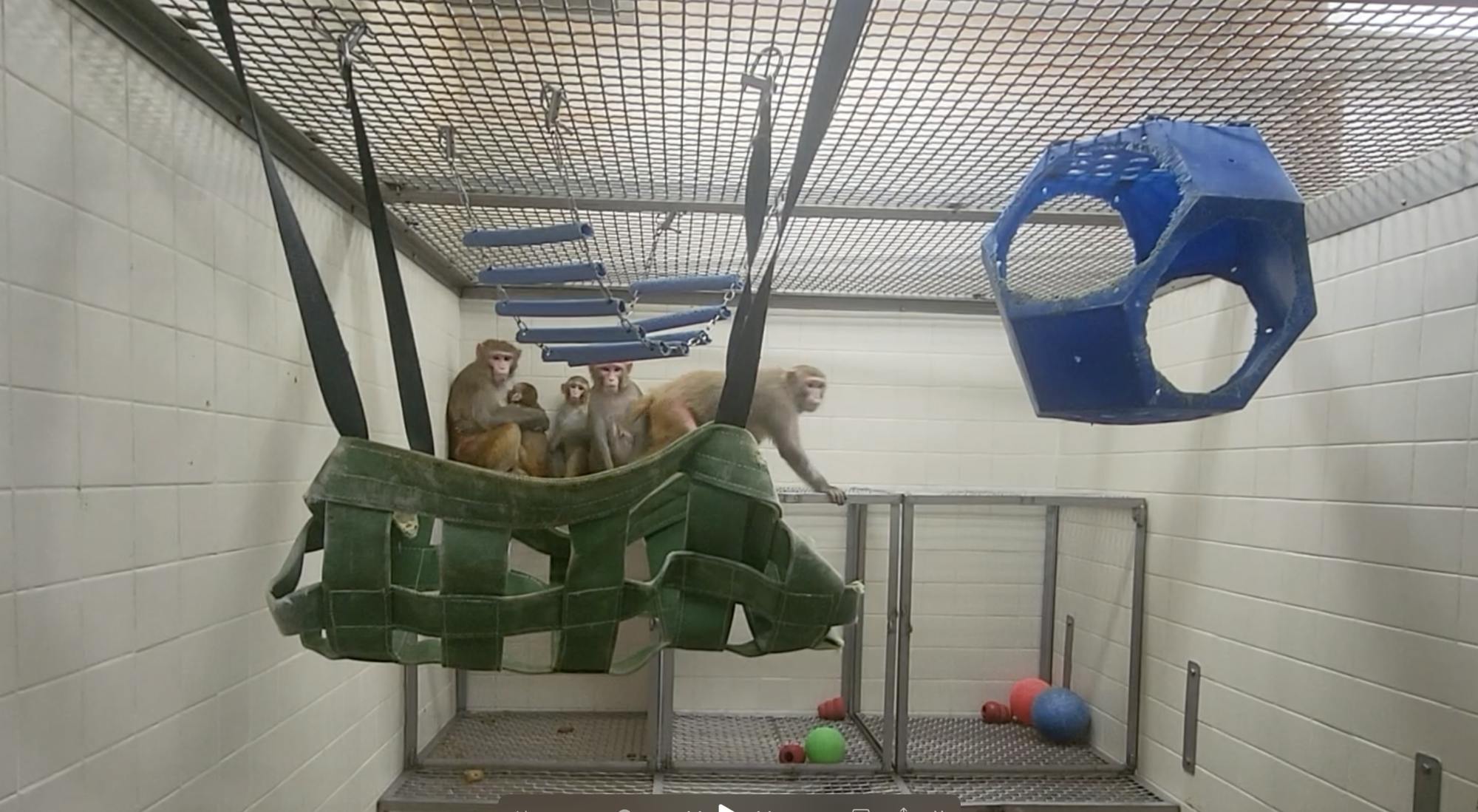
Krasno said she and another student were tasked with caring for over 500 monkeys, adding she was never involved in the research side. At the Sept. 30 meeting, she recalled several experiences from her time caring for the monkeys which she described as psychologically traumatic.
“In a single weekend, I placed the limp bodies of two newborns into biohazard bags and into a freezer," Krasno said. "It wasn't the first time, and it wouldn't be the last.”
At Sept. 30’s event, Krasno told the crowd about a monkey who would not let go of her dead infant. Krasno said her boss told her to remove the infant, so she lured the mother out of her carrier with marshmallows. On the fourth try, the mother set the infant down, pressed her lips to its forehead and went back inside without the marshmallow.
She also described Norm, a macaque who lived alone and received grooming from the caretakers. One day, Norm was missing; Krasno claimed he was picked for a study where he would be receiving an unlimited amount of alcohol. She never saw Norm again.
The Daily Cardinal was able to confirm UW-Madison has conducted alcohol studies on primates, but could not independently verify the specific anecdotes.
Krasno said she was later diagnosed with PTSD. She said she struggled to grasp what she had seen in the lab, but was determined to speak out for other lab employees.
“It felt like I was living two different lives in college: there was what you would think of as the normal college student who's double majoring and volunteering and going to football games and partying… and then there was the person who would go into what felt kind of like a dungeon, and be taking care of these animals in pretty upsetting conditions,” she said at the Sept. 28 event. “I kept those really separate to the point that I now don't have a lot of memories from the time.”
Krasno claimed animal research harms the people who carry it out, not just the animals.
“Supporting lab workers and speaking out is not separate from animal protection work. It is animal protection work,” she said. “Lab workers deserve compassion and support because they are human beings, and caring about their suffering does not diminish our compassion for animals.”
Krasno said former laboratory workers may feel pressured to stay silent about what they see to protect their careers and reputations and avoid being labeled “anti-science.” She said a supportive environment helps lab workers open up about their jobs.
“Every time someone with firsthand experience in this industry speaks honestly about what they've seen and done, it gives another person permission to do the same,” she said.
Gillian Drummond, a spokesperson for UW-Madison, said the university prioritizes employee wellness and offers “confidential individual counseling, assistance finding off-campus care and around-the-clock crisis support for both students and employees and their families” in a statement to The Daily Cardinal.
Drummond said research animals at UW-Madison “regularly receive care from specialist veterinarians, veterinary technicians, animal caretakers and researchers,” which could include “social housing with groups of other animals.”
“Animals are only incorporated in research when necessary — when alternatives such as cells and tissues or computer models are insufficient for answering scientific questions, when experiments are too dangerous for humans, and when results are expected to yield significant scientific outcomes to improve human or animal lives,” Drummond said.
After Krasno graduated from UW-Madison and left the lab, she began tagging the university on Instagram and commenting against primate research on their posts.
“For example, on Mother's Day where they’d say ‘Happy Mother's Day to all the moms’… I would comment and say, ‘but what about all of the mother monkeys that are in the labs and being forced to breed and have their babies taken away?’” she said.
When her comments started disappearing from the university's posts, she said she learned through a Freedom of Information Act (FOIA) request that UW-Madison had a list of words which would cause comments to automatically become hidden, including “monkey” and “wnprc.” Through another FOIA request, she learned that the National Institutes of Health kept a similar list, including “animal”, “experiments” and “monkey.”
She sued both the NIH and UW-Madison in two separate first amendment lawsuits in 2021, winning both in appeals courts in 2024 and 2025, respectively.
According to the NIH, the university currently houses 1,586 monkeys at the WNPRC, UW-Madison’s largest primate research center. People for the Ethical Treatment of Animals, an organization opposing animal research, urged the USDA to open an investigation into WNPRC after the reported injury of a rhesus monkey’s arm this year, and anti-animal testing nonprofit National Anti-Vivisection Society’s recent report claimed that eight monkeys at UW-Madison did not receive post-experiment pain medication as was required in 2025.
Krasno questioned UW-Madison research on anxiety and depression in monkeys. She said the work has included brain surgery and drugs used to make monkeys more or less anxious.
The Daily Cardinal identified a 2021 study describing primate brain surgery and involving drugs intended to lower anxiety and a 2016 study which described administering a gene through surgery which increased anxiety behaviors in primates.
“We're studying suffering while, in some cases, creating more of it around the research itself,” Krasno said. “After more than three decades of this anxiety research, I think it's reasonable to ask not simply what we have learned, but what tangible benefit patients have received.”
Drummond pointed the Cardinal to a publication by UW-Madison researcher Ned Kalin about anxiety and depression in youth.
“The UW-Madison researchers leading work on anxiety and depression have explained the importance of nonhuman primate studies in publications like this,” Drummond said. “And, in fact, studies like those done here at UW-Madison have led to a deeper understanding of what anxiety does in the brain, helping inform improved treatments and approaches for people.”
Naomi Charalambakis, the director of communications and science policy for nonprofit animal research advocacy group Americans for Medical Progress, told the Cardinal the public can look at the National Primate Research Centers website, view scientific publications on PubMed and use the NIH RePORTER tool to find information about WNPRC or Harlow Center for Biological Psychology projects and publications funded by the NIH. Drummond pointed the Cardinal to Charalambakis for additional comment on primate research.
“Medical treatments and techniques including blood transfusions, organ transplants and radiation treatment for cancer all relied on studies of animals to improve the lives of millions of people,” Drummond said.
Sonia Bendre is the campus news editor for The Daily Cardinal. You can reach her at sonia.bendre@dailycardinal.com.