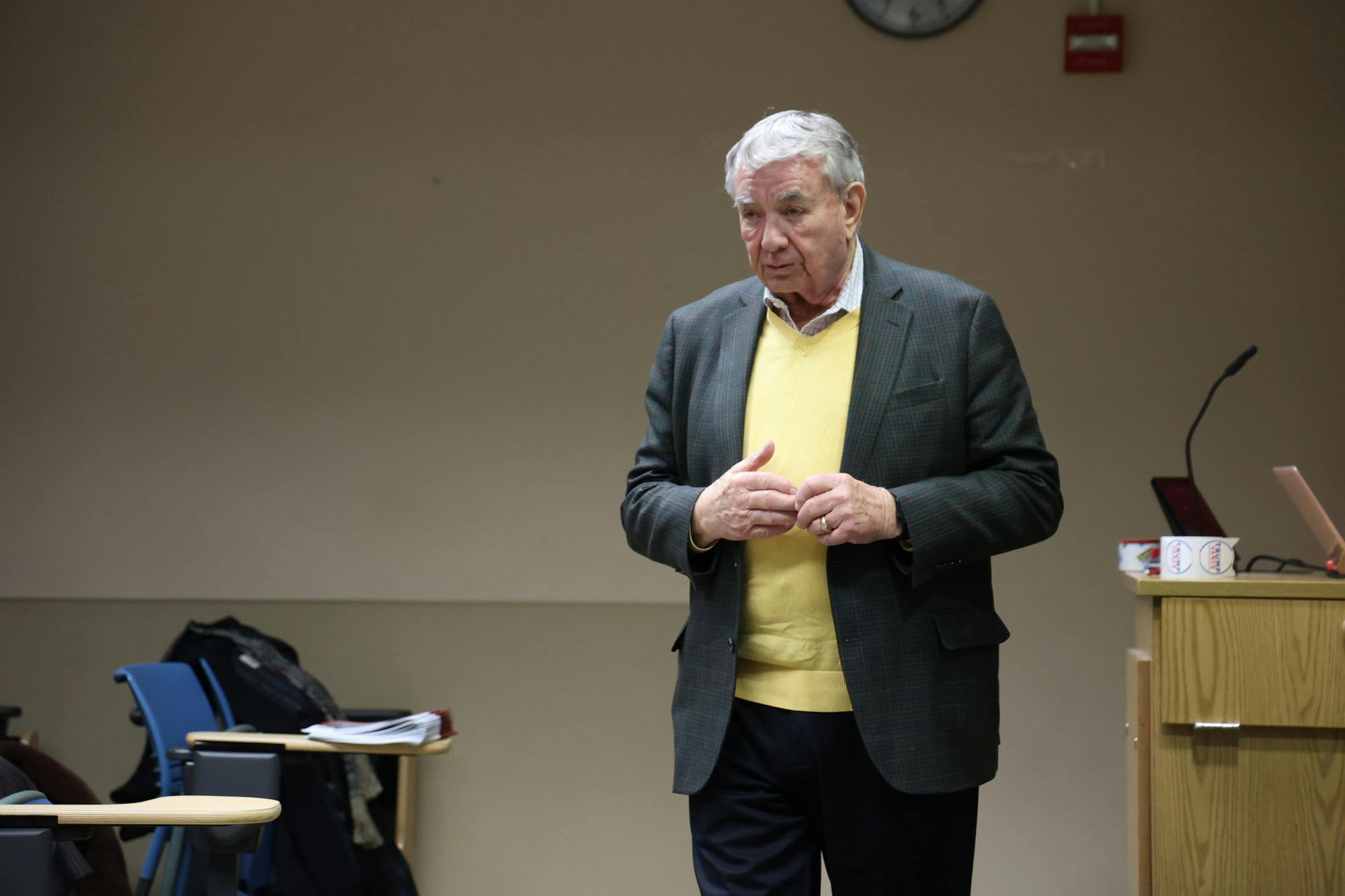
Former Wisconsin Gov. Tommy Thompson, former U.S. Ambassador to Luxembourg and Milwaukee Mayor Tom Barrett and former U.S. Rep. Tom Petri discussed political civility, polarization and extremism at the Effective Governance and Civility in Polarized Times panel in Wausau Oct. 1.
The panel, co-hosted by Wispolitics and The Wisconsin Institute for Public Policy and Service, comes at a time of increasing political extremism in American politics. A 2025 Pew Research poll found that 85% of Americans say political violence is increasing, while just over half see left and right wing extremism as major problems.
In his opening remarks, Thompson said the advent of social media, a lack of press coverage in the state Capitol and large monetary donations to state leaders are why divisions exist in today’s political sphere. He said he wasn’t sure today’s politicians get into politics for “the right reason.”
“You take a look at what’s happening in our state and in our country. I don’t see how anyone can be really happy,” Thompson said. “I’m not.”
Petri called civility “respecting people for who they are” despite what they believe.
He referenced a time the wife of one of his political colleagues had been accosted at the grocery store, and he emphasized the challenging environment today’s politicians face due to “tribalism.”
“Groups are using, as you say, the computers or the telephones and things to mobilize a small group of people to disproportionately skew the system,” Petri said. “And all I can say is that honest, ordinary, caring citizens in both parties have to figure out what's going on and be willing to stand up for people — even if they disagree with them on some things.”
Petri expressed concern over a lack of cooperation between party representatives. From 2001 to 2010, Congressional representatives voted across party lines less than 1500 times — a drop from more than 10,000 between 1967 to 1979.
He said politicians should avoid sticking to their parties as “team players,” and instead cross the aisle and engage with the other side.
“We appreciate your public service. We disagree with you on some of the things. But we think you have the right motives, and I'm going to support you,” Petri said. “If people aren't willing to do that, the system is going to continue to fragment.”
Echoing Thompson’s rhetoric, Barrett said people believe their opinions are normal, but if you look at the media, “you’re going to find out you’re not normal.”
“And [they] don't even care what your beliefs are, because if you're on the far right, the left is going to make you out to be a crazy person, and vice versa,” Barret said.
Despite expressing skepticism about politicians’ governing abilities, he said there’s “something fundamentally different” about social media that allows politicians to reach their base, referencing former Democratic gubernatorial candidate Rep. Francesca Hong’s decision to forgo cable TV ads during her campaign as one example of candidates adapting to a novel media environment.
Restoring effective dialogue
Despite the challenges facing political discourse in the U.S., Thompson expressed optimism for the upcoming 2026 midterm elections, saying the country “is going to solve their problems, as they always do.”
“It's always a little bit darker before the dawn, and I think the dawn is coming,” Thompson said. “I think this election is going to tell a lot, and I think this election is going to pretty much change a lot of the direction.”
He said once a candidate is elected, they have to forget they’re a Democrat or Republican, and be a “part of the peoples’ party.”
“If it's a Democrat idea, take it — run with it, it's a Republican idea, accept it,” Thompson said. “But let's start solving problems, and let's start getting along and making government work.”
Petri said there was “no real solution” to polarization in the media. He said it will take time for people to “adjust.”
“As new generations come along who've lived through this whole thing, they'll recognize the strengths of it and the weaknesses of it, and we'll adjust and change our approach so that things go forward as they need to,” Petri said.
Barrett said one way to combat extremism is to speak to other people, despite acknowledging that it “takes a lot of work to go out of your comfort zone.” Harkoning back to his opening remarks, Barrett stressed the common ground among people in politics.
He said “we all love our community,” despite the differences people have with one another.
“If you start with that — that the person who's your opponent, your adversary, loves your community but might have different ideas — then you can, I think, have respectful disagreements,” Barrett said.
Ted Hyngstrom is a staff writer. He formerly served as the Podcast Editor, and has covered a variety of city and campus issues. You can follow him on X at @NuffTed.