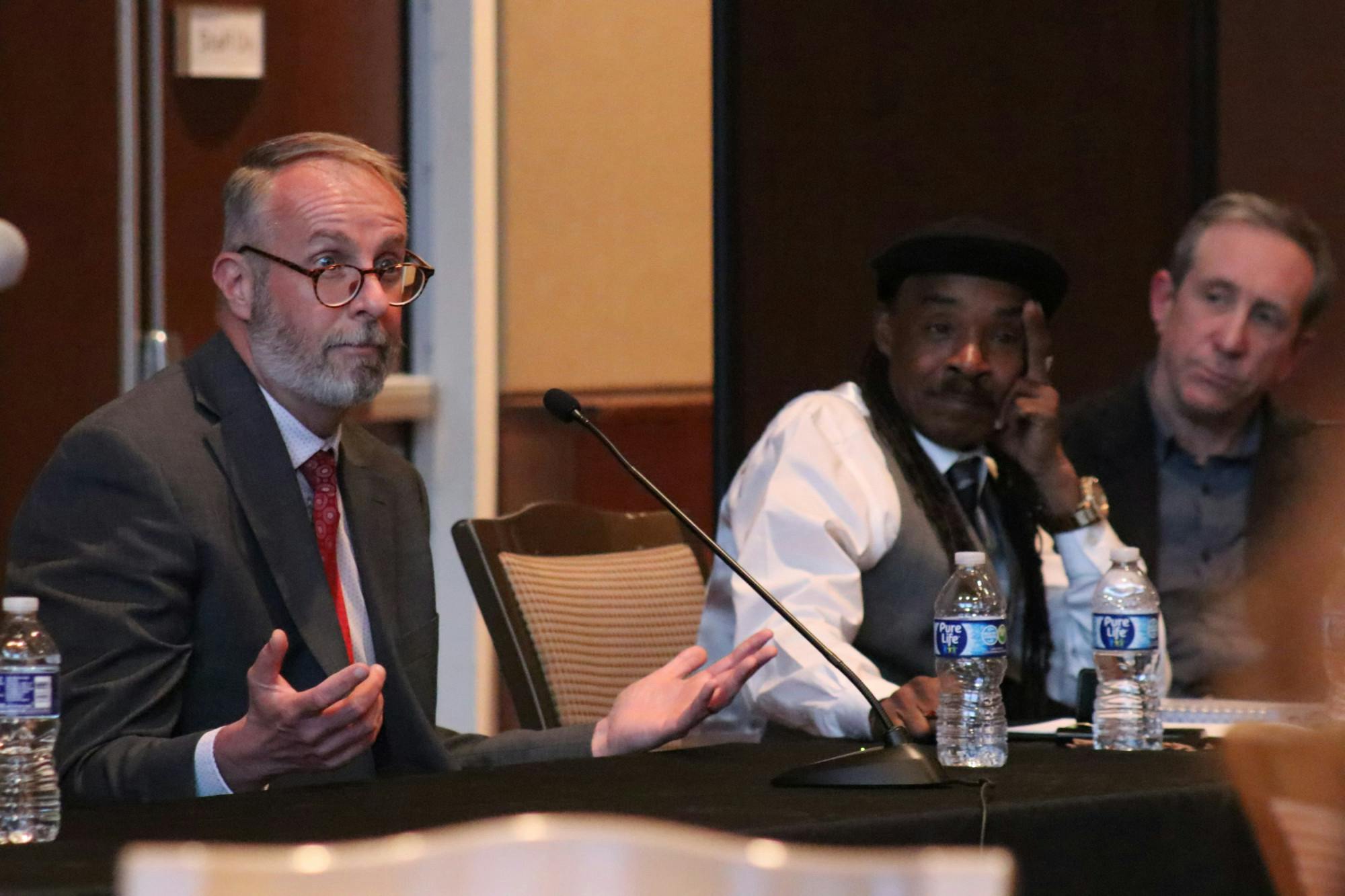
Students Against Mass Incarceration (SAMI) hosted a criminal justice reform panel at Union South on Oct. 7, discussing how homelessness, schooling and race intersect with issues in the criminal justice system.
The panel was moderated by Dr. David Pate, a professor of consumer science, human development and family studies at the University of Wisconsin-Madison. SAMI is a new organization on campus, and has multiple trips and events planned for this year, including a visit to the Dane County Jail.
Vice President of SAMI Gabriel Meyer-Herron described the organization as “pushing comprehensive understanding of the criminal justice system in Madison, and creating an environment for discourse and discussion.”
Panelists discussed several statistics that highlight the demographics being incarcerated. Data and Evaluation Coordinator for the Dane County Office of Justice and Reform Shar-ron Buie mentioned specifically that Black Wisconsinites were 12 times more likely to be arrested than white ones, giving the state the second highest disparity of Black-white incarceration rates in the nation.
Panelist and UW-Madison law professor Ion Meyn said “one way to understand [this disparity] is that after chattel slavery white institutions had to figure out a way to be fairly against the idea of chattel slavery, but then as white institutions, maintain the best of racism.”
“In the 1820s the incarceration rate was 1 in 10 not 1 in 12,” Meyn said. “What does that statistic mean today? It means we are doing worse than Jim Crow.”
The four panelists agreed the use of language is important when it comes to exposing corrupt institutions.
“Language is the currency of power,” James Morgan, a community organizer for Madison Organizing in Strength, Equity and Solidarity for Criminal Legal System Reform said, claiming the institutions use words that sound nice to hide exploitation from the public eye.
“A system of reservation and punishment, of dehumanization,” Morgan said. “I’m looking around to see who’s defining my reality, your realities, the people that you’re going to be voting for who determine the policies in this area.”
The panel also discussed the Dane County jail consolidation project. The project plans to consolidate outdated downtown jail facilities into a new tower attached to the Dane County Public Safety building. The project will reduce the bed count from 1013 to 825, and aims to eliminate or reduce the use of solitary confinement. Morgans believes the project will make outcomes worse for the incarcerated population.
“This project is totally inadequate,” Morgan said. “We have to look at who are the targets. People who are in this community, who are suffering from mental health issues, alcoholism and those conditions.”
Morgan worries with the population increase expected in the next 10-20 years,policy makers are focused on the wrong issues.
“They’re not talking about adequate housing,” Morgan said. “I’m listening to these policy makers talk about how to jail people.”
The panel conversation shifted toward solutions to these problems. Wisconsin Public Defender Benjamin Gonring discussed a way to fix the high recidivism rate among young people being incarcerated. The difference in recidivism rates between 20-24 year olds and those over 45 was 24.5% in 2016.
“These children need investment,” Gonring said, “you need to have…one person who really tells you all you can be.”
At the end of the panel, Morgan was asked about how the UW-Madison bylaws institutionalize these systems, citing statutes that require a certain amount of university supplies be made by prison labor through the Badger State Industries.
“Expose them,” Morgan said. “These places need a living wage, accountability practices, and reintegration assistance.”
Professor Meyn left the audience with a strong question and his strong position.
“Is it racist and doing racial harm by publicizing crimes?” Meyn asked. “It’s a question I have for you, the answer I have for it is yes.”