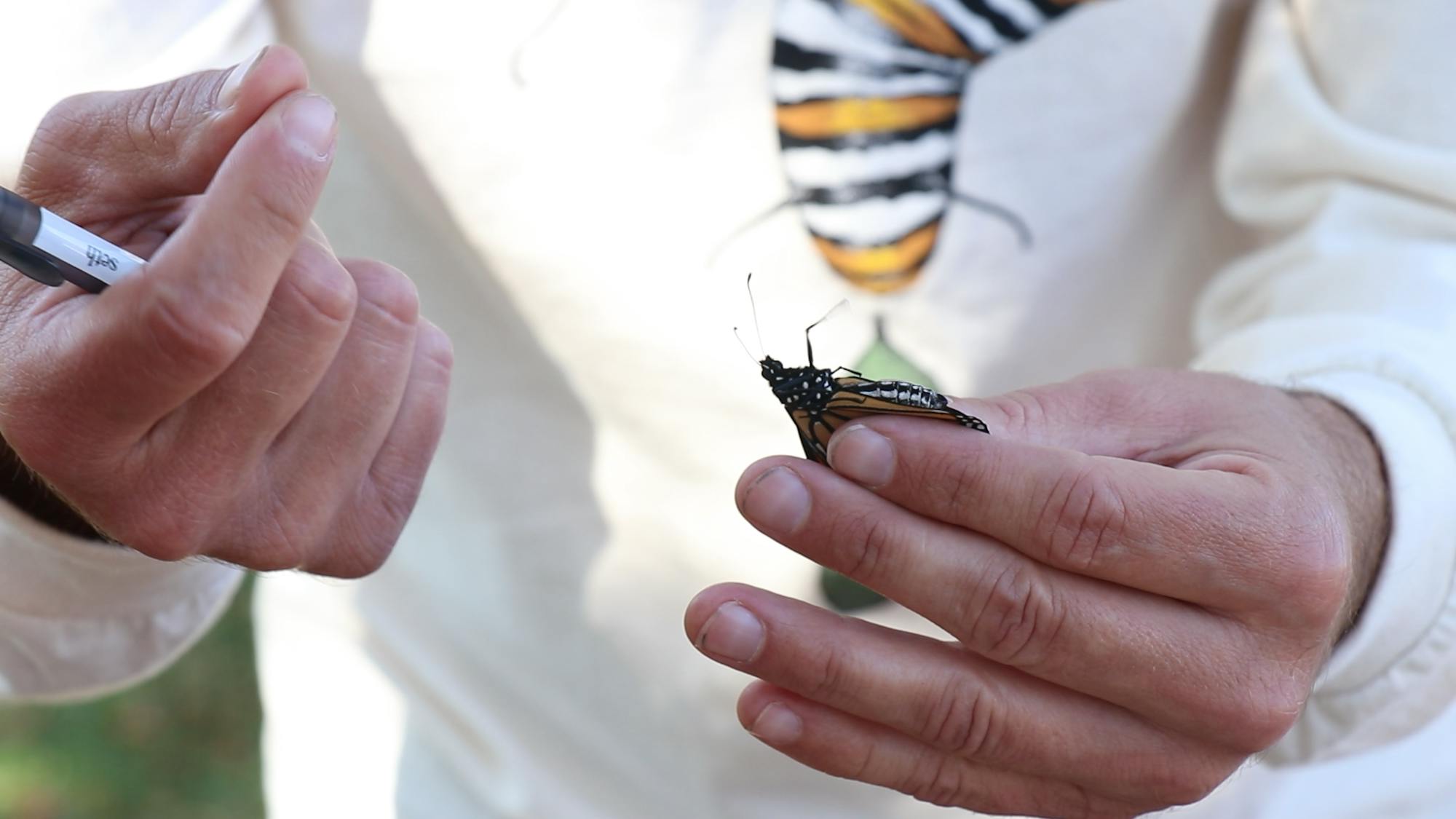
Every year in late August, tens of millions of monarch butterflies begin their migration south for the winter. Navigating thousands of miles against harsh weather and habitat loss, the monarchs face an uphill battle to reach their destination. A recent breakthrough in tracking technology may pave the way for improved understanding and protection of their annual trip.
At the University Wisconsin-Madison, Biology Professor Seth McGee is using solar power to track monarchs' full migration. The new tech will allow researchers to answer specific questions about flight behavior — such as whether butterflies fly into headwinds or wait for tailwinds, and how they react to inclement weather. This information can be transformative for conservation efforts by pinpointing critical parts of monarchs’ migration, McGee said.
Before Project Monarch Collaboration’s tech — the group of research organizations behind the solar panels — scientists could track monarchs' migrations partially, by placing stickers on their wings, but that method only provides two datapoints: where the tag is attached and where the monarch is found, according to McGee.
“It’s sort of like putting a message in a bottle,” McGee told The Daily Cardinal. “The data that you get is just two points, where you put it on and what the butterfly looked like then and then wherever it was found. So it's like the beginning and last chapter of a 2,000 mile book.”
The logistical hurdle to tracking monarchs’ complete migration was their weight. A single monarch weighs roughly the same as a paper clip. Attaching a traditional battery-powered tracking device on an insect that small would seriously impede its flight and ruin its chances of surviving the journey to Mexico, McGee said.
McGee displayed the brand new trackers at the Biocore Prairie, where he has been tagging monarchs for years. Tiny solar panels on each tag mean no battery pack is necessary. The new radio tags can track monarchs at every step of their migration, filling the chapters sticker tags could not.
The tags provide information on “Where they’re going, how they’re going, when they’re going,” McGee said. “It’s such a revolutionary technique.”
Upon receiving charge from its solar panel, the tracker emits a bluetooth signal that can be received by smartphones within 100 to 200 meters away. The phones automatically relay the signal to researchers at the Project Monarch Collaboration, the group of research organizations that pioneered the new trackers.
“It’s going to allow scientists to sort of concentrate our efforts in the conservation of the habitat that these organisms depend on,” McGee said. “We haven’t been able to do that before.”
As he works, McGee’s phone lets off a series of pings from the Project Monarch app — a fun addition to the new tracking efforts that allows smartphone users to track their favorite tagged monarchs.
“If somebody is using the app and the monarch is close, it will actually tell you that the monarch is there if you have the app open. So you can do like Pokémon Go with the monarchs,” McGee said.
McGee is rarely alone when he goes out to the Biocore Prairie to find and tag monarchs, often joined by interested students and members of the Biocore program.
UW-Madison Senior Eashna Agarwal told the Cardinal she has loved accompanying McGee on his tagging trips to the prairie.
“Every time I come here, I learn something new, and I get to apply a lot of what I’ve learned over the course of my biology education,” Agarwal said.
For students and community members looking to join the migration tracking, the Project Monarch app is free to download, offering real-time updates as tagged butterflies make their journey south.
“And it's really quite addicting actually to see,” Mcgee said. “It's just mesmerizing to see where they're going and when they're moving.”