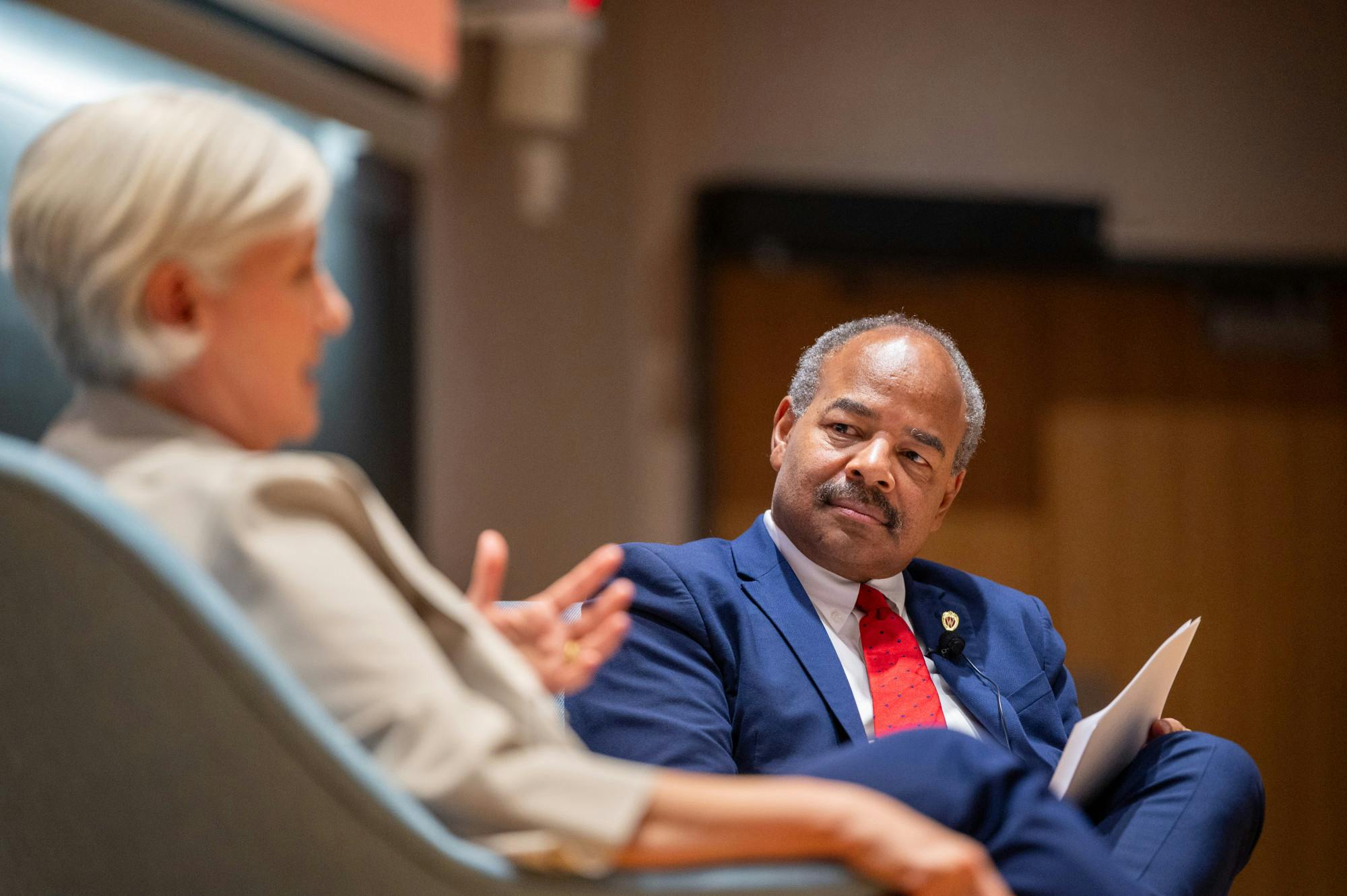
University of Wisconsin-Madison Interim Chancellor Eric Wilcots and Dr. Jane Kamensky, President and CEO of Thomas Jefferson’s Monticello in Virginia, hosted a fireside chat discussing the role of public universities in society on Sept. 16.
The event was sponsored by the Wolff Center for American Thought, Culture, and Society and was the first event hosted in the new Irving and Dorothy Levy Hall.
Kristin Eschenfelder, the Interim Dean of the College of Letters and Sciences, opened the event by explaining the core foundations of a liberal arts education, saying it “provides a transformative experience for students,” and “empowers them to go out and participate substantially and meaningfully, as free citizens, in society.”
Those ideas set the stage for a conversation centered around preparing students to enter into a polarized world.
Interim Chancellor Wilcots began the discussion by asking Kamensky about how she views the country's current political polarization.
“I believe in hope as a practice, and one of the ways, as a historian committed to rigorous truth-telling, that I practice hope is by looking at times when Americans have faced equal problems and found small ways through,” Kamensky said.
Kamensky brings a long career in American history to her role at Monticello. An author and historian, she is the John Trumbull Professor of American History, Emerita, at Harvard University. As the head of Jefferson’s Monticello, she oversees the site’s educational museum and research programs.
She discussed the long feud between Thomas Jefferson and John Adams, which began when Jefferson served as Adams’ vice president.
“Like many people in the heat of politics, their differences reached a point where they decided they could no longer talk to each other,” Kamensky said. “And part of that was because they were both living entirely as political beings.”
She explained Americans today are similar, constantly living in “the sphere of national politics.” Her key point was that the two men eventually overcame their differences and were able to work together.
“They said that the American Union was more important than whether you realized it through Federalist or Democratic Republican principles,” Kamensky said.
Wilcots then asked Kamensky how she thinks controversial topics should be discussed in a university setting.
“There are exterminationist ideologies in the world. I don’t think they’re sitting next to you in class. For the most part, I think we can pull back that concept of words as harm, and think a lot more deeply and a lot less reflexively than we tend to about what I might learn from hearing someone who thinks radically differently than I do,” Kamensky said.
As the conversation turned to how public universities should navigate the current political climate, considering they rely on taxpayer funding, Kamensky introduced the idea of obligation.
“I think [obligation] is both an honest and key strategy of the way universities can successfully negotiate in this time is by recognizing that you have an obligation and a trust to fill, rather than always speaking in the language of rights, which is of course vital too,” Kamensky said.
She connected that sense of obligation to the importance of viewpoint diversity on campus, arguing that universities benefit from bringing people with different perspectives together, much like building a faculty.
“Recognizing that pluralism itself is a strength,” Kamensky said.
The discussion attested to a larger effort at UW-Madison to embrace diversity in all forms.
“[Jefferson] was a foundational dinner table diplomat,” Kamensky said. “His granddaughter said that conversations at his table were always feasts of reason. And so, we have the imprimatur of our founder to do this difficult thing — disagree.”