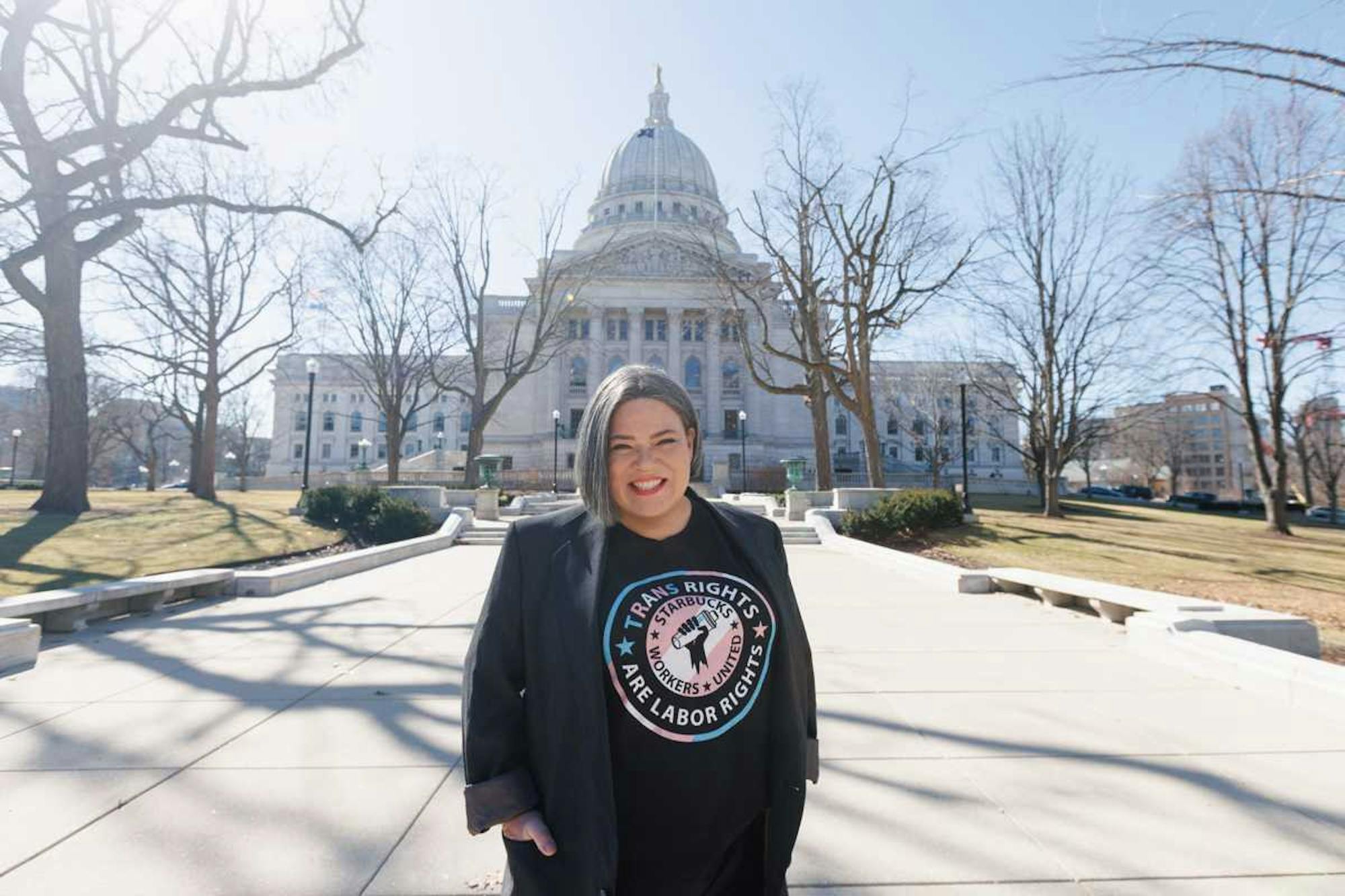
Dina Nina Martinez-Rutherford said the color orange “totally typifies” her personality. That’s why she chose it to represent her Assembly campaign.
“It's hopeful, it's bright, it's fun. That's who I am,” Martinez-Rutherford told The Daily Cardinal.
Rather than centering a campaign around the color blue — to signify the Democratic party — she felt the color orange was “more connective than divisive.” She also felt that it was a symbol of good.
“In the middle of great turmoil, joy and laughter and fun and whimsy and quirkiness are all part of what saves us,” Martinez-Rutherford said. “There’s something good coming… I will endeavor to be that good.”
Martinez-Rutherford won the Democratic nomination for Wisconsin’s 76th Assembly District in August.
While she has a Republican opponent, Nina Chat, Martinez-Rutherford will likely win in November due to the district’s historically bright blue nature on Madison’s east side.
Martinez-Rutherford is an open transgender woman, who will be the first transgender person in the Wisconsin State Legislature if elected. She currently serves on the Madison Common Council and represents District 15.
Rep. Francesca Hong, D-Madison, currently holds the 76th District. She is one of the most prominent democratic socialists in Wisconsin and narrowly lost the Democratic primary for governor to Milwaukee County Executive Daivd Crowley.
While Martinez-Rutherford said she and Hong share similar policies, particularly since they both share a background working in a restaurant, she said she will have her own spin in the Legislature.
Universities of Wisconsin System funding
Martinez-Rutherford said she wants to “revive” funding for the Universities of Wisconsin System and remove impediments to higher education in Wisconsin.
“Education is paramount to creating the future that we want, the future that we see,” Martinez-Rutherford said.
The UW System received the largest funding increase in two decades in the last biennial budget. While Gov. Tony Evers had initially proposed $856 million, he and Republican legislative leaders settled on $256 million.
In 2024, Wisconsin was ranked one of the lowest in the country for four-year university public funding.
Now, the Board of Regents approved a proposal that requests a $730 million increase for the UW System in the next budget, and that would give the University of Wisconsin-Madison an additional $260 million.
“University of Wisconsin System is one of the best in the country, and it needs to continue to be the best,” Martinez-Rutherford said. “I believe that with the right funding… we’ll be able to restore that and really be a shining beacon for the rest of the country.”
Data centers
Martinez-Rutherford has taken a hard stance on data center reform throughout her campaign, and she said she would want to instate a moratorium to allow for guardrails to develop before construction of any new data centers.
Data centers have been given tax breaks in recent budgets to bring economic development, but the Legislative Fiscal Bureau now projects the subsidies to cost the state more than $2 billion in sales tax revenue.
“Instead of giving billions of dollars of tax breaks to billion-dollar companies, we need to give that to the people and start doing work for the people,” Martinez-Rutherford said.
Crowley has said in the past that the state can benefit from being a data center hub, and he has recently clarified that communities should decide if they build a data center. Martinez-Rutherford said Crowley is a “reasonable man,” and he will listen to constituents when they don’t want data centers.
Using the money from the tax breaks, she said she would fund cities, community initiatives and small businesses.
“Many people in our political system have lost sight of who they serve,” Martinez-Rutherford said. “The data center issue goes far beyond party lines.”
The Republican nominee for governor, U.S. Rep. Tom Tiffany also wants to end the tax breaks on data centers and let communities decide if they want a development in their area. While both Crowley and Tiffany try to paint the other as more pro-data-center, their clarified stances show similar means.
School vouchers
Private school vouchers have been hotly debated this election cycle as more states begin programs. Milwaukee’s school choice program – Milwaukee Parental Choice Program – is the oldest in the country.
Martinez-Rutherford said she wants to roll back school vouchers, and instead invest in public schools to improve education and pay teachers more.
“We can take care of our children and give them an education that will set them up for the rest of their lives,” Martinez-Rutherford said. “Or we can negotiate that away to benefit private institutions that don’t deserve public money.”
While she acknowledged the voucher support in Milwaukee, she said she wants the city to have just as good public education as private.
The National Assessment of Education Progress found Milwaukee Public School students near the bottom in reading and math among other urban school districts tested across the country in January 2025.
While Crowley said in a July debate that he does not want to expand nor eliminate the voucher system in Wisconsin, Martinez-Rutherford said, similar to data centers, he should listen to constituents when they do not want the program.
Affordable housing
Martinez-Rutherford has experienced homelessness before, and she said she knows how that has an impact on the way she works as an alder.
“I know how policy failure impacts us, and I want to make sure that we are being cognizant of that for working people and not just shrugging it off,” Martinez-Rutherford said.
Wisconsin’s homeless population increased nearly 5% this year to just under 5,500 people. To combat the rising number, Martinez-Rutherford wants to raise state funding for affordable housing projects, expand affordable housing unit eligibility and support transitional housing services.
One of her biggest goals in the Legislature is to emphasize taking care of vulnerable people, particularly those experiencing homelessness.
“One of the things that our society has been so short-sighted on is the fact that when we take care of the poorest people… it benefits us,” Martinez-Rutherford said. “We are all responsible for each other.”
As alder, she has sponsored legislation to support and increase funding for affordable housing initiatives in Madison, much of which has easily passed.
Still, Martinez-Rutherford said more work needs to be done to take care of homelessness in Wisconsin, and she needs other lawmakers to help her in passing legislation in the next session to do that.
“I’m so mad that we can’t see past our nose at how all of these social programs actually benefit all of us,” Martinez-Rutherford said. “When we invest in homelessness aversion… it benefits us as a state. It benefits us as a society.”
The general midterm election is set for Nov. 3.
Audrey Lopez-Stane is the state news editor for The Daily Cardinal. She has written in-depth on free speech on campus, higher education and elections including the Wisconsin Supreme Court race and upcoming governor primary. Audrey previously interned at WisPolitics and now works for Wisconsin Watch. Follow her on X @ALopezStane.