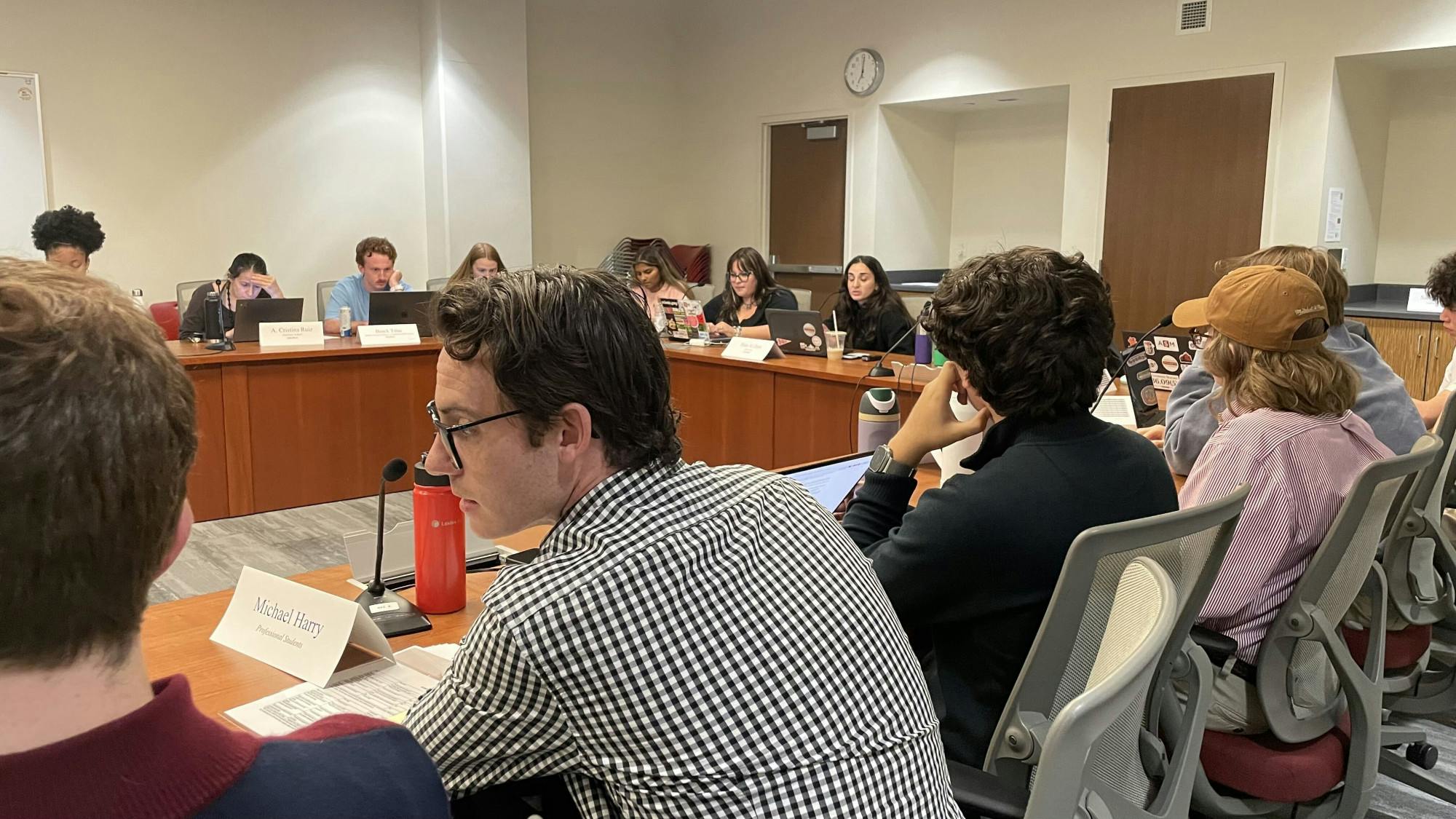
Associated Students of Madison (ASM) representatives blocked a motion to re-elect their 33rd session chair and tabled discussion of a new ASM code of conduct at their first fall meeting Sept. 16.
ASM representatives voted down a motion to discuss a judiciary order from spring chair candidate and ASM Rep. Michael Harry, which, if passed, could have allowed representatives to re-elect their 33rd session chair by a majority vote.
The motion to discuss Harry’s judiciary order required a two-thirds majority to pass. 15 students voted in favor and nine voted against — blocking the motion by one vote.
Harry lost the April 24th election for 33rd session chair. He claimed the election results were invalid in a petitioner's brief sent to the Student Judiciary Committee six days later.
In the brief, Harry said meeting rules were violated during the election and the Chief Justice was not present, thus nullifying the results. The Student Judiciary Committee released an ordinance on Sept. 8 to allow discussion of Harry’s brief during Wednesday’s meeting.
There was no official debate over the motion, but Graduate and Professional Committee Co-Chair Elizabeth Anderson made comments in support during the open forum preceding the vote. She claimed ASM Chair Haia Al Zein intimidated opponents, including a candidate for Internal Affairs Chair and other candidates for 33rd session chair.
In a previous email to the Cardinal, Al Zein denied telling Student Services Finance Committee (SSFC) Vice Chair and spring chair candidate Lander Levers that anonymous letters would be introduced against him at the April open forum if he ran for chair — one claim in Harry’s petitioner’s brief.
Levers left his position as a representative over the summer, but will continue to serve as SSFC Vice Chair.
An anonymous letter was also read in the open forum, claiming the previous election was conducted inappropriately and urging representatives to vote in favor of the motion.
“The mistakes that were made in [the April 24] meeting have seriously damaged my trust in ASM. I am frustrated and frankly enraged by the behavior I saw on display,” the letter read. “Student Council is supposed to be a space to advocate for the good of all students, not to conduct personal crusades or political attacks on members of the body.”
New Code of Conduct pushed to Sept. 30th meeting
Later, ASM Chair Haia Al Zein introduced a new code of conduct that could block ASM members from contacting others using UW-Madison directory information, including email addresses and phone numbers, without their direct consent.
The motion was tabled to the Sept. 30 ASM meeting, where it will be reconsidered. Several representatives voiced confusion with the new code of conduct and asked for more time to review the document. ASM members currently follow the 29th session code of conduct, Al Zein said.
Al Zein said the new code is adapted from the 29th session code based on feedback from last semester and over the summer, including from ASM members who said being contacted by phone made them uncomfortable.
“While I recognize the intent, this code of conduct as written is flawed and may contradict existing university policies and federal, state and local laws,” Anderson said.
Anderson raised concerns about the stipulations prohibiting using contact information from university directories to locate or contact individuals without their consent. Students in ASM who use the directory to search for information like a teaching assistant’s office or a group project member’s phone number could be violating the code.
“If you don't opt out, your cell phone number that you provide to the university is on the student directory,” Anderson told the Cardinal. “To me, if people don't want to be contacted by their cell phone number, they should take it off.”
Harry added that without more clarification, it is unclear whether the new ASM code of conduct is meant to apply only to non-public university sources, or aims to prevent ASM members from accessing information that the university already makes available in an email to the Cardinal. He contacted some student representatives by text in the spring but told The Cardinal he didn’t use student directory information to contact anyone.
“I had concerns told to me by other representatives and members of the body that their phone numbers were getting searched via the directory, and they were very uncomfortable,” Al Zein said. “This specifies asking people if you can have their phone number or their email, or if you can reach out to them [and] making sure the other party is in consent of a working relationship in ASM.”
The 29th session code also has a section on “conflicts of interest” requiring outside employment, certain financial interests and student organization membership be disclosed when they affect an appointment or distribution of resources.
The new code continues to require that distributions of funds be made in a “viewpoint neutral manner,” but does not explicitly require disclosure of outside appointments, though it does note that “all processes for appointments and the distribution of resources must be transparent and well regulated.”
The program chair of Sex Out Loud currently sits on the SSFC, which helped to allocate $132,991.54 to Sex Out Loud in the 2026-2027 school year. At least two members of Badger Catholic, which was allocated $72,875.13 this school year, also sit on the SSFC.
One rule in the new code prohibits ASM members from requesting another person’s phone number, address, schedule or location to engage “outside of legitimate ASM business.”
Anderson asked for clarification of a rule that reads: “Contact with another member outside ASM must be reasonable, relevant to legitimate ASM business and respectful of the individual's boundaries.”
“Relevant to legitimate ASM business’ would suggest that if someone is a friend or is in the same department, that we would no longer be able to talk to each other,” she said.
Al Zein replied the line was meant to encourage ASM members to respect boundaries.
“If the individual you are speaking to is comfortable with you reaching out to them and talking to them as their friend, then it is totally within the code of conduct for you to be friends with them,” she said.
Sonia Bendre is the campus news editor for The Daily Cardinal. You can reach her at sonia.bendre@dailycardinal.com.
Dominic Violante is a senior staff writer for The Daily Cardinal.