Scaffolding provides a brief shield from the summer heat as you wait for the walking man to return to a never-ending red light. On your right, a fence stands between you and building construction and on your left, students talk amongst each other with pizza slices in hand. Gazing in the distance, you realize the city has changed. Cranes and half-finished buildings make the skyline look like a blueprint of what’s to come. There’s a new high-rise apartment, an art museum and restaurants. But, despite how it all sounds, no, I’m not writing about New York City for The Daily Cardinal. This is Madison, Wisconsin.
If you’re returning to Madison this semester you’ve probably noticed the city’s new appearance. While construction rampaged the city this summer, new buildings were erected, old ones received makeovers and there have been more than a few additions to Madison’s food scene. Here’s a glimpse into some of the city’s new offerings for students to explore this fall.
Lots of Pizza
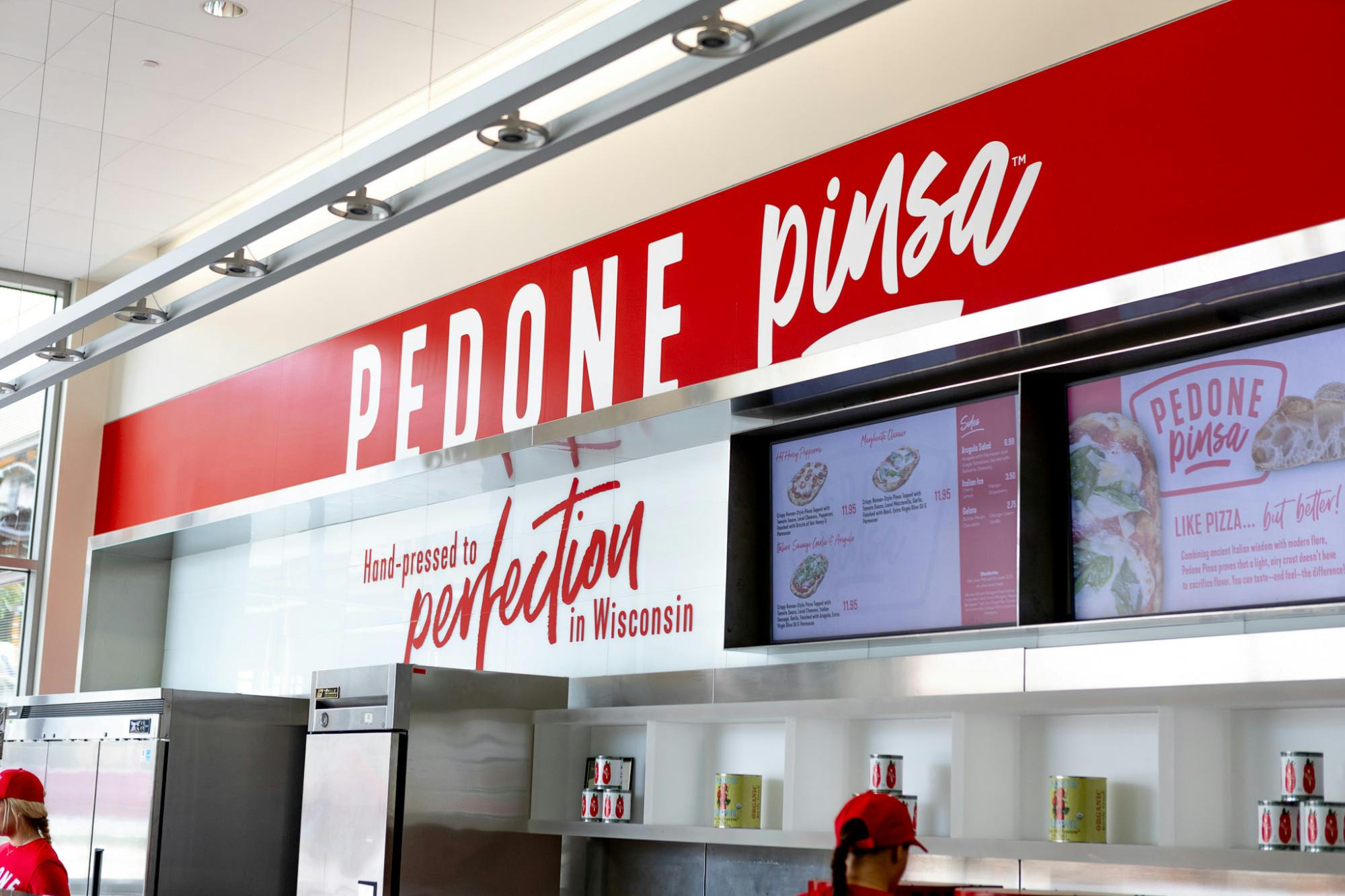
Strada may have to prepare for competition as a new Wisconsin Union Italian offering arrives: Pedone Pinsa. The pinsaeria, located in the Discovery Building on N Orchard Street, serves a Roman style pinsa on a thin, light crust. For students who need a quick bite between classes but don’t want to overspend on Badger Market snacks, they have an enticing offer: the pinsa only takes 90 seconds to cook, and won’t be a huge hit on your wallet at $11.95 a pinsa.
Wesley Erpelding, a rising junior at the University of Wisconsin-Madison, told the Cardinal Pedone Pinsa could become a new staple for him, as he eats lunch at Union South “once a week.”
“I think Strada pizza is not good at all,” Erpelding said. “I think [Pedone Pinsa] is gonna blow it out of the water.”
If students want a break from the Roman experience, they can get a taste of both Sicily and Philly at Frank & Andrea, a Minneapolis-based pizza and cheesesteak joint that has opened its second ever location under the Hub apartment building on N Frances Street.
Erpelding, however, said he does not have high hopes for the new spot based on his experience at their Minneapolis location.
“It’s abysmal. They don’t keep it in the oven long enough and the cheese never melts,” Erpelding said. “It’s gonna be tough to compete with Ian’s.”
While I cannot say how the pizzeria will fare for UW-Madison students who pledge their 1 a.m. weeknights to Ian’s, I can only hope that Hub hands out free pizza and cheesesteaks the next time they advertise their leasing options on State Street.
A Reimagined Art Museum
For many, the Chazen Museum of Art has been under construction for their entire time at the university. This was mostly the case for The Elvehjem building, which houses parts of the museum and has been adorned in scaffolding since 2023.
But after a full closure of the Chazen for reinstallation this summer, the museum will gradually reopen throughout the Fall semester. “Recollection,” a first-floor exhibition to provide historical context for the museum’s new collection is now on display until Dec. 23. The first two floors of the museum will be reopened by Sept. 8, with more following as the semester unfolds.
Dasha Berezhanskiy, a rising junior at UW-Madison and a tour guide at the Chazen, told the Cardinal all the permanent galleries will be based around a “focus object” that will help tell the exhibition’s story.
She said some galleries will consider the “impact of trade and interactions between Europe and Asia.” This concept differs from how many art museums organize their collections, typically by time period or geography. Berezhanskiy said the idea came to Katherine Alcauskas, the chief curator of the Chazen, on a bike ride.
“She saw it as a nucleus of an atom and the electrons spinning around it,” Berezhanskiy said.
The Chazen can be a popular place for instructors to take their students to for both inspiration and for an insight to the cultural context of the time period being studied. As classes start up again, Berzshansky said she hopes students will get to look at more than just “pretty things” as a result of the reimagined galleries.
“The way that the galleries are organized allows you to connect the art to many things,” Berezhanskiy said. “To increase conversations that extend beyond art, but also let you understand how art is so interwoven into our world and our lived existence.”
A New Humanities Home
After years of discussion, the polarizing Mosse Humanities Building has finally… not been demolished. Instead it’s been joined by the newly-opened Irving and Dorothy Levy Hall at North Park Street and West Johnson Street, a new home to eight humanities departments. The building will house African American Studies, American Indian Studies, Asian American Studies, Chicano & Latino Studies, Gender & Women’s Studies, History, Jewish Studies and Religious Studies.
While many are eager to get rid of the original Humanities building, I think that — maintenance issues and all — Harry Wesse’s brutalist beauty plays an integral role in the campus. What other building has a courtyard where I end up being happy to see everyone I know while on a lunch break? Though the new building is certainly more modern, there’s a certain charm to learning about history and pondering large questions in a confusing concrete building.
While construction has finished for this fall’s additions, both the campus and city continue to change. There are still many more campus buildings to be built, renovated and demolished. Though I wish John Nolen Drive could halt construction for at least long enough for me to resume my running loop again.