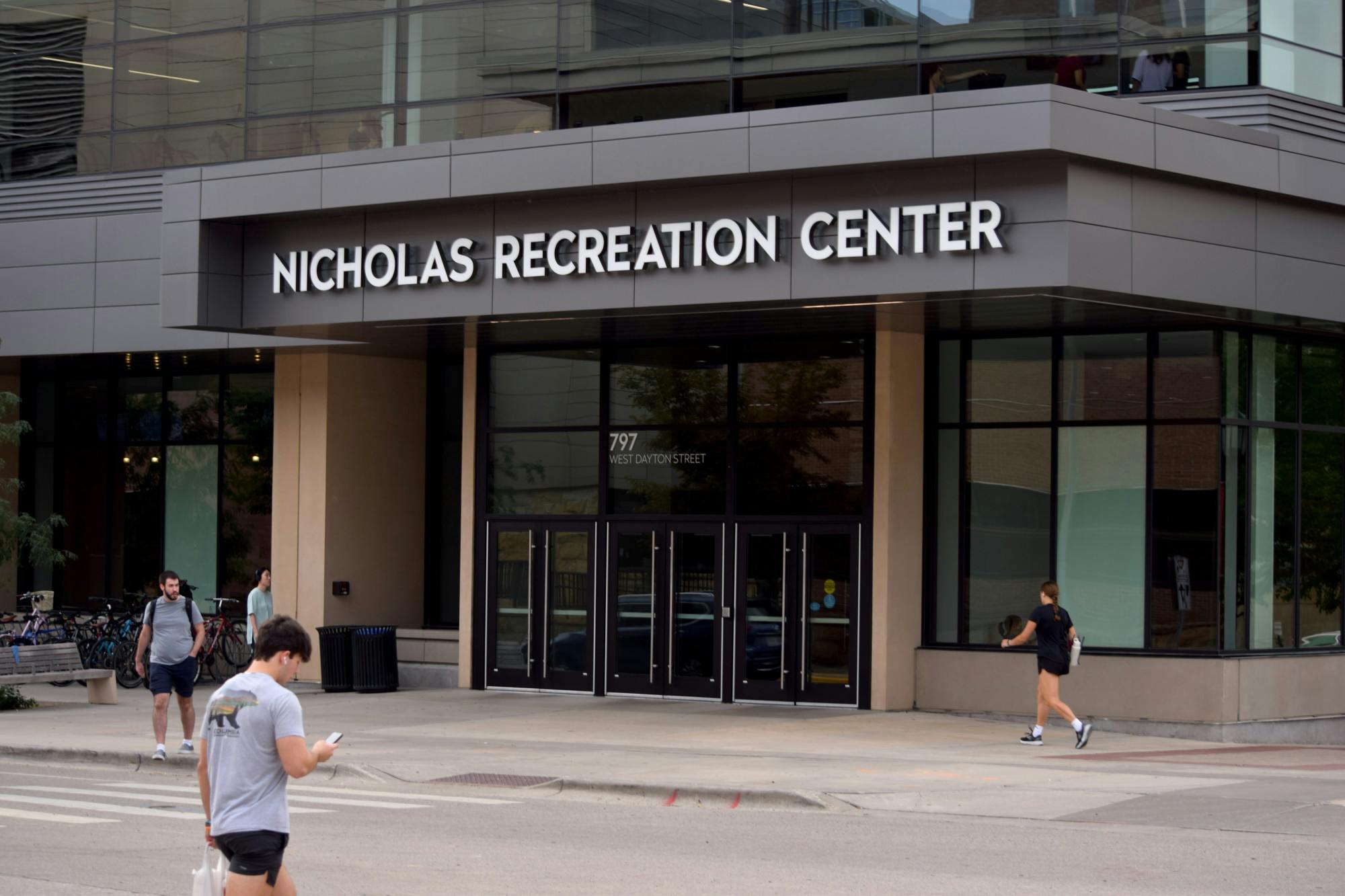
When Kris Marconnet was a student at the University of Wisconsin-Madison, the Nicholas Recreation Center didn’t exist. Instead, she remembers taking an aerobics class in the Natatorium, a “hideously hot” building near the Lakeshore dormitories with no air conditioning.
She didn’t imagine that years later, she would play a hand in designing the new athletic center as part of her work with Thysse (pronounced TIE-See), a facility branding company located in Oregon, Wisconsin — just 10 miles away from the university.
Thysse’s work with UW-Madison spans over 15 years and over 25 spaces, Beth Hamacher, Thysse’s director of business development, told The Daily Cardinal: in addition to the Nicholas and Bakke Recreation and Wellbeing Center, the list includes work at Memorial Union, the Kohl Center, Engineering Hall, Morgridge Hall and Levy Hall, which hosts its first classes this fall.
Hamacher said among other projects, Thysse is working with UW-Madison on branding the Phillip A. Levy Engineering Center, currently under construction, as well as renovating the Student-Athlete Performance Center adjacent to Camp Randall.
Memorial Union’s terrace chair history
Marconnet started as a STEM major, but switched to art, realizing during her time at UW-Madison that she wanted to continue a lifelong passion for drawing and illustrating.
She began her design career in Milwaukee, making print brochures and annual reports. After she had children, she entered the world of experiential design, which she described as a form of visual storytelling that drew upon her love for home renovation. Now, Marconnet has been at Thysse for 11 years, where she designs history walls, feature pieces and more for the university and other clients.
One such piece: a display of the history of Memorial Union’s iconic terrace chairs, placed between the Memorial Union entrance and Peet’s Coffee.
The terrace chair piece was originally allotted for shelving, Marconnet said. But instead of “tchotchkes and whatnot,” she placed light boxes in the shelves, some backed and some transparent, depicting pictures of the chairs alongside text explaining how the design originated. Next to the light boxes, she hung chair backs on display.
“That was actually quite fun, to translate that shelving into a meaningful space instead of just having stuff collecting dust on the shelves,” Marconnet said.
When Marconnet was a student, that space was across from a Babcock Dairy store.
“They had [ice cream] cookie sandwiches, and they were delicious,” she said. “It's just interesting to have been a student there experiencing it in a whole different manner, then being able to be part of the look and feel of what people are going to see on campus… I never intended for that to happen, but here it is, and it's been lovely.”
Designing the Nick and the Bakke
Hamacher said Thysse often works with UW-Madison marketing teams, general contractors and interior designers to put a space together.
Each project requires different levels of involvement. In some areas, Thysse’s main role is wayfinding: constructing signs that point people in the correct directions. In other projects, the company designs, fabricates and produces statement pieces at a 95,000-square-foot facility in Oregon, about three-fourths of which is designated for production.
In the Nicholas Recreation Center, Thysse was behind nearly every design element.
“They said they had gotten some ideas from the architect that they were working with, and they weren't too excited about what they had received, so they asked us to step in and help them,” Marconnet said. “That was my first opportunity at doing a full-scale, multi-floor complex, which was really exciting for me.”
Thysse originally created branding and graphics for a temporary athletic facility housed in Ogg Hall. After more “baby steps towards building trust,” Rec Well asked Thysse to help rebrand the facility to the Nicholas Recreation Center and design its logo.
“They wanted to change their image and mode, and get into the wellbeing aspect: ‘the university isn't just about studying and books, it's about living life and moving and being well,’” Marconnet said.
The wayfinding element served as the precursor to more extensive work at the Nicholas Recreation Center. Marconnet designed wooden facades with geometric designs tailored to individual athletic studios, like the Spark Studio. She also designed a wood slat donor wall in front of a set of stairs, a terrazzo floor with an illuminated stripe lining up with the front desk and privacy vinyls for offices within the center.
“Everybody wants really wide open glass offices, but then they find they're in a fishbowl when they actually get in there, and they need a little bit of privacy,” Marconnet said. “We ended up designing patterns based on the new brand mark, that they can use to frost those areas and get some amount of privacy when they need it.”
The Nicholas Recreation Center building broke ground in May 2018 and opened in Sept. 2020. It was another new element in a rapidly developing Madison.
“When I went to school there, there were a lot of surface parking lots where you could park, and now there's high-rise buildings all over the place,” Marconnet said. “It's absolutely nothing like what I went to, which is really fun to see — the evolution of the university from many years back to what it's becoming.”
Thysse also worked on the Bakke Recreation and Wellbeing Center, which opened in April 2023.
“All the folks from Rec Well, they are amazing people, and all the rest of the folks that we've worked with,” Marconnet said. “It’s just fun to form relationships and get to know people and get to know their story… finding out who they are.”
Hamacher said students are at the heart of every UW-Madison design.
“The work we do on campus needs to resonate with the student body: to be inclusive, feel wide-reaching, have an emotional tie, make you excited about the experience you're having,” she said.
What goes into a space?
When Marconnet graduated during “the advent of computers,” she intended to become a gallery artist before pivoting to design. “I learned the [design] software faster than other people did, because I was just so excited to actually be able to do this, to illustrate in there,” she said.
She still does pencil sketches for illustrative artwork, but “you’d be surprised how little I actually draw,” she said. Mostly, she uses Photoshop to map design pieces onto a 3-dimensional computerized mockup of the space before the building breaks ground, based on architectural floor plans and the materials being used.
“It’s much more of an overhead, spatial view,” she said. “We Photoshop our intention in a snapshot of the model, and then when it actually comes to life, it looks just like it.”
As the building comes together, designers “go there in our hard hats and our construction high-visibility vests, and look the place over,” she said.
After installing drywall, Thysse designers take field measurements. Sometimes even altered connection points, like how a ceiling connects to a wall, can affect Thysse’s work if they’re putting up wallpaper.
“The worst part… whoever goes through for safety systems will put a fire strobe right smack in the middle of a beautiful open wall,” Marconnet said. “It's not usually a huge thing; it's the unexpected things… like if you have a name on a conference room but there's a room scheduler there now, right smack in the middle. We try to ask those questions a lot during the process.”
Thysse works with thousands of materials that differ by project: when Thysse helped with the football tunnel under Camp Randall, they made their pieces “bump-proof” by screwing them into the tunnel’s concrete walls, Hamacher said..
Right now, many of Thysse’s projects with UW-Madison relate to biophilia: “bringing the outside in” by using reindeer moss — which is actually not moss, but a type of lichen — and wood features, Marconnet said.
She preserves the reindeer moss herself, at Thysse’s production facility. The process resembles plastination, she said: “[If] you’ve ever seen Body Worlds… I think it's that kind of thing, where it stops the process of degradation after the plant is no longer growing.”
Then she dyes the moss, keeping it at humidity for a spongy and soft texture, rather than a crunchy one, as it dries.
Recently, Thysse completed a Wisconsin-shaped moss installation at a UW Extension office which was previously a bank building, Hamacher said.
Marconnet said helping design the university spaces she walked through as a student was “gratifying.”
“To revisit these things as a professional adult, helping to shape and form the look of the university, is pretty amazing,” she said.
Sonia Bendre is the campus news editor for The Daily Cardinal. You can reach her at sonia.bendre@dailycardinal.com.