University of Wisconsin-Madison’s University Health Services is hosting a free art and history gallery this April highlighting campus sexual assault activism over the past 50 years, featuring student-made artwork for Sexual Assault Awareness Month.
The exhibit is open from 9 a.m. to 5 p.m. Monday through Friday on the first floor of 333 East Campus Mall as part of a Connect and Reflect series to raise awareness about sexual violence.
“This is a distinct opportunity to move beyond prevalence statistics to center the all-too-common experience and impact of sexual violence on our campuses,” Molly Caradonna, associate director of survivor services at UHS, told The Daily Cardinal in an email statement.
Student artwork on display includes paintings on canvas, a denim garland and poetry. One art piece depicted a sunflower and its underground roots growing over time. Dozens of students put together the denim garland on Denim Day, April 24, 2024.
A student artist who asked to remain anonymous decided to share their art to the gallery after viewing an online call for submissions. They started their piece during therapy, and the experience allowed them to reflect on trauma and dissociation.
“Art and creativity mean a lot to me,” they told the Cardinal. “I enjoy looking at other people’s artwork and drawing inspiration from it, and [it] also helps me express myself. Perhaps, I can pass some inspiration on and inspire others, just as I have been inspired.”
They said their sexual assault experience altered their sense of reality, “creating a clear divide between a ‘before and an ‘after.’”
“It felt as though my world had been turned upside down, transforming so much of how I see and understand things, while also leading me to realize how much I had been carrying, often without fully recognizing it,” they said.
This is the fourth year of the annual exhibit. Caradonna said it has “expanded in scope, engagement and impact each year.”
The gallery walks through legal aspects such as Title IX, which was designed to protect individuals from discrimination based on sex, pushbacks against it and new legal precedents around it. The historical timeline, which can also be found online, covered student grassroots efforts to educate other students about their protections under the law.
The gallery spotlighted activism from students and what the university itself has done to prevent sexual violence on campus, including a 2024 task force developing a Sexual Assault Prevention and Community Equity Toolkit.
The student artist, a graduate teaching assistant, experienced sexual misconduct on campus last year outside of their working hours. They said UW-Madison has a “wide range of resources” and a “strong support system” with staff “dedicated to doing their best, consistently working to improve resources, support services, education and prevention efforts.”
However, they found fewer support options for graduate students, especially teaching assistants, in comparison to undergraduate resources.
“I found there was a lack of clarity for me around what resources are available for graduate students in instructional roles and what support exists for teaching assistants in particular,” the student said. “Additionally, it felt incredibly difficult for me to discuss the situation with a male advisor, especially when I needed to request a reduced workload.”
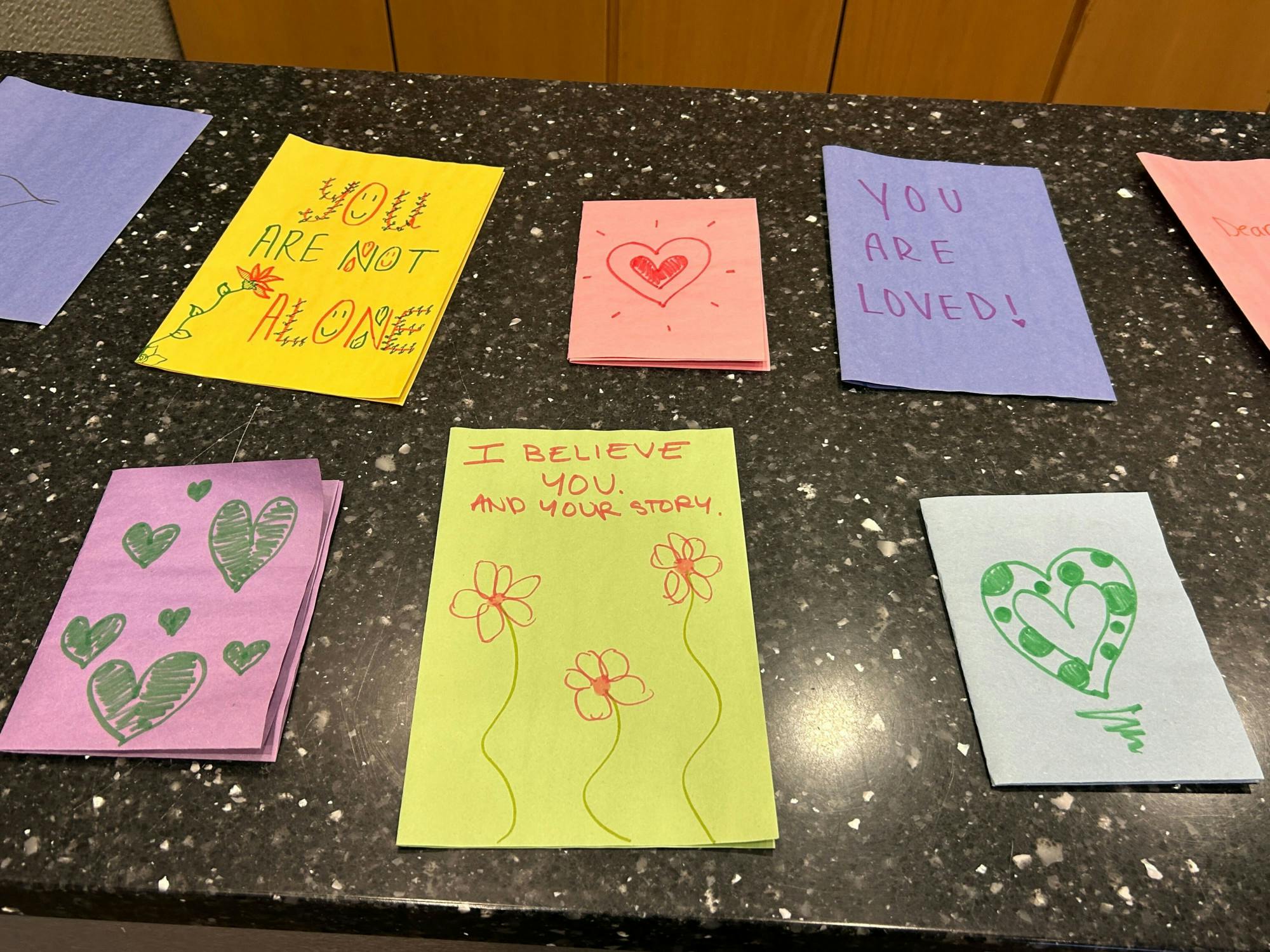
The exhibit contained several letters and posters addressed to student survivors. One letter on green paper and decorated with flowers read, “You are brave, you are important, you are worthy, don’t forget you matter!” A poster read, “I believe you and your story.”
“I wish people would listen to and believe survivors more, and that they wouldn’t have to fight so hard simply to be heard,” the student told the Cardinal.
The historical timeline mentioned Laura Dunn, a former UW-Madison student athlete who filed a Title IX complaint against the university following an assault by members of the men’s rowing team when she was a freshman.
“It was late. I wanted to be safe. I had no reason not to trust them. I thought rape was a stranger jumping out of an alley attacking you with a knife. I didn’t have any narrative where it’s someone I knew,” Dunn said in an interview with People Magazine in 2017.
Now a victim’s rights lawyer, Dunn was on a committee that helped regulate the 2014 Campus SaVE Act, mandating sexual violence education for students of federally funded universities.
Student survivors were invited to take blue ribbons with supportive messages pinned to a corkboard and leave ribbons of their own.
“It is our collective responsibility — each and every one of us — to practice healthy relationships, support survivors and create a campus climate that is safe and respectful for all,” Caradonna said.
Sonia Bendre is the campus news editor for The Daily Cardinal. You can reach her at sonia.bendre@dailycardinal.com.