The state of Wisconsin ranks third-to-last in the nation in funding for the arts, according to the National Assembly of State Arts Agencies. The state spends 18 cents per capita on arts funding, while neighboring Minnesota spends $7.85 per capita and ranks first in arts funding.
Despite this, the Madison arts community hasn’t stopped supporting the arts.
Brenda Baker and Bird Ross are the founders of the Women Artists Forward Fund, an organization dedicated to recognizing women artists and providing support to address gender disparities in the arts. Through the Forward Art Prize, they provide financial support by awarding two Dane County-based female artists $10,000 each year.
The idea for the fund came during the pair’s creation of “Being Forward,” a photographic collection honoring women artists and philanthropists in celebration of the Wisconsin State Capitol’s 100th anniversary. After completing the project, Baker and Ross wanted to do more.
“We were highlighting … a deficiency, but what we really needed to do is do something about the deficiency,” Ross said.
The Women Artists Forward Fund awarded its first prizes in 2019, hoping to help offset the lack of state funding. Since then, multiple University of Wisconsin-Madison alumni have received the award.
“It's important to the community,” Ross said. “It's important to the survival of women artists staying in Madison.”
In 2024, UW-Madison Master of Fine Arts alum Rebecca Kautz received the prize after applying for six consecutive years. Every year, her portfolio and application got stronger. She received the news that she had won by phone from Baker.
“Beyond the financial, it's having a committee of your peers, arts professionals, that look at a lot of work and say, ‘this is worthy,’” Kautz said. “This recognition is just tremendous.”
Along with applying for grants and other funding sources, Kautz runs her own studio practice. Her art spans a variety of mediums, including painting, drawing and performance art. She has always been passionate about art, and she draws inspiration primarily from what’s happening in her head.
“I think that my work is still very much connected to this sort of therapeutic process,” Kautz said. “It’s just how I talk, it's just how I breathe, it's just what I do.”
Arts economy
As if minimal funding wasn’t a big enough threat, there is also an increased conversation about the value of arts degrees and the profitability of human art. A rise in digitization, an unstable economy and job losses have led to this sentiment, among other factors.
22-year-old Nola Bantle-Felt found art at a young age and followed that passion through high school. Bantle-Felt is a current UW-Madison senior pursuing a Bachelor of Fine Arts degree, despite entering her freshman year as a Wildlife Ecology major.
“I just really missed making art, and I gave myself no time or priority to do it,” Bantle-Felt said. “I felt like something was missing.”
Although she acknowledges the potential struggles of the art field, for her, an art degree is invaluable. After finishing her undergraduate degree, Bantle-Felt hopes to pursue a graduate degree and become a professor.
“It proves that I’ve done the work,” Bantle-Felt said. “It shows a level of commitment.”
Kautz echoed this statement and believes the cost of an arts degree is worth the return.
“I'm paying for the time to devote to actually establishing some kind of a practice,” she said.
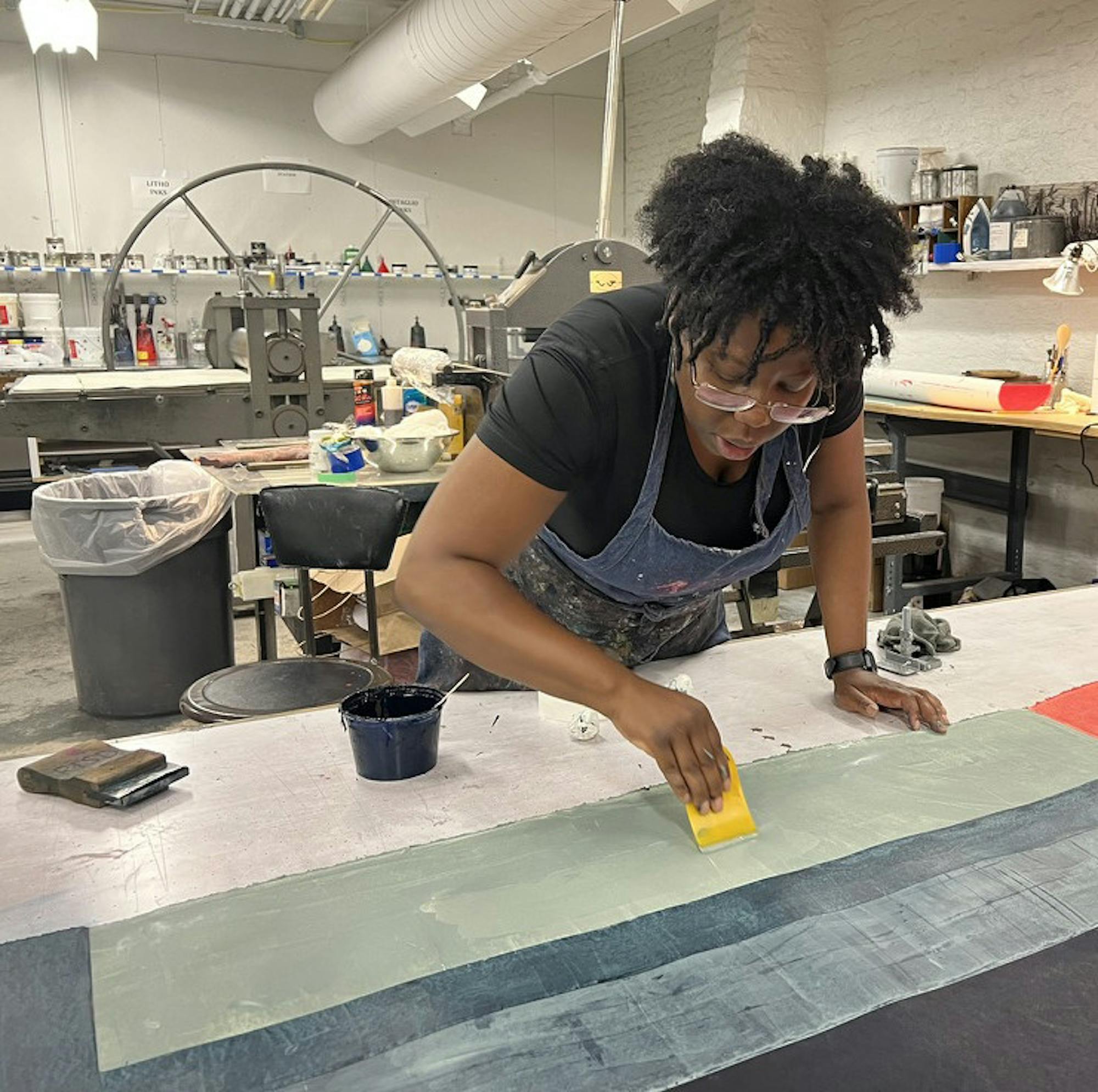
UW-Madison Master of Fine Arts alumna Tyanna Buie is living proof of Bantle-Felt’s statement. Buie is an associate professor and graduate program director at the Rhode Island School of Design.
Buie was commissioned to create a large-scale screen-printed piece for the Obama Presidential Center in June 2024. The piece is titled “Be the Change!” and it will be her biggest and most viewed piece to date. She credits this achievement to her growth during her academic career.
“I knew in undergrad, I was just scratching the surface of where I could go,” Buie said. “With Madison being a three-year MFA program, I got to do everything I needed to do to get my art to a place where I felt confident after I graduated.”
Along with growth in technique, Buie highlighted that for artists, an art degree expands their network, provides access to resources and teaches artists how to present their work. Buie acknowledged that it’s hard for art students coming out of college, but that their struggles post-graduation aren’t unique to the field.
“We still honor degrees in this country,” Buie said. “We still value college at a very high place, yet we are telling poor people that it's not worth it to send your kid to art school.”
Although the value of a degree varies by artist, Buie, Kautz and Bantle-Felt share the same goal of creating, having an outlet and highlighting the importance of art.
“[Art is] so important not only for the artists themselves but also just for the world at large,” Bantle-Felt said. “Art influences so much, and it moves with the social and political movements.”
Along with a degree, funders like Baker and Ross are invaluable to the arts community. They open opportunities for artists and increase access.
“We should care about funding art because it allows artists to follow their passions and to create these important artistic works,” Bantle-Felt said. “It allows art to be for everyone.”
Amid a challenging arts environment, those in the field are optimistic, encouraging artists to keep pursuing their passion.
“If you are a real artist and you love art making, you'll always find a way to make the work,” Kautz said. “No matter if you decide to drop out or to continue with your degree, you will find a way.”