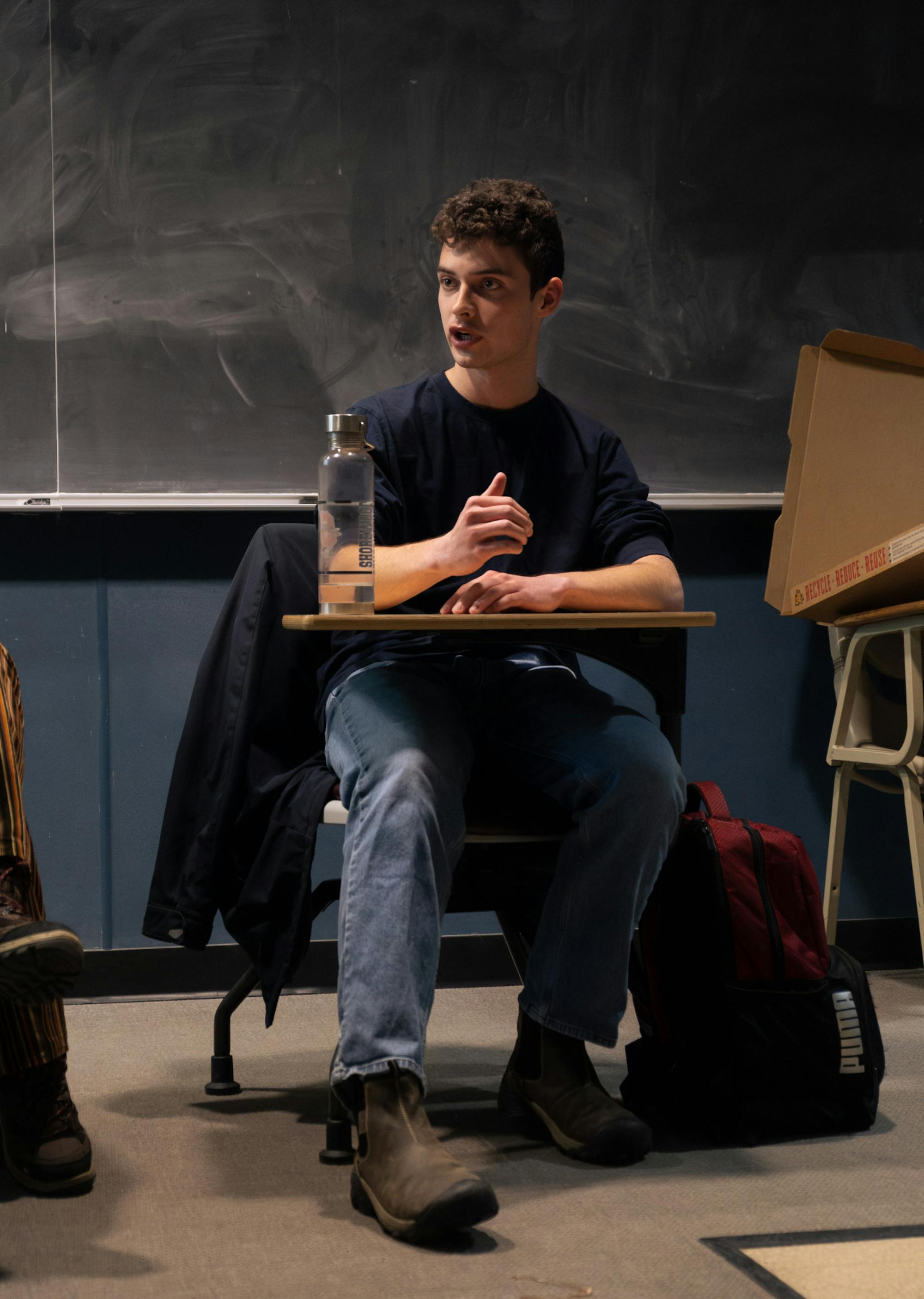
District 8 alder candidate and University of Wisconsin-Madison sophomore Bobby Gronert discussed affordable housing, transit and policing in an interview with The Daily Cardinal.
Gronert emphasized his role in a greater student movement to make Madison a more affordable and welcoming city by creating long term change. He said he supports public housing initiatives and not increasing the Madison Police Department budget.
Gronert, a Young Democratic Socialists of America member and endorsee, is running against UW College Democrats-endorsed candidate Ellen Zhang in the upcoming April 7 Election. MGR Govidarajan, the current District 8 alder, will not seek reelection.
This interview has been edited for clarity and brevity.
Tell me about yourself. Why do you want to become a Madison alder?
I've been working in my community as an organizer for the past five years in Milwaukee and Madison. In Milwaukee, I fought on my school board for my teachers and won for them, and I was a part of the Palestine encampment at UW-Milwaukee.
Here in Madison, I've been working with local rapid response networks, preparing for if ICE comes. With the Associated Students of Madison, I have been defending student funding for Sex Out Loud, University Health Services, Muslim Student Association — groups that have come under some attack recently.
I decided to run for Common Council because I was asked by my peers, and through looking at what the Common Council can do around housing and transit and issues that I've always cared about, I decided this was a good way to help protect and provide for my community.
Many students face less-than-ideal landlord situations in Madison, with poor management and rent hikes. What will you do as an alder to help these students deal with dismissive landlords and rent hikes?
We have a legal system designed with huge barriers of time and money — prohibitive barriers, to make it harder for tenants to hold their landlords accountable. This is to make it easier for landlords to exploit their tenants, and it needs to change.
YDSA, in the vein of Milwaukee State Assemblyman and then-County Board Supervisor Ryan Clancy, proposed a universal legal defense for all tenants in Milwaukee County, which has been a very effective policy there. To bring that here would make sure that every tenant has access to free legal defense, or legal protection when they're advancing cases against their land or defending against evictions.
What is your plan to support building new housing units that will be competitive in pricing while providing quality housing for residents?
This gets to the heart of the problem with the current housing market and the structure of the private market as a whole. When you're talking about increasing supply, we're just increasing supply of luxury apartments. We're not actually increasing supply of what we need.
We don't need more apartments that cost $1,300 a month. We need more apartments that cost $800, $700 a month. I think the only way to do that is by having public intervention in the market. There are two ways that we can do that.
The first is public housing. The value of public housing is that it's run by the city. You're cutting out the profiteering landlord, and you're building a city. You can be sure what it's going to be like and how it’s going to be managed.
But it is more expensive to build. That's where landbacking comes into the equation. Landbacking is buying land for the city and then leasing that land to developers. We're able to, since we own the land, put restrictions on it. We can't do zoning in this state by saying that you have to have a certain amount of affordable units. But if we own land, we can tell the developer, “Hey, we're not leasing this to you unless you do that.”
What is your plan to support Metro Transit in Madison?
This subject I'm very passionate about. I think we have a good system here in Madison. I like the expansion of Bus Rapid Transit. It was a very good choice in my opinion, but we're a growing city. We're going to keep growing. We will have half a million people in 25 years. We need to grow our train system with that. I think that for students, there's a lot of demand for late night bus service.
No one likes having to walk home half an hour in the freezing cold because the buses aren't coming anymore. I think it's an issue of convenience and public safety.
You and Ellen are similar in a lot of ways. What’s the biggest way you two differ?
I think the biggest thing that differentiates us is the organization behind us.
We're trying to build a student movement in Madison that will be able to, in 10 or 15 years, affect change. We're trying to really build it, and that will last longer and will be bigger than me. One person in two years is not going to be able to get much done there. You need more people, you need more time.
I think the biggest thing is just the movement we are building. In two years, I'm not going to be an undergrad. I'm going to leave this seat. But I hope that we can build a real movement that can keep someone else in this seat who has the same future focus and priorities.
When you're looking at the ballot on April 7, it's my name, but you're not voting for me. You’re voting for a student and worker-led grassroots movement to fight for a future Madison that's welcome and affordable to all.
You are a Young Democratic Socialists of America member. What does the organization do, and what is their role in your campaign?
I’ve been a part of it now for five years. I started in high school in Milwaukee in one of the youth branches of the Democrat Socialists of America. We would do work around ongoing issues in politics to try and fight for a better future.
We have working groups that do different things — one for immigrants’ rights, one for anti-imperialism. You know, fighting. We have some members fighting to prepare for ICE coming to Madison and some members fighting to try and win divestment from the United Arab Emirates and Israel and other countries engaged in imperialist and genocidal actions.
I'm a proud socialist. YDSA really is the backbone of this campaign, I'm proud to say, and they're not the only organization. We have unions involved. We have different student groups involved, like the Students Against Mass Incarceration. YDSA does great work, and I'm very proud to be a member.
What, if anything, do you believe was positive about MGR's time in office? Is there something he started that you wish to continue? What makes you different?
He worked very hard during his time in office on a couple of projects. I think that he brought a lot of money into District 8. He was very good at working on the Common Council with others to get new projects done, to get more money put in the district with Regent Street Street construction, with lighting, the bike path and other various improvements in the area. I'd say he's a good example of how you can work with your colleagues to really benefit your constituents.
I've said before, I'm not the biggest fan of his decision on Dairy Drive and how he responded to constituents around that. I've heard, talking to student groups, many of them have said MGR came to them back then and was holding a lot of stuff and just didn't speak to them after he got elected. I think we're up to build on MGRs achievements. I hope to fight for more change.
What measures would you take regarding public safety and policing in Madison?
Just about a week ago, it was the 11th anniversary of the murder of Tony Robinson, who was killed by Matt Kinney, a MPD officer who is still on the force and has killed another man since. He is now training officers, which is quite frankly ludicrous.
Madison absolutely has problems with policing, racialized policing and police brutality. I think the CARES program has been a great first step toward ensuring that with mental health crises, we don't see police responding — we just see mental health responders responding.
I would love to keep funding CARES and keep trying to expand as much as we can to have it be that when mental health crises happen. Quite frankly, police are not trained to deal with that. I think we don't need to give any more funding to MPD. I think they're large enough as it is.
I hope to see more action from MPD’s independent police monitor in the coming years. I'd love to work to ensure that we're having real accountability for those who are being given the power to enforce our laws. So, I'd love to see more accountability and love to see a stronger, better community with police response only when necessary.
Many of your proposals are similar to ones that have already been implemented by the City of Madison. How do you plan on exceeding the effort already in place?
I think the city in a lot of ways has done great things. I think the Housing Forward initiative is great, but I think we should push further on it. I think we did that with Parkside Triangle.
That's a great example of public housing using state and federal grants to get that done. I think we should expand that. I think Madison's a city where we've seen a tradition of radicalism and a tradition of progressivism.
I really want to expand those proposals and also talk about them, not just looking at problems as being simply one off thing but as being systemic issues and part of wider systems that we need to change in the long term.
I think that one of the unique parts of our campaign is the focus on both addressing problems in the short term and solving them in the long term.