With an influx of DePop resellers, some University of Wisconsin-Madison students see thrifting second-hand clothing as a status symbol in and of itself — a wide turn from thrifting’s once humble reputation.
“It kind of becomes more performative, because people thrift solely for the purpose of selling rather than actually reusing it for a while,” said Kiera Plotner, a Depop seller and UW-Madison fashion student. “It used to be people who genuinely wanted to thrift for a good cause.”
Since 2019, thrift stores have seen a 39.5% increase in foot traffic. As styles from the 90s and early 2000s re-emerge and cement themselves in pop culture, one way to reign as ‘fashionable’ is to shop these styles from the source.
UW-Madison fashion student Colleen Duffy said, reflecting on growing up in the Chicago suburbs, “It used to be entirely older people…at least where I live, we really didn’t ever see a white person in the stores — but now that's basically all you see.”
There’s a new ambiance in local thrift stores or bins. Instead of shopping out of necessity, it's now about competition. There's a fierce fight to find the best item, the rarest brand, the trendiest t-shirts.
“When I see a man in a [thrifted] carhartt jacket, I run the other way. That’s a bad sign, as we know,” Duffy said.
Plotner’s online shop “Repurpose With a Purpose” takes second-hand clothing that is damaged or otherwise unwanted and transforms it into something new.
“I’m not just buying the first clothes I see [or] finding clothes that are more trendy,” Plotner said. “There’s a reason for which I make the clothes, not just that it’s popular on social media.”
With retailers taking notice of resale’s success, chain thrift stores like Goodwill have reflected this in their prices. Madison residents reported on Reddit that children's t-shirts were priced at $3.99.
Goodwill has also been criticized for its ‘Goodwill Marketplace’ where they sell donated items online for market prices.
“I feel like I used to be able to buy a shirt for like $2, now it’s not likely,” Duffy said.
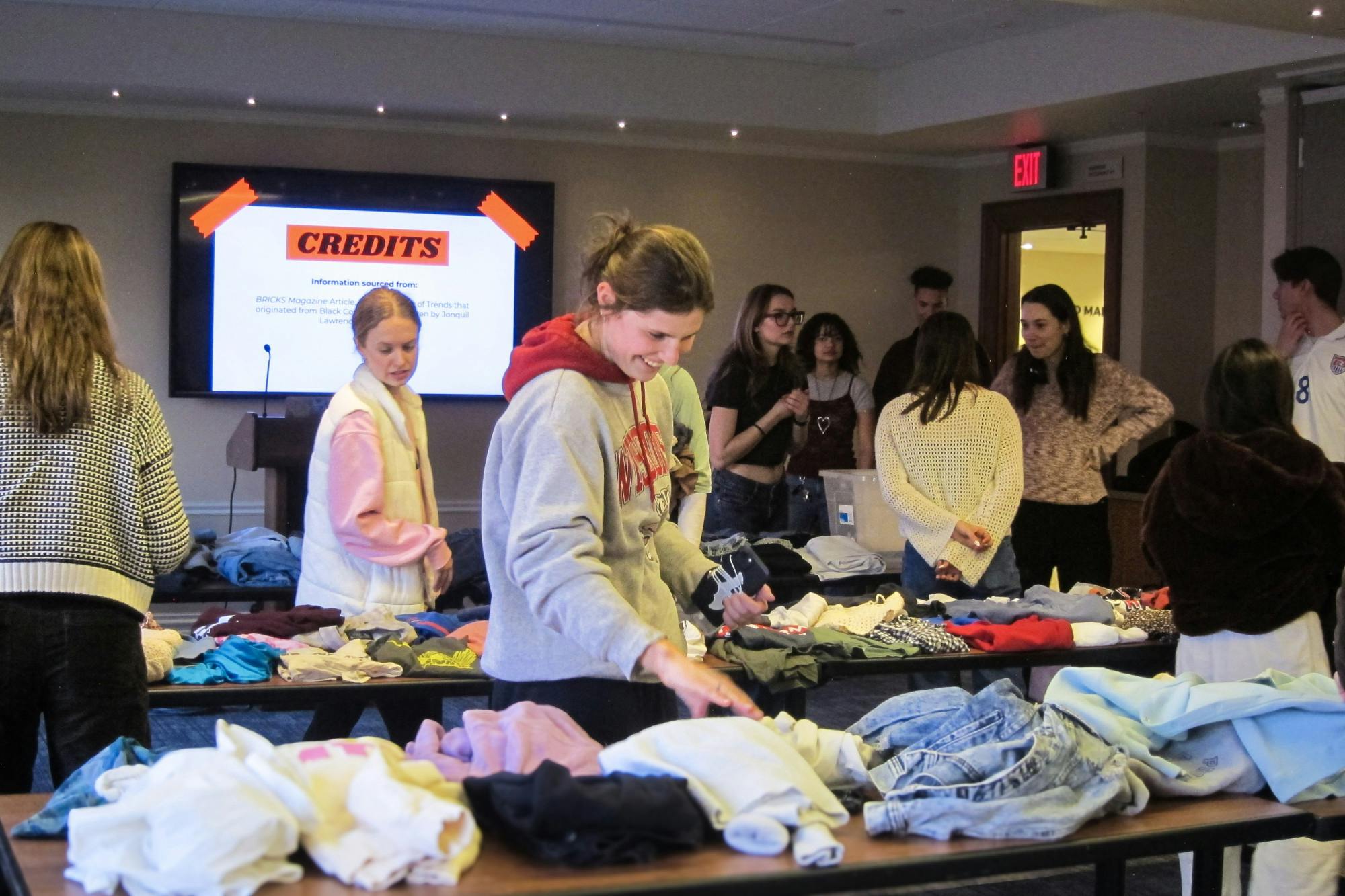
At a Re-Wear It swap, small piles of clothes cover tables. Students can browse, try on and chat without having to worry about price gouging.
“People really kind of take what they need,” Re-Wear It President Jordyn Czyzewski told The Daily Cardinal.
Every other week, the organization hosts ‘swaps’ — where students can donate and pick-up clothing completely for free.
“You don’t have to donate clothes to come and take clothes. I think that’s a really important part of our mission, just trying to make sure that everyone who wants to come and access is more than welcome to,” Czyzewski said.
Czyzewski said students don’t exploit the program and only take what they need.
“We haven’t had any problems with that at all,” Czyzewski said. “We really try to make it clear that our mission is to have the best outcomes for students.”
Traditional thrift stores in recent years have posed a higher risk to overconsumption and waste. Because of the lower cost, consumers are prone to impulse buying.
“It’s ultimately devaluing the clothing in general…if you’re buying something and you don’t actually wear it and use it to its full potential…it just repeats the cycle of buying it and not using it,” Duffy said.
Anika Kozlowski, a UW-Madison researcher and assistant professor, said donation quality is a major issue for stores to handle. Organizations do not have the resources to manage unwearable items, so this clothing just gets sent to landfills anyway.
“Oftentimes, a lot of our donated stuff ends up exported out, and then it ends up in other people’s landfills…generally in the Global South,” Kozlowski said.
In 2018, the U.S. exported around 790 tons of clothing to various countries.
Kozlowski said part of the problem is that there is not a lot of great recycling infrastructure in North America, so exporting waste to other countries is often the cheapest, most efficient option for thrift stores.
“It keeps flowing through a path of least resistance,” she said.
It’s something UW-Madison design professor Marianne Fairbanks sees as a shame.
“What a burden that other countries have to take our rejected clothing. It just doesn’t make sense,” Fairbanks said.
Increasingly, this waste has also become more synthetic. Clothing from ‘fast fashion’ brands like Zara, Shein and Target rely on cheap, plastic materials to get their clothes on the shelves as fast as possible.
“Fast fashion is trend driven and quickly produced with often cheap materials…the things that end up on the shelves are not generally well made, or made to endure,” Fairbanks said. “I think when we choose something that’s polyester, it’s been positioned as eco friendly…and yet, the microplastics that are a part of that are still something we need to think about deeply.”
Kozlowski contextualized the issue further, saying landfills in the Global South are not as highly engineered as those in the West. She said many landfills in the US are able to capture methane and have plastic liners to keep out toxic byproduct. “A lot of places where second hand clothes are exported to don’t have these…[so] they can clog dialer gutters, which causes health issues,” she said.
Re-Wear It helps divert this plastic excess before it ends up in foreign lands and oceans.
“If you donate to a Re-Wear It swap, it’ll stay in the campus community,” Czyzewski said.“I’ve picked up a donated item at a Re-Wear It swap, worn it a few times, and then I decided to donate it back. A few weeks later, at a different swap, I saw someone wearing what I donated.”
Re-Wear Its’ excess clothes are even upcycled with Kozlowski using their excess for creative projects and workshops with students.
Czyzewski still warns of the dangers of overconsumption, especially as a college student.
“Thrifting can be a really good tool, but when it’s used in excess or overconsumed a lot of the time, it can become a negative,” Czyzewski said. “[It’s] almost like fast fashion thrifting.”
Cyzyewski said Re-Wear It’s local ties help reduce her consumption habits. “It helps to think about, in what ways can I find this through someone else, through my community network?”