Forward Theater’s latest production places a spotlight — or rather, a streetlight — on the experience of American immigrants, with Martyna Majok’s dark comedy “Ironbound” set to run from Jan. 29 to Feb. 15 at Overture Center.
“Ironbound” examines the life of Darja (Cassandra Bissell), a Polish immigrant whose story is told through a series of moments captured by the desolate setting of a city bus stop. She seems to be trapped in a perpetual state of waiting. And while she waits for the bus, she is also waiting for her son to return home, her love life to heal and her life to turn around.
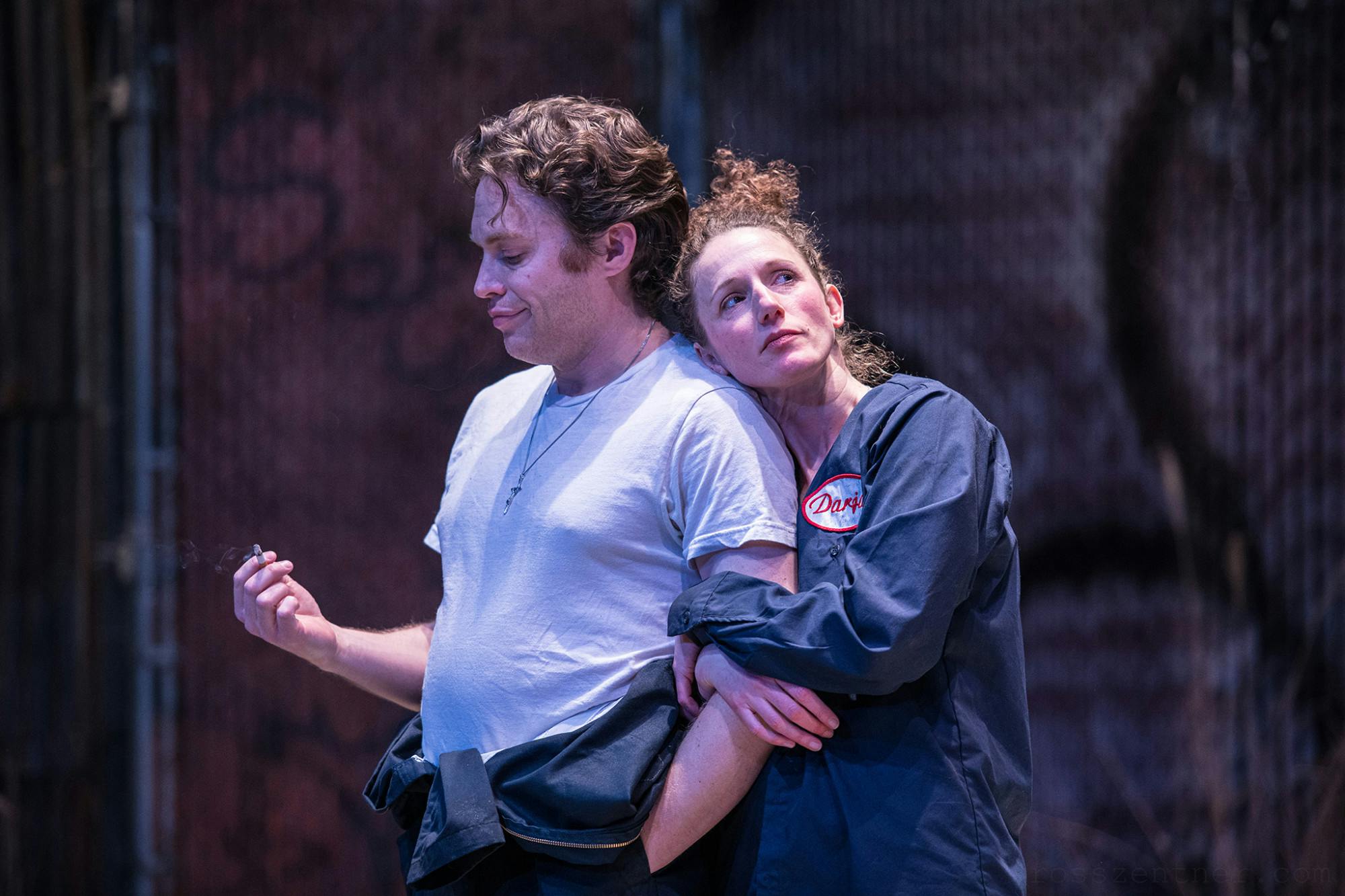
In the present day, Darja is in a relationship with an American man named Tommy (Jonathan Wainwright). Their journey throughout the play is driven by conflict in their relationship.
Wainwright keeps the audience feeling conflicted about Tommy’s suitability for Darja. He is able to turn empathy into disapproval, and back again, within moments — an impressive skill that contributes massively to the audience’s emotional connection to the story as a whole.
Flashbacks show a younger Darja at the bus stop with her first husband, another Polish immigrant named Maks (Josh Krause).
The pair hold a sense of youthful optimism between them. Maks dreams of moving to Chicago, planning to pursue his passion for music. It becomes increasingly clear that this ambition will lead to the collapse of their relationship, as Darja’s choices reflect her prioritization of security over love or dreams.
Maks’s actions arguably do not hurt Darja as badly as Tommy’s. However, he lacks Tommy’s likability.
Krause and Wainwright’s contrasting portrayals are responsible for the varying emotions that their characters elicit. While Wainwright allows Tommy to yield himself to Darja, Krause brings a strength and defensiveness to Maks that keeps him and Darja from having the same emotional connection.
Perhaps the most impactful interaction held at the bus stop is between Darja and Vic (Gabriel Anderle), a teenage boy who discovers her curled up beneath the bus stop’s bench. Vic empathizes with Darja in a way that neither of her romantic partners were able to, though he is not able to express it effectively.
Anderle is truly captivating as Vic. In many ways, his portrayal mirrors Bissell’s portrayal of Darja, as both actors expertly balance their characters’ struggles to mask their troubles with their desires to be understood.
It would be wrong to refer to Vic as the comedic relief of the play, as there is no true relief from the striking realness of these characters. However, Anderle’s charm elicits many moments of laughter, making Vic’s scene with Darja one of the most heartbreaking and memorable examinations of humanity within the entire play.
The intense realness of “Ironbound” is largely owed to the precise details of the set. Scenic designer Lisa Schlenker crafted an impressive replica of a run-down bus stop, complete with cracked pavement, scattered trash and graffiti.
Arching above the bench where Darja’s story unfolds is a tall streetlight. This light is always shining down brightly, representing the bus stop’s role as a place where Darja’s truth is unmasked and put on display.
Such careful precision in designing the story’s environment has succeeded in sending a clear message to the audience: this play is a snapshot of someone’s reality. Upon entering the theater, any person is able to immediately recognize the setting. It is a place everyone has seen and likely avoided before.
But Darja does not have the luxury of avoiding the bus stop. For her, it is a place of comfort, even though it cannot always offer her safety. This reflects Darja’s constant conflict between love and security throughout the play.
Bissell’s body language communicates this conflict beautifully. As Darja, she places a shield around herself. This manifests in the masked emotions expressed subtly on her face, the confidence or lack thereof in her stance and the way she interacts physically with the three men joining her at the bus stop.
Darja is a woman who everyone has passed by at some point in their lives. The realism in Bissell’s performance is what makes this production so impactful. She is hilariously witty, devastatingly vulnerable and, above all, incredibly human.
“Ironbound” is a snapshot of reality. It brings into focus the idea of the American Dream, taking the audience on a bumpy, yet beautiful journey of hope, resilience and discovery through the eyes of one woman representing millions of others in America.