The Super Bowl has always been an explosion of branding, celebrity and patriotism compressed into a single night of unity and celebration. What unfolded around this year’s halftime show, however, revealed something less polished: a divided country arguing about political undertones.
When Bad Bunny was announced as the headliner, criticism surfaced almost immediately. The objection was not that he lacked popularity — after all, Bad Bunny was Spotify’s most streamed artist of 2025 with 19.8 billion streams. It was because his discography is recorded overwhelmingly in Spanish. The debate became whether or not he truly represented America.
For many viewers, seeing a Puerto Rican artist perform primarily in Spanish on a large platform meant recognition. Spanish is the most spoken non-English language in the United States. Latin music continues to dominate global charts. Latino communities — in more ways than one — shape the country’s economy, politics and culture. Visibility at that scale reflects reality.
Yet representation in Spanish on a major national stage triggered discomfort for some viewers. The main criticism, that the show was “not representative” of the country, propelled an already ongoing debate: who gets to define the center of a national narrative?
The U.S. has never been culturally singular. It has always been a melting pot of diversity shaped by migration, reinvention and tension. Still, there is a persistent attachment to a narrower image of what it means to be an American — one that is implicitly monolingual and historically dominant.
This conversation is not uniquely American. Many countries wrestle with similar anxieties as demographics shift and cultural influence diversifies. But due to the United States’ global prominence, its internal debates frequently play out in public view. The halftime show became less about entertainment and more about symbolic ownership — about who is seen, who is centered and who is still expected to remain peripheral.
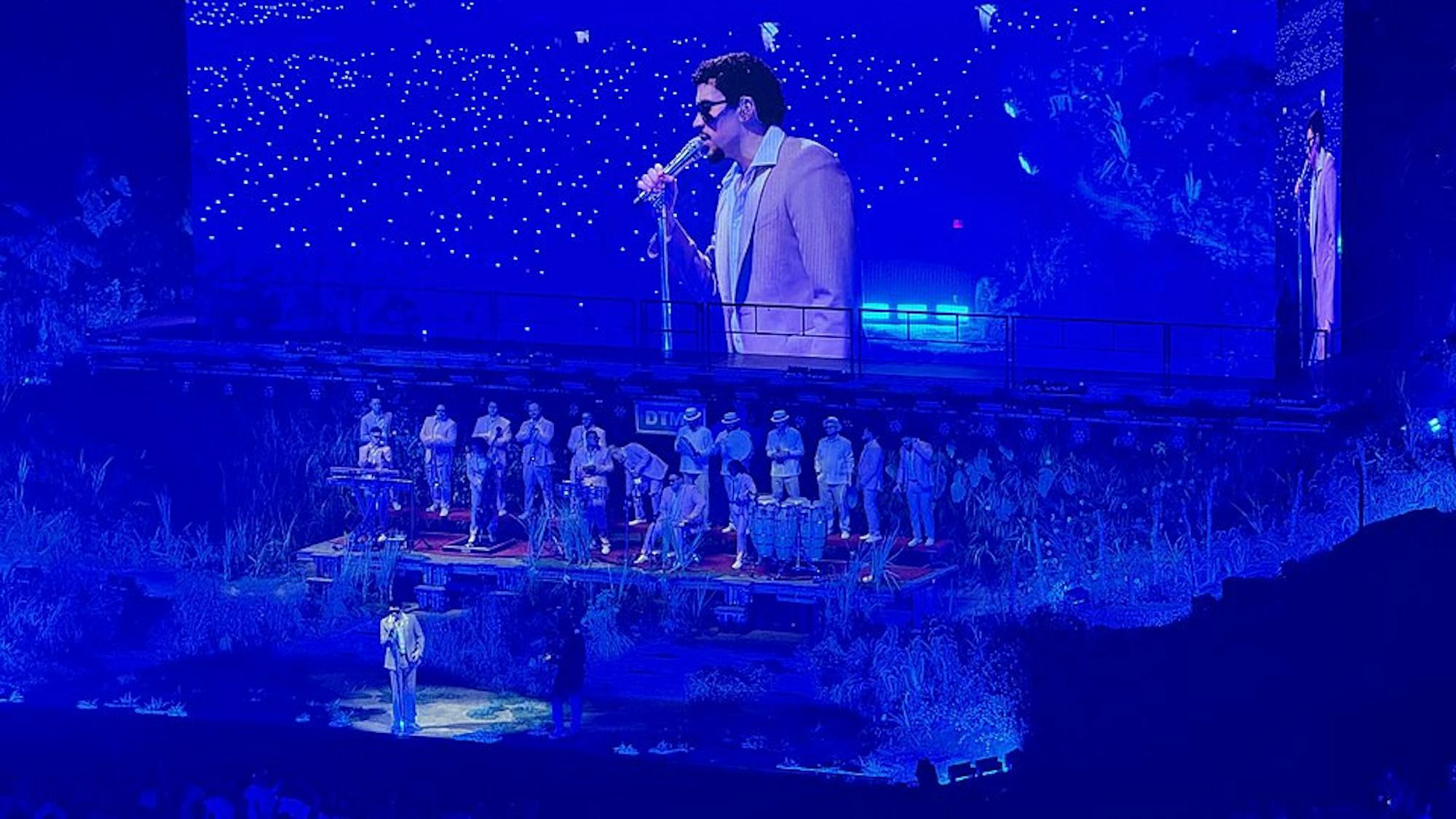
As if to answer this, a message appeared across the stadium’s massive screen during the performance: “The only thing more powerful than hate is love.”
The line was simple, but in context, it was pointed.
The backlash that preceded and succeeded the show demonstrated that art and language are politicized. A Spanish-language performance was interpreted by some not as inclusion, but as exclusion. This particular reaction reflects the belief that belonging is finite. If one identity becomes more visible, another must be diminished.
But identity is not a limited resource. National narratives are not static monuments. They are living constructions, shaped by demographic shifts and cultural exchange. The United States is becoming more diverse. Younger generations are more multilingual and multiracial than any before them. Cultural influence moves across borders with ease. These changes are not ideological arguments. They are measurable realities. Pride is not provocation, and representation is not replacement.
These evolving definitions of what it means to be American are signals of growth, not loss. Identity should not always be preserved in a fixed form to remain legitimate. Hate thrives on such fear, narrowing belonging and insisting on rigid boundaries. It treats difference as a threat. Love, on the other hand, demands something harder. It requires accepting that national identity is not static. It asks whether the center can expand without collapsing. It challenges the instinct to interpret someone else’s visibility as personal displacement.
While the halftime show lasted just fifteen minutes, the debate surrounding it reflects decades of unresolved tension about who belongs at the symbolic center of the United States. If belonging depends on exclusion, it will always be fragile. If national identity cannot accommodate linguistic and cultural plurality, it does not reflect the country as it exists. Bad Bunny’s halftime show became a question America needs to answer: is expansion a threat, or is it simply the next chapter in a story that has never been singular to begin with?
Lily Andrias is a freshman studying Electrical Engineering. Do you agree that Bad Bunny's Super Bowl performance forced America to confront who it is willing to see at its center? Send all comments to opinion@dailycardinal.com