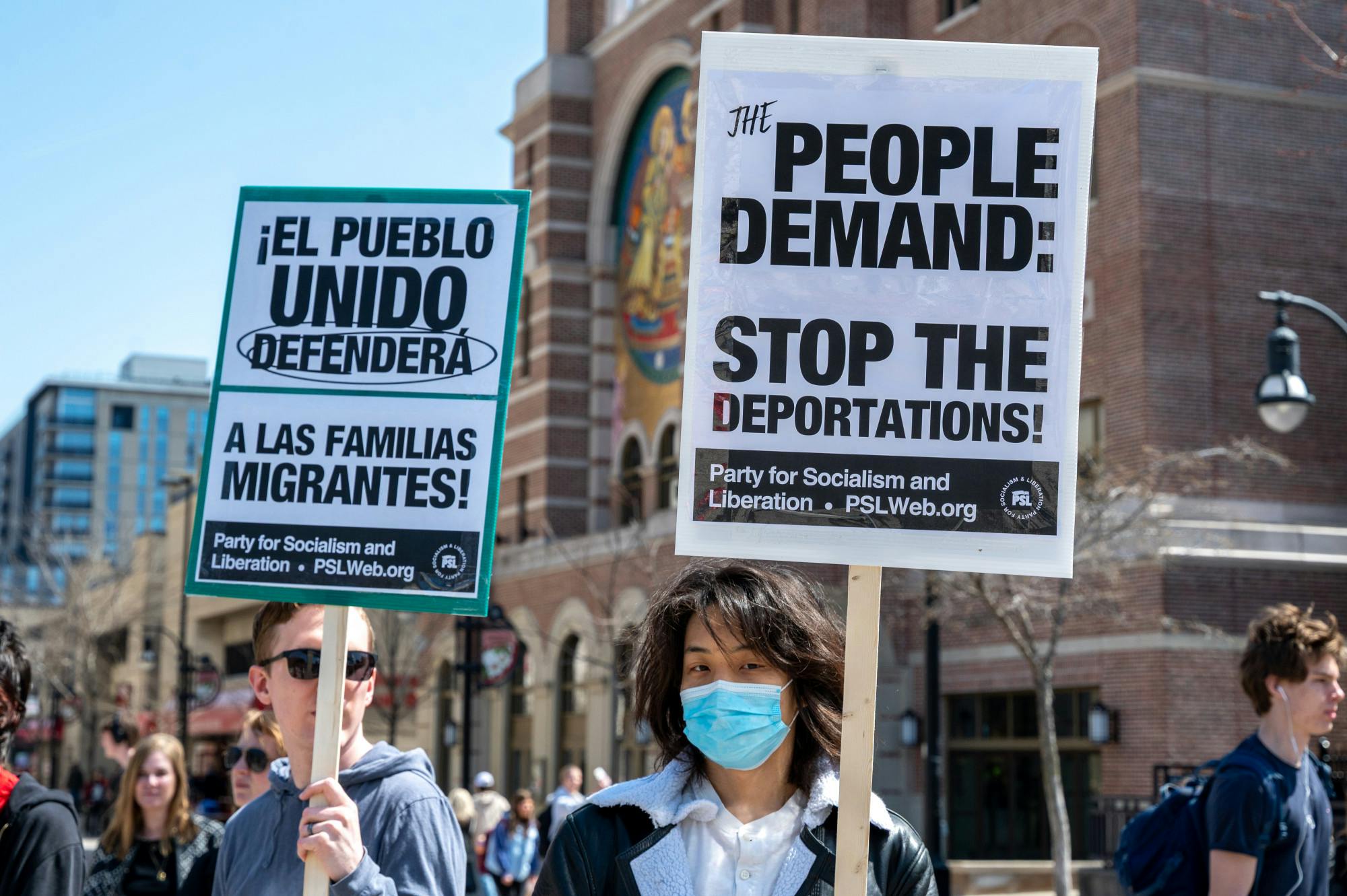
The United States has always had a strong response to periods of economic fluctuation: the call for increased deportations. This is political theater and the government’s way of redirecting public anxiety and putting the strain on vulnerable communities, minorities and marginalized people. During economic downturns, labor instability and financial stress lead to heightened immigration enforcement.
These fluctuations themselves foster fear among communities. Rising inflation, job insecurity and market volatility all create curiosity, leaving people with more questions than answers. Rather than confronting these issues, the U.S. would rather find a scapegoat: immigrants.
History shows a pattern of this. During the Great Depression, the U.S. government carried out mass “repatriations” of Mexican and Mexican-American communities, many of whom were legal U.S. citizens. For a long time, immigrants have been framed as “job-stealers” despite evidence showing deportations did little to improve the economy. What these actions did provide was political reassurance — the appearance that something was being done.
Similar patterns arose during the economic volatility of the 1970s, when inflation and industrial decline coincided with increased border enforcement and rhetoric about “illegal labor.” During the 2008 financial crisis, immigration raids and deportations surged once more. Although the collapse was driven by financial speculation and regulatory collapse, immigration was once again used as a point of blame.
When the economy becomes unstable, immigration enforcement becomes a show of support for citizens. Deportation is sold as an economic solution, but it instead functions more as an emotional fallback. Immigrants become a target for futile American frustration and discourse. This allows political leaders to claim they are protecting workers without addressing why they are struggling in the first place and getting at the root of the issue.
As a result, anti-immigrant rhetoric spikes during times of uncertainty, because it plays into longstanding ideas regarding who belongs in this country and who is seen as “deserving” of economic prosperity. The idea that removing immigrants will restore the economy is an unfounded, baseless claim grasping at straws even when utterly false.
In truth, immigrants are deeply embedded into the U.S. economy. They are the backbone of our nation. They work in fields spanning across service industries — healthcare, construction, agriculture and manufacturing; sectors that are often hit the hardest during periods of economic hardship. Deportations only worsen these industries, making recovery from an economic struggle more difficult.
Studies project that mass deportation reduces overall economic output, shrinks GDP and lower wages for high-skill workers. This affects nearly two-thirds of the labor force. Rather than stabilizing industries, deportation policies lead to labor shortages, skyrocketing prices and communities being pulled apart.
Despite these consequences, deportation remains a political tool because it shifts blame.
This pattern is even visible today. As inflation, housing costs and a poor job market dominate public discourse, creating greater rifts between people and government, immigration has once again become a central motivator for economic solutions, creating greater fear among immigrants too. Frustration is being repackaged as anxiety over safety and “illegal aliens.” Structural inequality is reframed as migration crises.
According to the Federal Joint Economic Committee, immigrants have expanded the labor supply by nearly $580 billion in taxes alone, boosting the U.S. economy, not funneling from it.
However, the truth is that economic instability is cyclical, and so is scapegoating. Deportation spikes aren’t reactions to just immigration levels but to moments when the U.S. government fails to deliver stable economic growth. Rather than addressing those failures, policymakers reach for the easiest way out: increased deportation and enforcement.
These actions tear families apart, further destabilize struggling communities and create lasting fear among immigrant populations, people of color and even those with legal status. Struggles include families arrested in their driveways and innocent people being killed in the streets. Entire communities have learned that economic struggles have always led to violence and punishment, not protection like promised.
Recognizing this pattern reveals the true function of deportation policy. It doesn’t fix the economy; it manages public perception during a crisis to protect political leaders, not the common man.
Breaking this cycle calls for acknowledging that immigration is not the root cause, nor does it impact economic fluctuation as direly as many make it seem. It is simply an excuse to avoid deeper reform.
Economic justice cannot be met with exclusion. Stability can’t be built by removing those who founded and keep this country running. Until policymakers stop using deportation as a distraction, the same response and same harm will come from economic crises.
History has already brought us here, to this point of destruction. The question is whether we are willing to learn from it.
Safa Razvi is a sophomore studying journalism and serves as the Opinion Editor for The Daily Cardinal. Do you believe the economy and deportation rates are correlated? Send all comments to opinion@dailycardinal.com