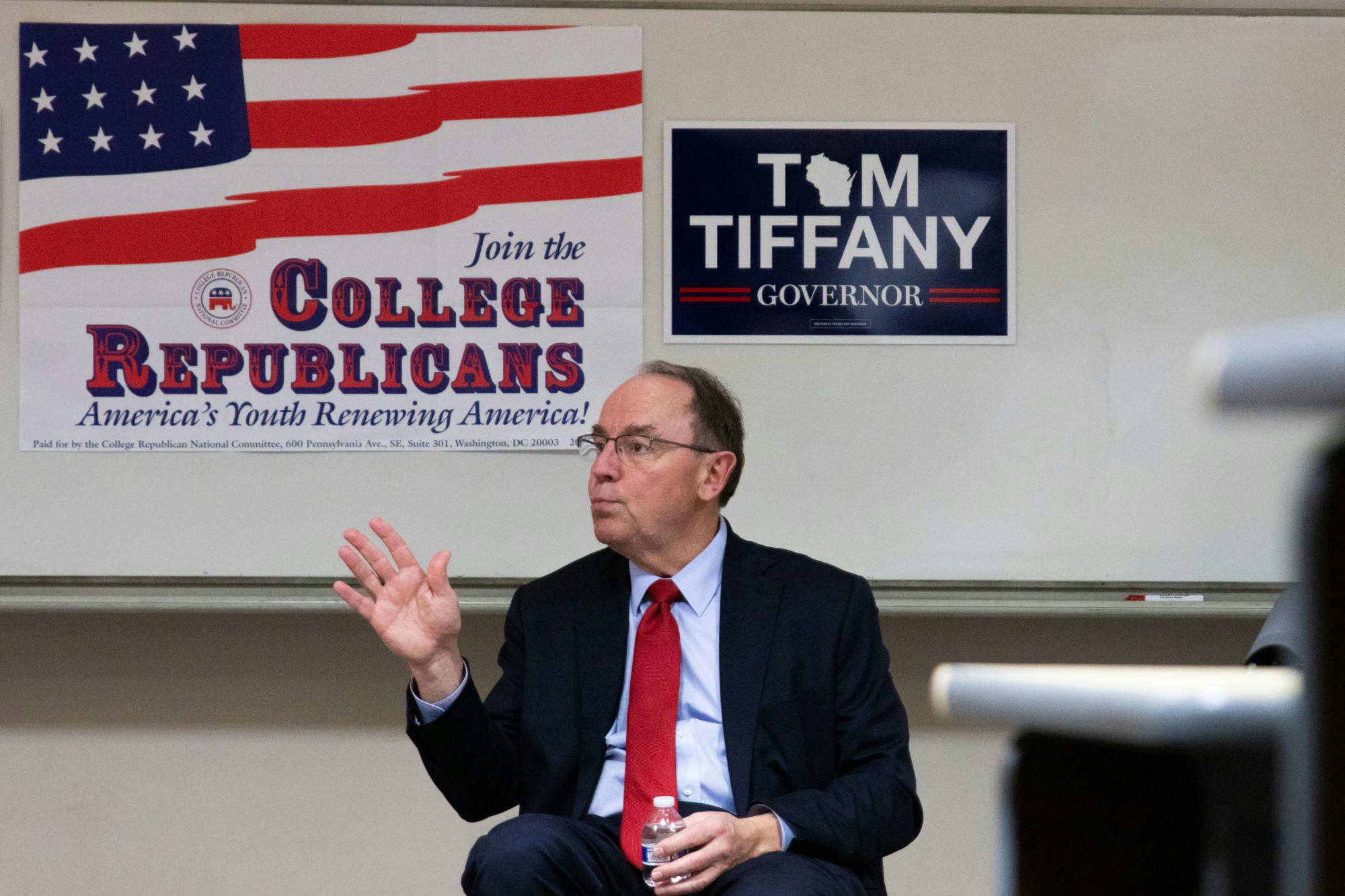
Republican gubernatorial frontrunner Tom Tiffany discussed plans for a University of Wisconsin System tuition freeze, campus free speech policy and marijuana reform in a campus event hosted by UW College Republicans.
Tiffany, who announced his bid for governor last September, currently serves as a U.S. representative for Wisconsin’s 7th congressional district. Following President Donald Trump’s endorsement, he’s the only candidate in the Republican field, with Washington County Executive Josh Schoemann dropping out in January.
If elected, Tiffany said he would impose a tuition freeze on the UW System to compensate for recent tuition hikes and this past year’s $256 million budget from the legislature — the largest funding increase in almost two decades.
Tiffany said he would have to conduct more research before deciding if he would decrease funding in 2027, but said the tuition freeze he would impose would be “in light” of the budget.
“The public has an expectation of us as stewards of their taxpayer dollars,” Tiffany said, adding that he would lower property and income taxes and end Evers’ 400-year K-12 funding increase.
While he said he is not sure how long the tuition freeze would last, he knows he would “certainly do it in the first budget” in 2027.
Tiffany pointed to a 2013 controversy when the UW System revealed approximately $1 billion in unspent tuition revenues, which caused a tuition freeze to go into place which ended in 2021.
“We need to direct more money to the classroom, because that’s ultimately what you are here for,” Tiffany said. “Ultimately, it’s about educating children.” He said education is one of his top policy priorities and understands higher education is the “engine that drives Wisconsin’s economy.”
Free speech
The Foundation for Individual Rights and Expression gave UW-Madison an F grade for free speech on campus. The survey shows that of 423 respondents, 35% said using violence to stop someone from speaking on campus is acceptable.
“That’s deeply disturbing,” Tiffany said. “What can we do about it?”
Tiffany said that while he would be willing to implement statutory changes in legislation, he thinks the UW Board of Regents is the key to free speech reform.
Tiffany said he would ask any new regents where they stand on free speech and what they would do to protect it on college campuses before appointing them. He said he believes former Republican Gov. Scott Walker had a “very solid policy” with the regents on free speech, and he hopes to return to that standard.
“I thought the regents did a good job a decade ago, and I think that needs to be reinforced,” Tiffany said.
Republican lawmakers reintroduced a bill in October on free speech on college campuses, referencing the FIRE studying and calling for consequences for universities that violate free speech. The bill passed the legislature, but Evers told The Daily Cardinal in January he would veto it if it reached his desk.
Marijuana
Tiffany said he would not fully legalize marijuana, unlike many Democratic candidates in the race.
He referred to a recent New York Times editorial addressing a growing concern over marijuana abuse in the United States. Tiffany said he worries about cannabis-induced psychosis and calls for more research on medical use, which he voted for in 2022.
“You should not be smoking that right now,” Tiffany said, “It will chew up your brain.”
Tiffany said he would approve medical marijuana use but would wait for more research before legalizing recreational use.
The gubernatorial primary will take place on Aug. 11, 2026.
Audrey Lopez-Stane is the state news editor for The Daily Cardinal. She has written in-depth on free speech on campus, higher education and elections including the Wisconsin Supreme Court race and upcoming governor primary. Audrey previously interned at WisPolitics and now works for Wisconsin Watch. Follow her on X @ALopezStane.