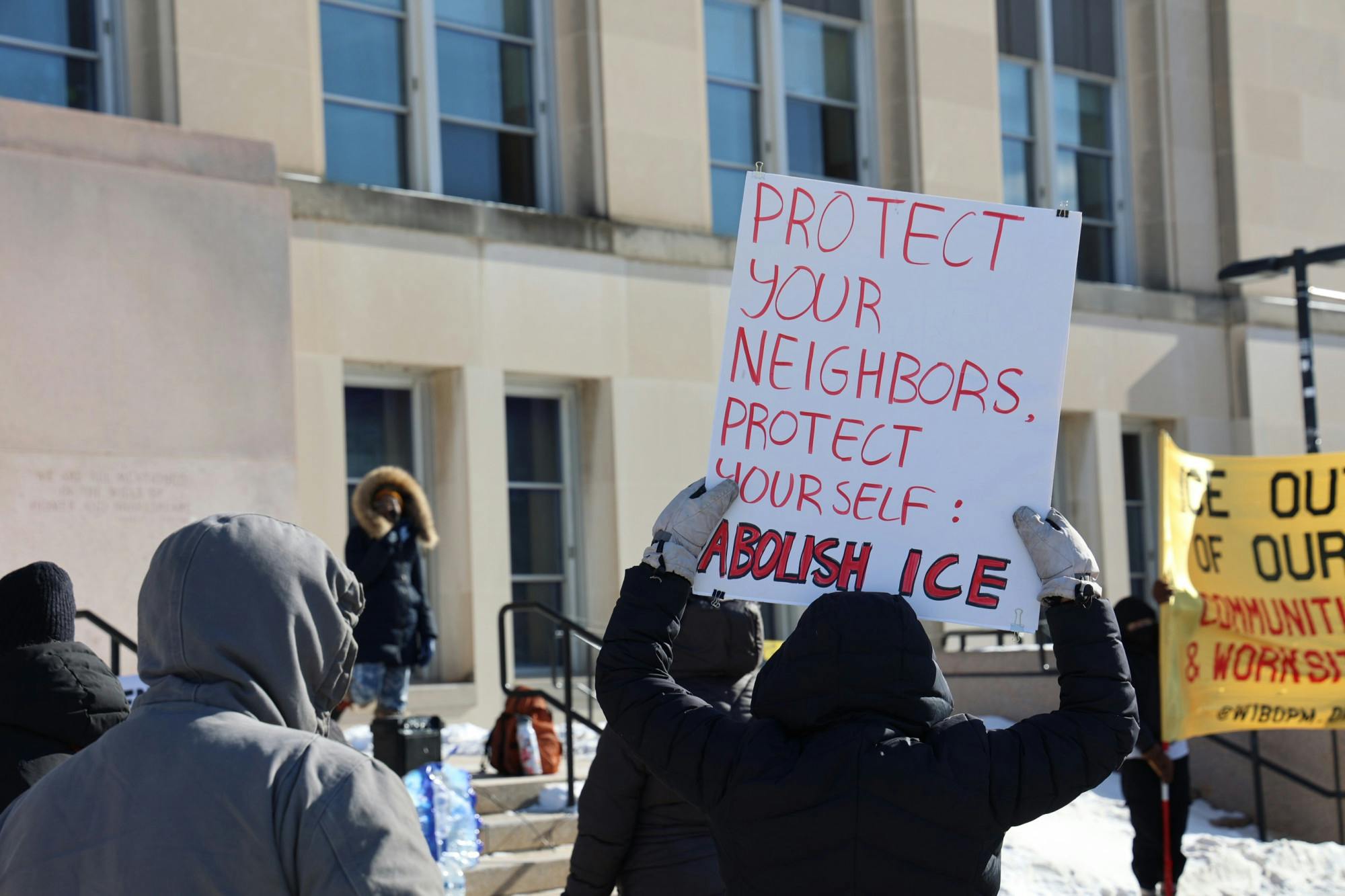
University of Wisconsin-Madison community members from Minnesota say the recent escalation of Immigration and Customs Enforcement agents in Minneapolis has left them feeling frightened, angry and helpless — while also prompting renewed conversations about community, resistance and collective action.
Many Badgers come from Minnesota due to an in-state tuition reciprocity agreement, with about 10% of the UW-Madison undergraduate population calling Minnesota home.
Ruby Davies-Larson, a sophomore from south Minneapolis, told The Daily Cardinal that news of ICE in the city felt deeply personal, given the role immigrant communities play in shaping the region’s culture and identity.
“Anyone who’s from Minneapolis, or even Minnesota in general, can agree that immigrants make up our community,” Davies-Larson said. “They give us our culture. They’re established here.”
Davies-Larson said her initial reaction to ICE’s presence was fear — not only for immigrants in the city, but for friends and neighbors.
“I was terrified for my community,” she said. “I had no idea what to expect or what I could even do.”
While ICE activity in Minnesota is not new, Davies-Larson said this time felt different, describing a noticeable shift in tone and intensity.
“Something felt targeted,” she said.
That fear, she said, intensified following the shooting deaths of Renee Nicole Good and Alex Pretti by federal agents. Davies-Larson described a growing sense of helplessness and distrust in legal and ethical safeguards.
“It’s become blatantly morbid,” she said. “People say, ‘They can’t do that, that’s illegal,’ but they are doing it. You can’t fall back on the law anymore.”
Davies-Larson said witnessing ICE agents regularly during her winter break made the situation feel unavoidable.
“You see them everyday,” she said. “Driving around, walking around, people getting arrested. It’s everywhere — in Minneapolis and the surrounding suburbs.”
Cooper Markley, a freshman from suburbs west of the Twin Cities, said much of his experience with ICE has been indirect, coming through friends, family members and teachers in Minneapolis. Still, he said the emotional toll has been significant.
“If I had to give it one word, it’s heartbreaking,” Markley said.
Having moved to Minnesota as a child, Markley said the state’s reputation for kindness and openness feels at odds with what he sees unfolding.
“No matter where you go in Minnesota, you find the same sense of home,” he said. “It’s awful how the current administration is trying to take advantage of that and turn Minneapolis into a headline instead of an amazing city.”
Assistant Professor Kong Pheng Pha, whose hometown is also Minneapolis, said he feels “very removed” from the situation.
“I watch every day from the vantage point of Madison and feel despair that I'm not there, and I can't go out and support,” Pha said. “I would love to visit the memorials that were set up at the locations where the two killings essentially had happened … It's been hard to not be able to go there and witness that and pay my respects to those folks who were killed by ICE.”
But Pha said he believes Minnesota can come out of this stronger than before.
“Minnesota has been a site where we’ve seen many uprisings and revolutions, and with each moment of destruction comes renewal,” Pha said. “Through [the Black Lives Matter and police accountability movements], the community got stronger and people were looking out more for each other.”
He said this moment will make people realize community and mutual aid are at the root of what will empower Minnesota and the Twin Cities to “come out of the fire,” and ICE’s presence is mobilizing cross-generational, transracial and interclass solidarity.
“This is a moment where even though we're facing a lot of uncertainty and difficulty and sadness, I'm seeing a lot of renewal and resistance that I have never seen before,” Pha said. “I think that's a really beautiful thing.”
Both students emphasized the importance of collective action, particularly among young people and college students.
Davies-Larson said showing up — even in the smallest of ways — matters.
“People want to help, but they don’t know how,” she said. “Just being there, showing up at rallies and protests, showing up for immigrants — that's powerful.”
She pointed to the large protests happening in Minneapolis as evidence of that impact.
“They sent out about 2,000 agents, but over 50,000 people showed up,” Davies-Larson said. “We are always going to outnumber them.”
Markley urged UW-Madison students to continue to use their voices.
“Be loud,” he said. “If every single person uses their voice, no matter how small, it adds up.”
He also suggested universities could take institutional steps, such as adopting sanctuary campus policies, to show solidarity with affected communities and to protect its students.
Markley acknowledged that fear — particularly from parents concerned about safety — can discourage students from speaking out, but those conversations are necessary.
“That fear is a huge inhibitor to change,” he said. “Standing up for the right thing, even when it’s scary, is what has to happen.”
Davies-Larson stressed the issue extends beyond politics.
“This is humanity,” Davies-Larson said. “These are real people with families and lives.”
She said the situation is a reminder that immigration enforcement policies have immediate and personal consequences, even for those watching from across state lines.
“This isn’t abstract,” Davies-Larson said. “This is happening to our people.”
Alaina Walsh is the editor-in-chief for The Daily Cardinal. She formally served as the associates news editor and as the city news editor. She has covered breaking news on city crimes, a variety of state and campus issues, the 2024 presidential election and the UW-Madison budget. You can follow her on twitter at @alaina_wal4347