The University of Wisconsin-Madison has required international students with partial or full teaching assistant appointments to prove their English fluency for decades, but now, amid heightened federal funding uncertainty, some international graduate students say departments are using the test to force them out.
Consequences for failing the language test differ by department and year, and this year, some students say those consequences have become increasingly punitive.
While UW-Madison has lost $27 million in research funding in the past year, John, an international student given a pseudonym for privacy, told The Daily Cardinal departments are “taking advantage of the SPEAK test to get rid of the international students.” UW-Madison saw a greater than 27% drop in new international graduate students between the 2023 and 2024 fall semester.
John turned down offers from universities like Johns Hopkins for a PhD at UW-Madison. When he spoke to the Cardinal last fall, he feared his funding would be terminated. He has since transferred to a different university, despite scoring a 45 on his November test, which would have allowed him to TA in the spring semester.
“I came here for [UW-Madison’s] reputation and its good graduate school,” John said. “But gradually, I found out that it's not a fact. They treat the international students rudely, and some instructors and staff even take advantage of the SPEAK test.”
Even for students who initially fail the oral communication test, called the SPEAK test, Letters & Science departments have a responsibility to continue supporting students if they demonstrate improvement and follow interventions. According to international students, departments have threatened not to follow through.
What is the SPEAK test?
The nine-question, 15-minute SPEAK test for international TAs aims to “evaluate the spoken English of International TAs,” according to a UW-Madison International TA Training webpage. The test is online and administered through HonorLock, the same software undergraduate students use to take their placement math and English tests. Two raters independently evaluate tests.
Tests are graded on a scale from 20 to 60, with 40 indicating “somewhat effective” communication skills and 50 “generally effective” communication. If students score a 45, they can serve as TAs, but must take supplementary English as a Second Language (ESL) coursework; without a 45, they cannot be TAs. Students who did not score a 50 must retake the test after ESL coursework until they score a 50.
“Students who do not pass typically demonstrate clear challenges in grammatical accuracy, pronunciation, and fluency — not simply accented speech,” UW-Madison spokesperson Gillian Drummond told The Daily Cardinal in an email.
She said about 10%, or 33 students, who took the SPEAK test in 2025 scored below a 45, with 28% of students scoring a 45. The test can be retaken every three months and is graded by two out of 11 total graders, five of whom are former international TAs.
Students report discrimination, policy inconsistencies
John first heard of the SPEAK test weeks before the first summer test date and did not pass his first two attempts in May and August, respectively, scoring a 40 on both. Failing the SPEAK test meant he could not serve as a TA during the fall semester, as the next available opportunity to retake the test was in November.
“There's three international students in our department this year, and all of us failed the SPEAK test twice,” John said.
At first, it appeared that John’s STEM department would not follow L&S guidelines to “continue to financially support students” so long as they followed interventions.
“On the first day I came here, they told me that I should [go] back to my homeland — they can’t afford me anymore because I failed the SPEAK test,” he told the Cardinal.
UW-Madison received a 17% cut to federal grant funding in 2025, and all academic units were instructed to implement 5-10% budget cuts this year.
The second day, department staff told John he could receive support from a selective departmental award for graduate students. But later it became uncertain whether funding would follow.
“The next week, they told me that maybe I should self-fund my graduate study, and I should return to my homeland,” John said. “They changed again and again.”
A departmental committee allowed John to serve as a TA in the fall, but not the other two international students.
One more week passed, and plans changed again. In a meeting, John and the two other international students were told their offers would terminate if they failed the November SPEAK test.
John’s offer letter from the department guaranteed five years of funding, contingent on a background check, “meeting departmental standards for spoken English proficiency,” and “satisfactory progress,” but did not indicate whether he had a TA or RA appointment, only that the appointment he received would be the source of his funding.
Part of John’s TA responsibilities included sending a welcome email to students in his course before 11:00 p.m. the day before school started. “Some TAs just ignore the requirement,” he said. When his professor emailed him a reminder, John said he didn’t see the email for two hours, because he was eating dinner.
At around 8:00 p.m., John received a follow-up: “You MUST send out your emails tonight. You did extremely poorly on the SPEAK test, so you may be removed from the TA list, and thus the payroll list, as soon as you fail to meet our expectations. This is your last warning. I don’t have the time and energy to play games with you.”
John said, “They are just taking advantage of the SPEAK test to put pressure on you and ask you to do more work for them.”
John said in a separate incident, his graduate coordinator told the three international students, “‘It's all you international students' responsibility to deal with such things. We can offer nothing to you, and it's your own choice to come here. We don’t ask you to come here.’”
Other students in John’s department, who had arrived before last fall, told John they had not passed the SPEAK test on their first attempts yet had been able to serve as TAs and receive their salary, while concurrently taking an ESL course.
SPEAK test spreads among international community
Jane, an international TA also given a pseudonym, said student accounts of the university’s SPEAK test policies have been spreading on popular Chinese social media app RedNote, driving international students away from applying to the school.
International students, primarily from China, India and Korea, are essential to UW-Madison, accounting for around $400 million in local revenue and comprising 15% of the student body in 2024. With international students shying away, the school’s cultural cache, research output and program rankings could decrease.
Jane turned down offers from at least three other U.S. universities to attend UW-Madison.
“The reason I chose here is because of the research, and the people here [were] kind during my campus visit,” Jane said, adding that other universities she applied to didn’t have a SPEAK test, only an organized committee to determine English proficiency. “If I knew this, I would really carefully rethink whether I needed to take this offer.”
Her offer letter from a different STEM department than John in fall 2023 didn’t include any mention of the SPEAK test, or contingencies based upon her ability to communicate effectively in English. She was first scheduled to take the test around Christmas in 2023 after her first semester as an RA.
“On a graduate school level, they need to set up some policies, some rules, as to whether the offer should say some details about the SPEAK test, and the consequences for whether you pass or fail the SPEAK test,” Jane said.
SPEAK test follow-ups vary between departments
Drummond said the ESL Program offers support including “targeted instructional assistance and individualized mentoring within the students’ recommended academic ESL courses, which may also include SPEAK Test coaching,” to students who fail the SPEAK Test multiple times. She said most of the support offered “falls outside the ESL Program’s official instructional duties.” The ESL program also connects students with tutors and conversational English partners.
“Many [students] make significant gains in both overall proficiency and their ability to communicate effectively with undergraduate students,” Drummond said.
A sample test on UW-Madison’s website requires students to interpret a comic strip, present information about an event and debate solutions to the energy crisis.
Students agreed the scoring of SPEAK tests were similar across years and departments. But interpretations of scores and follow-ups varied widely by department.
In Jane’s department, “no one cares whether you pass or fail,” she said. Students who fail are recommended to take a second SPEAK test after enrolling in an ESL course. After taking the course, even if students fail the SPEAK test again, the department considers them “qualified to be a TA… because [they’ve] already taken that course.”
She didn’t have any English fluency requirement, nor information about the SPEAK test, in her offer letter.
John said he took the SPEAK test three times in total: twice without the ESL course and once while taking it. This year in his department, he said if students failed the test after enrollment in the ESL course, their funding guarantee was terminated.
“In previous semesters, the policies [were] totally different,” John said. “One student… also failed the SPEAK test and they allowed him to TA normally, just taking the ESL course.”
Seho Son, a PhD student in economics, currently serves as an international TA for Economics 100. Son said his offer letter explicitly stipulated that he had to achieve a score of 45 points or higher to retain his funding guarantee. He scored a 40 on his first and second attempt, then a 45 on his third attempt, allowing him to serve as an international TA while taking ESL 370: International Teaching Assistant Training.
Son said most schools he applied to didn’t have a specific requirement to take a test, only some form of demonstration of English proficiency.
Son, John and Jane heard students in other departments had inconsistent requirements.
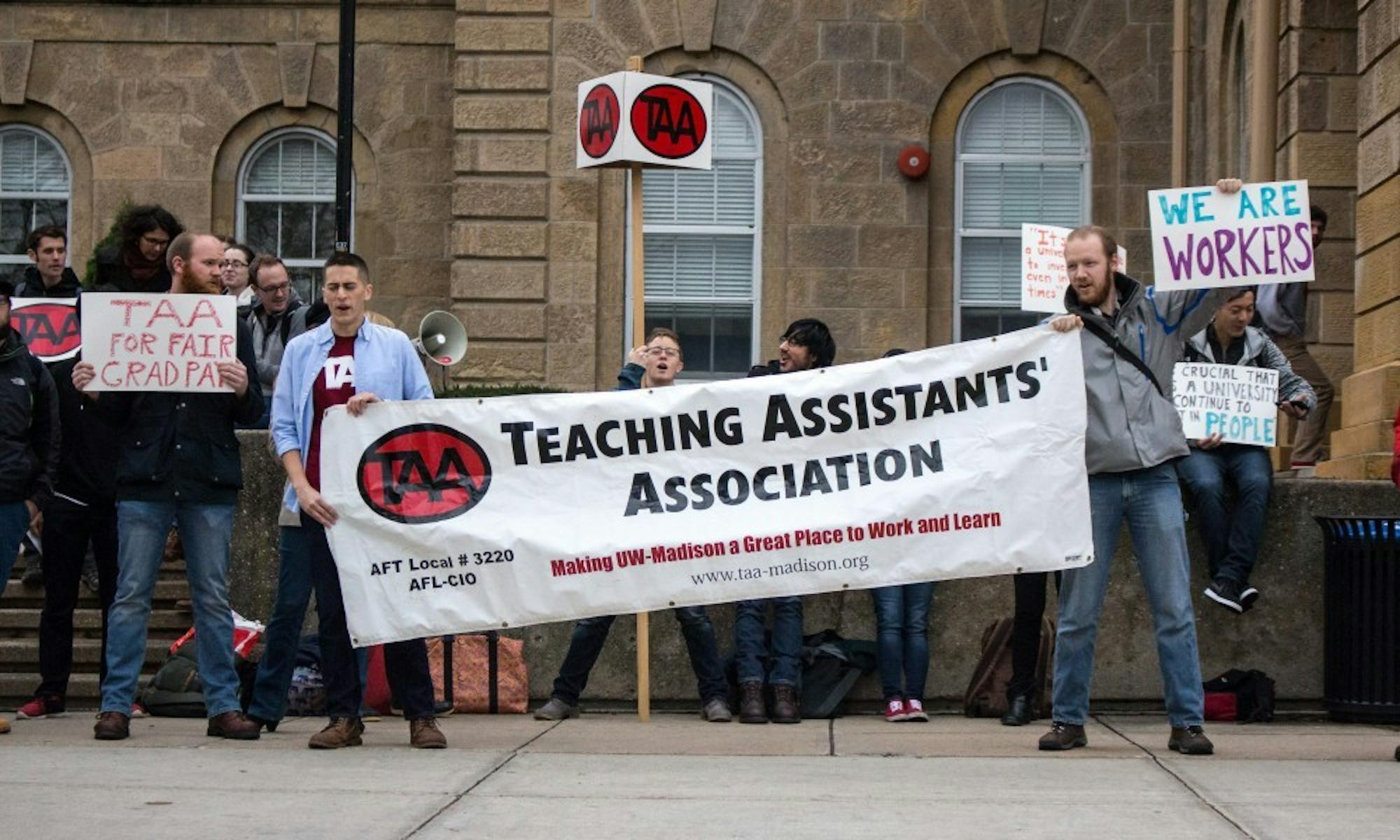
“It would be tragic and self-defeating if departments saw students' falling short on the SPEAK test as a chance to cut spending, rather than an opportunity to learn and grow,” the Teaching Assistants’ Association told the Cardinal in an email statement. “We urge campus administration and individual departments to provide clear and consistent guidance to students taking the SPEAK test and help students get the support they need to further develop their language skills.”
Depending on a department’s discretion, students may be exempted from the SPEAK test by passing other English-language tests with scores. Many students do not pass these metrics alone, and must take the SPEAK test.
John, Jane and Son all said they wished they had received more in-depth instructional materials before their first SPEAK test. John and Jane said they weren’t given a way to study or informed of the test’s structure before their first test, aside from a brief informational packet.
Son was informed of the SPEAK test a month out from the test date. But after failing twice, he took an ESL course he said helped him succeed. His professor, ESL senior lecturer Ludmila Rao, told the Cardinal students can prepare for the test by using pronunciation apps, repeating after their favorite English shows and recording short speeches on topics of interest, then listening and re-recording.
“[On my] third attempt, my ESL teacher gave me a lot of materials, which was very helpful for me to prepare,” Son said. “If they provide students with materials even earlier, then some students can pass the test, even in the early stage.”
Son scored a 45 on the November 2025 test, meeting the cutoff to TA in the spring with additional ESL coursework. He must continuously retake the test until scoring a 50 or higher, according to L&S department guidelines.
Son said he didn’t know exactly what would have happened had he failed. “It’d be impossible for me to serve as a TA this semester,” he said.