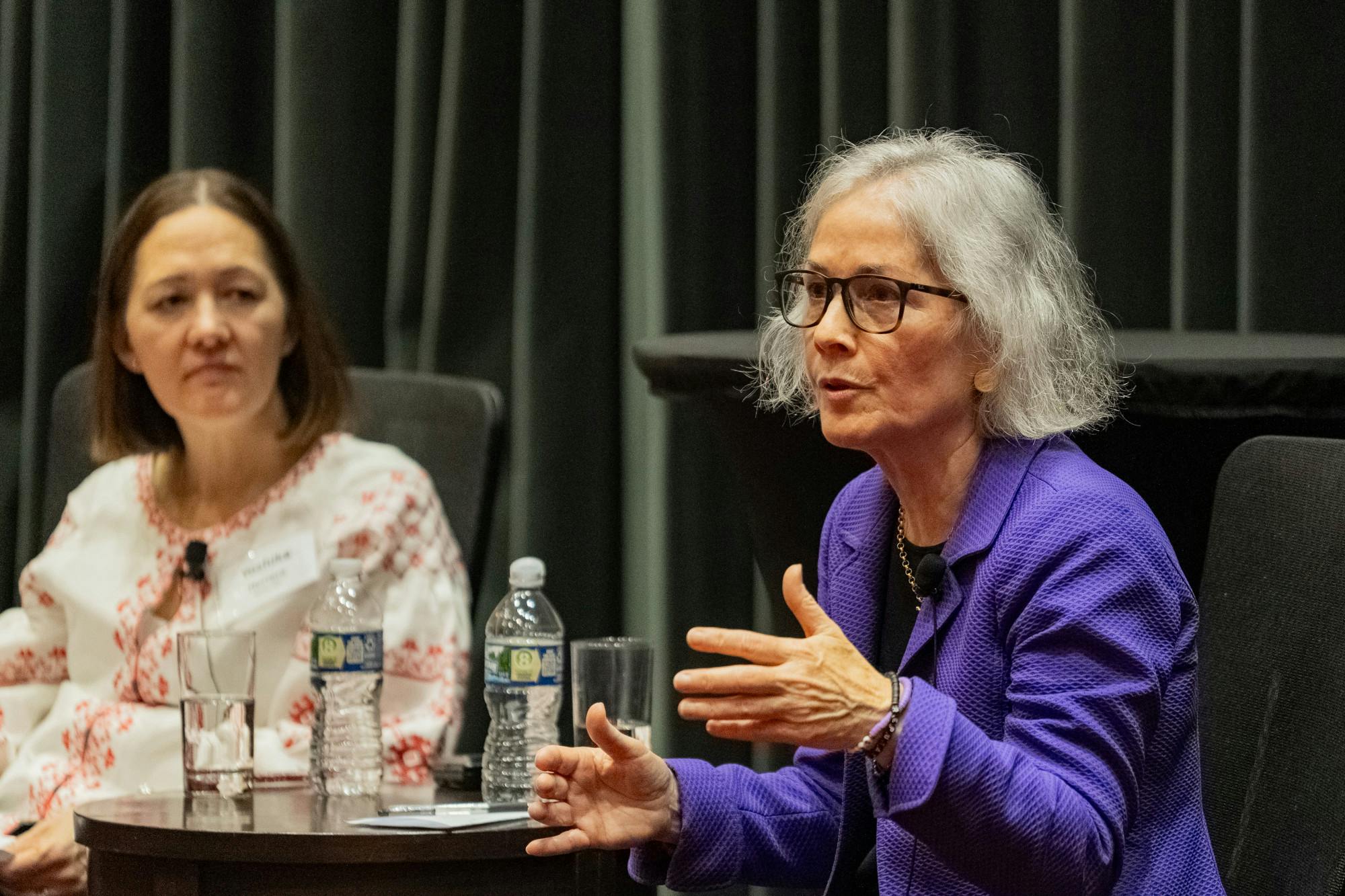
Ambassador Marie Yovanovitch, who served as U.S. ambassador to Ukraine from 2016 to 2019, spoke to community members at the Fluno Center Wednesday in an event with the Madison Committee on Foreign Relations, featuring a moderated Q&A panel with University of Wisconsin-Madison political science professor Yoshiko Herrera.
Yovanovitch said her immigrant family inspired her to join the foreign relations field. Her parents moved to the U.S. from Europe following World War II to pursue economic opportunities and escape religious persecution.
“We were lucky to be in the United States,” Yovanovitch said, “and we needed to give back.”
She encouraged students to think about how to best serve their country. “Freedom isn't free,” she said, “but it's also something that we all need to work at and keep working at to create a more perfect union.”
Yovanovitch began her Foreign Service career at the State Department in 1986. She served as ambassador to the Kyrgyz Republic from 2005 to 2008, then became ambassador to Armenia between 2008 and 2011, before landing as the ambassador to Ukraine in 2016.
In 2019, the State Department asked Yovanovitch to postpone her retirement to provide continuity during the Ukrainian presidential election. At the time, then-former Vice President Joe Biden looked to be the most likely Democratic nominee in the 2020 U.S. election.
Yovanovitch was warned that President Trump’s personal attorney, Rudy Giuliani, wanted the Ukrainian government to start an investigation into Hunter Biden’s dealings in the country. “Giuliani and the American side thought that I would probably not be supportive of that effort to create a made up case against any American, and they were right,” she said.
Her 2022 book “Lessons From the Edge: A Memoir” details the fallout from her removal. “When I went back and I asked what's going on, the Deputy Secretary of State said, ‘We know you've done nothing wrong.’”
Yovanovitch said she never got answers as to why she was removed, but described it as a difficult time. She also criticized Trump making a domestic issue a foreign policy issue. “He's using our national security for his personal and political ends, which is just wrong,” she said. “The American people deserve better than that.”
The discussion turned to the difficulties of working in non-democratic nations and standing up for American values in countries that may not share the same stances on rule of law and liberty. While American diplomats may advocate for democratic reforms, Yovanovitch said the real desire for change must come from the people.
This was the case in 2014 during the anti-corruption Revolution of Dignity that overthrew the Ukrainian government. She said this desire for change is also present in Ukraine today with the ongoing war. “Zelensky is feeling the push from his people on issues of corruption, democracy and also these ongoing negotiations,” Yovanovitch said.
Nearly four years after the war began, Ukrainians are still fighting, and Yovanovitch said Ukraine’s dedication and strength is evident.
“You look at a map and you think Russia is so big, so many more soldiers, bigger population and everything is just bigger,” she said. “But the spirit of the Ukrainian people is bigger, and that's why I think they’ll win.”
When asked what she thought about future negotiations between Russia and Ukraine, Yovanovitch said she wasn’t reassured. “I wish I could be optimistic about that right now, but I'm not.”
She proposed that the Ukrainians have two main strategies: agree to any U.S. negotiations for peace or continue the fight. She has found encouragement in Ukraine’s development of weapons, noting that at the beginning of the war in 2022, they were only able to produce 3% of the weapons they needed and have since become able to produce 50%.
“[Russia is] not winning,” she said. “They are not losing, but neither is Ukraine. And so they're hoping that if they just extend this out over time, that they can prevail.”