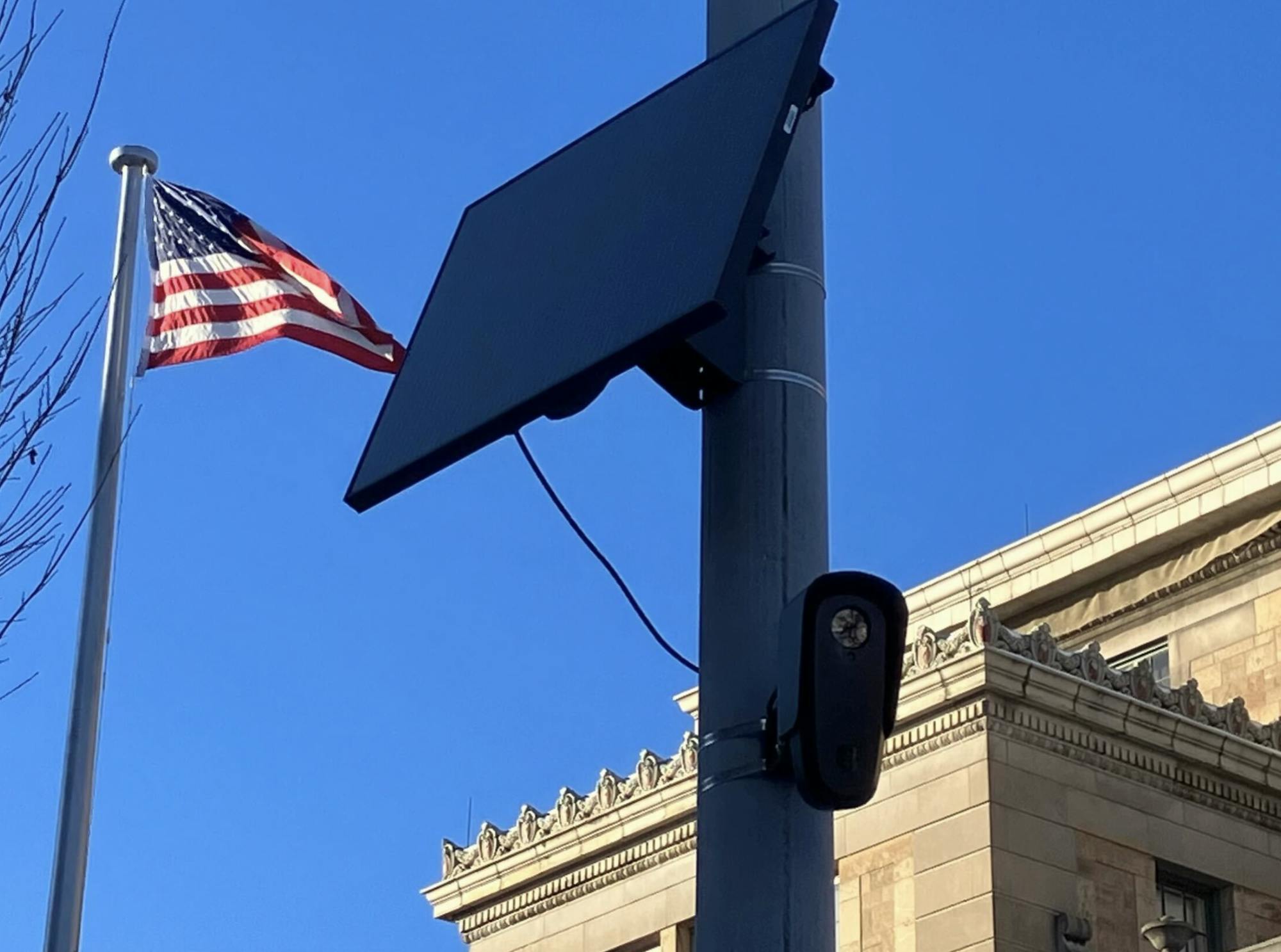
Local activist groups and faculty members are calling out the University of Wisconsin Police Department and technology company Flock Safety over eight security cameras they say bring privacy and security concerns to campus.
UWPD — who has access to the data through a contract with Flock Safety — said the cameras aid law enforcement in solving crimes and are not used for “surveillance” of the community like some suspect.
Flock Safety is a private law enforcement technology company who contracts with local police, providing them with automated license plate readers. The plate-reading cameras now have newer functions, like sharing information across agencies and using artificial intelligence to identify and search vehicles beyond just the license plate. Communities around the country have questioned Flock’s ethics, security, legality and regulation.
Flock cameras are prohibited in Madison Police Department’s jurisdiction because of a Common Council ordinance banning the use of face surveillance technology but near and on campus in UWPD’s jurisdiction and near the Capitol under Capitol Police jurisdiction, Flock cameras operate.
As local police turn toward license plate tracking to solve crimes, federal law enforcement like Immigration and Customs Enforcement is also using Flock Safety data.
UWPD policy says Flock data from campus-area cameras is only shared with in-state law enforcement, UWPD Communications Director Marc Lovicott told The Daily Cardinal in an email. However, Lovicott said he couldn’t speak to what state agencies do with their data.
“Access to the system is restricted to UWPD personnel only, and all access is logged and audited to ensure compliance. Data is shared only with Wisconsin law enforcement agencies — federal agencies do not have access to our Flock cameras,” Lovicott said. “We can't speak to what other agencies in Wisconsin do with their Flock systems or who they share data with… what I can tell you is that we currently only offer access to in-state law enforcement.”
Although Flock Safety does not directly share data with ICE, many departments in Wisconsin already partner with ICE with 13 counties in Wisconsin having agreements to help federal authorities identify and deport undocumented individuals, according to a report from the Wisconsin ACLU.
Members of the University of Wisconsin-Madison’s Faculty union, United Faculty and Academic Staff Union (UFAS), criticized the Flock Safety cameras, raising concerns about data protection.
“How is this sharing happening? Are they cutting a copy of the data and sending it to the state of Wisconsin, because at that point they no longer know what happens to that copy of the data. Somebody at the state level could be sending it to the feds, and we would not know,” UFAS member and UW-Madison Information School faculty Dorothea Salo told the Cardinal.
Eleven of the 13 county sheriffs’ offices who agreed to partner with ICE showed up in a Flock data audit — yet it is still unclear what information was used, according to an analysis by the Wisconsin Examiner.
Additionally, UFAS members expressed worries over transparency.
“I think one of the things that's concerning is how little we know. UWPD didn't make any announcements… There's no transparency about how this is being done,” Co-President of UFAS Barret Elward told the Cardinal. “They're not violating the legality of Madison general ordinance but they are violating the spirit by having these face surveillance technologies in the city of Madison.”
Despite UWPD saying they do not share data with federal agencies, Salo still believes the cameras should not be used.
“What this does is set up an antagonistic relationship between the campus community and the campus police, and I don't think that is ever productive. I don't think it's good that we should have to worry about campus police really overreaching their mandate to keep campus safe,” Salo said.
Salo shared reported instances where the company reinstalled cameras following orders from city officials to remove them, with city officials turning to physically covering them with trashbags. Additionally, in December 2025, Flock left control panels for some of their cameras open to the internet where anyone was able to watch footage.
Across the country, citizens have sued municipalities over the Flock system. In Virginia, residents argued Norfolk violated their Fourth Amendment rights, which protects against unreasonable searches and seizures requiring law enforcement to typically obtain a warrant to track a person's movements.
Democratic lawmakers are urging the Federal Trade Commission to investigate Flock over cybersecurity and hacking concerns.
Lovicott said UWPD uses Flock cameras to keep the campus “safe,” adding that the cameras aid them in recognizing vehicles connected to criminal investigations and help locate missing persons.
Lovicott also said UWPD does not store any of its data unless it is pulled for an investigation or a police report. Lovicott said Flock stores the data from their cameras for 30 days before permanently deleting it.
UWPD recently launched a website page to provide more information about the camera system, answering frequently asked questions and linking their policy regarding access.
Editors note: This article was updated at 1:35 p.m. Thursday, Feb. 5, to add additional information about UWPD's website.
Clara Strecker is the state news editor emeritus for The Daily Cardinal. She previously served as copy chief. Clara has written in-depth on the 2025 Wisconsin Supreme Court race, the 2024 presidential election and abortion rights. She currently works with WisPolitics and will spend the summer interning with The Milwaukee Journal Sentinel. Follow her on X at @clara_strecker.