DEFOREST, Wis – A proposed data center in Dane County is facing waves of backlash from local residents after a local activist organization uncovered emails between leaders of QTS Data Center and the village president.
QTS first proposed a Dane County data center in the Town of Vienna, but moved it to DeForest after Vienna voted against an agreement with the company. But the development still faces widespread community opposition, with DeForest residents accusing local leadership of collusion with QTS after a local activist group uncovered emails through an open records request.
Emails released by the “No Data Centers in DeForest” group indicated QTS leadership and Deforest Village President Jane Cahill Wolfgram discussed QTS’ relocation plans from Vienna to DeForest before notifying the public. Dan Jansen, a DeForest resident and member of the group, presented the group’s findings at a public village board meeting Jan. 13.
Jansen questioned if the village president remained neutral on the QTS development, citing emails obtained from the open records request to claim Wolfgram Cahill guided QTS leaders on phrasing to limit scrutiny. In an Oct. 31 email, Wolfgram Cahill wrote to QTS representatives that many DeForest residents are “college educated and smart and looking for ways to question” QTS’s water cooling system. The company described their cooling system both as closed-loop — using a small amount of water as a coolant — and water-free.
Wolfgram Cahill did not respond to The Daily Cardinal’s requests for comment.
“No Data Centers in DeForest” started a petition to change a village ordinance to prevent further QTS development. The petition called for a referendum in the next election for any new projects requiring an annexation of land greater than 30 square acres or a financial obligation of more than $10 million. QTS’s data center would be 1,600 acres, with a financial obligation of $12 billion. However, the Village Board voted to not take action on the referendum, which Jansen said “effectively killed it.”
Tricia Boehlke, part of “No Data Centers in DeForest,” is concerned the project will continue despite community opposition. She referenced the village’s decision to remove fluoride from local water supplies beginning last March, drawing public backlash.
“There's been a history of the board doing things that the community doesn't want, which is why this is really scary,” Boehlke said. “In my conversations with hundreds of people that signed [the petition]… the number one thing that stood out was [people] feel like the board has not listened to the community in the past.”
Boehlke, who serves as a job developer for people with disabilities, is also concerned about potential noise pollution. “People with disabilities have sensory issues, especially people with autism,” Boehlke said. “The sound the center would make would be really hard for people with [these] issues.”
QTS filed two petitions to annex land from Vienna from the project, but they were recently rejected by DeForest. In a memo to the board, Village Administrator Bill Chang said considering one annexation petition will prioritize a more comprehensive consideration of the proposal.
The Village anticipates QTS will file a new, consolidated annexation petition. The Wisconsin Department of Administration (DOA) must review and determine if annexation is in the public interest. DOA has 20 days from the date a valid petition is filed to make that determination.
What about QTS’s environmental impact?
Boehlke also mentioned potential environmental impacts in DeForest and the Yahara Watershed. “Anything that gets into the groundwater could affect our lakes and impact everybody in the Madison area,” she said. QTS has said their closed-loop water cooling system will not require water from the Yahara watershed.
Kathy Kuntz, Director of the Dane County Office of Energy & Climate Change, said environmental groups have reached out to the office about the project, but the county has no role in these decisions since the project is in the Village of DeForest.
Kuntz’s office is “nudging” QTS and DeForest to develop in a way that helps meet the county’s climate goals outlined in their Climate Action Plan, which aims to cut countywide emissions in half by 2030 and achieve carbon neutrality by 2050. “How do we help [QTS] do the things [they] want to do in a way that also contributes to the climate goals?” Kuntz said.
In October, when QTS plans were still in Vienna, estimates had the data center consuming two and a half times the energy consumption of Dane County. Kuntz said she has not seen an updated report on how much energy the DeForest data center would consume.
Residents also have concerns about rising energy costs. Recent data found wholesale electricity costs up as much as 267% more than it did in 2020 for those who live near high capacity facilities. Jeff Green, QTS’s Senior Manager of Economic Development, said the company is working with Alliant Energy to prevent increased energy prices. “QTS will partner with Alliant Energy to deliver 750 megawatts of new renewable generation in Wisconsin at QTS’s cost, lowering the cost for consumers across the state,” Green said.
Data centers are a complicated issue as UW-Madison, healthcare entities and businesses in the county rely on AI and cloud computing, said Kuntz, adding that it would not be appropriate to say data centers should go somewhere else. Instead, she said residents should focus on developing the best data centers that create the best outcomes for the community. “We're Dane County, and we should be able to figure this out,” she said.
Madison’s city council unanimously passed a one-year data center moratorium. Satya Rhodes-Conway, Madison’s mayor, proposed the bill to regulate potential data center developments in the municipality.
Reactions to data center developments around the state
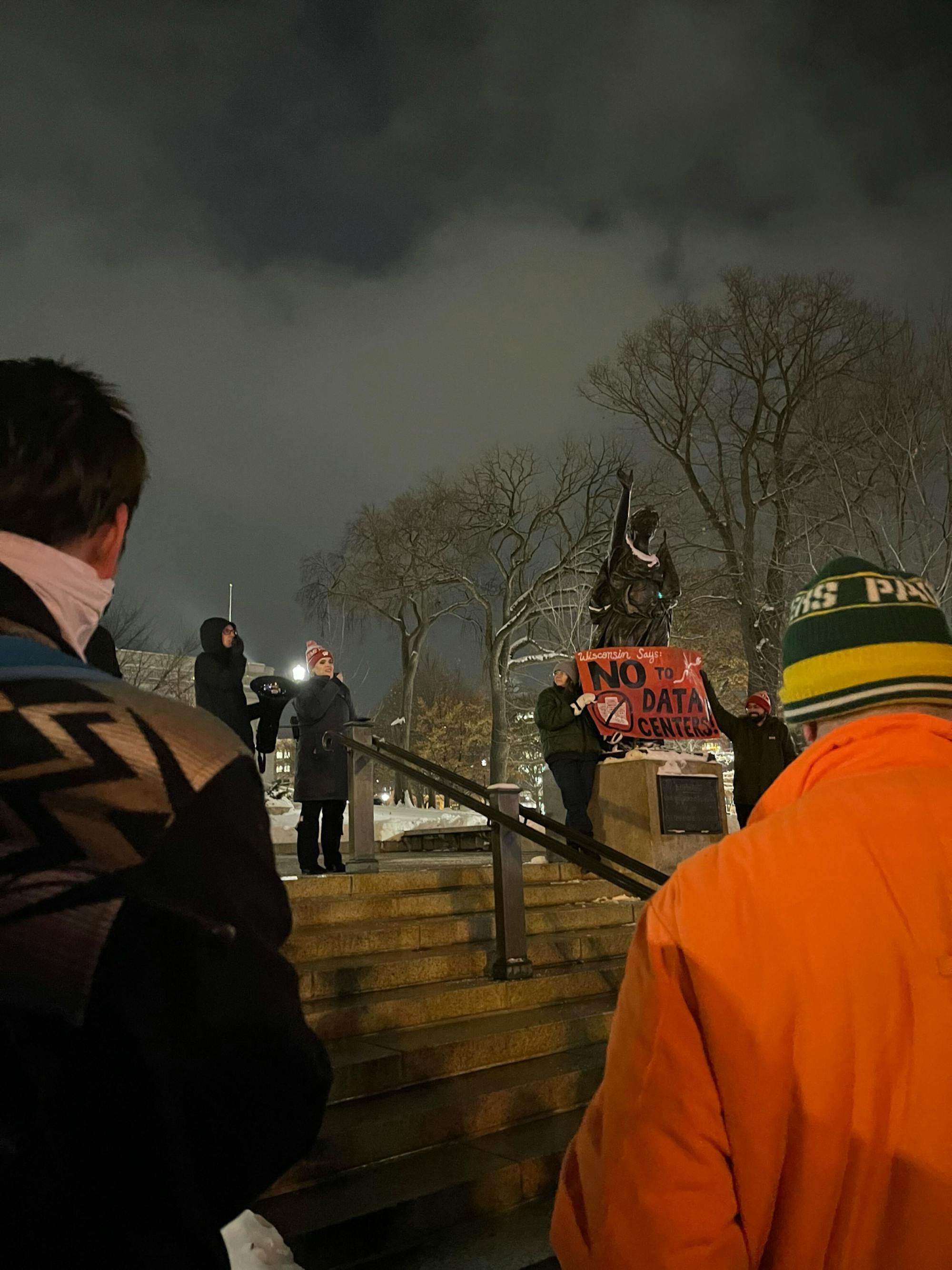
Eli Morey, a member of the Madison branch of the Party for Socialism and Liberation, said the DeForest local government and other local governments supporting data centers are not working in the interest of their constituents. “The most fundamental question here is the question of democracy,” Morey said. “We want people to be able to decide, do we want data centers or not?”
Morey and other PSL chapters coordinated a statewide day of action against data centers on Dec. 2, coinciding with a Milwaukee meeting of business leaders discussing the economic opportunities of data center development in Wisconsin. There are no active data center proposals in Madison, but Morey said PSL Madison is supporting communities around the state fighting against data centers.
Morey wants residents to have a chance in deciding what is best for their community. “We haven't gotten a single opportunity to vote or participate in a democratic process around AI,” he said. “We're being force-fed this new technology with zero say in how or where it's used or [if] we want to use it at all.”
In November, QTS Data Centers announced a partnership with the Building Trades Council of South Central Wisconsin to build the data center. Andrew Disch, North Central States Regional Council of Carpenters representative, supports the development. “If your answer is ‘don't build it’, then what's your solution? Because as a society, we rely on the modern day conveniences that data centers are providing,” Disch said.
To involve residents in the development process, QTS hosted community feedback sessions allowing residents to ask QTS officials questions about the project. Residents have raised concerns about the actual number of jobs the center would create. QTS claimed the project will create 5,000 construction jobs and 700 permanent full-time positions once completed, but a recent analysis found the largest data centers employ fewer than 150 permanent workers.
Stephanie Robinson, co-director of 350 Wisconsin, a grassroots environmental organization, was also not convinced about data centers’ promises. “We know that these companies are justifying their choices by saying they’ll invest in green infrastructure and energy efficiency,” Robinson said. “That isn’t enough. Empty promises are not enough.”