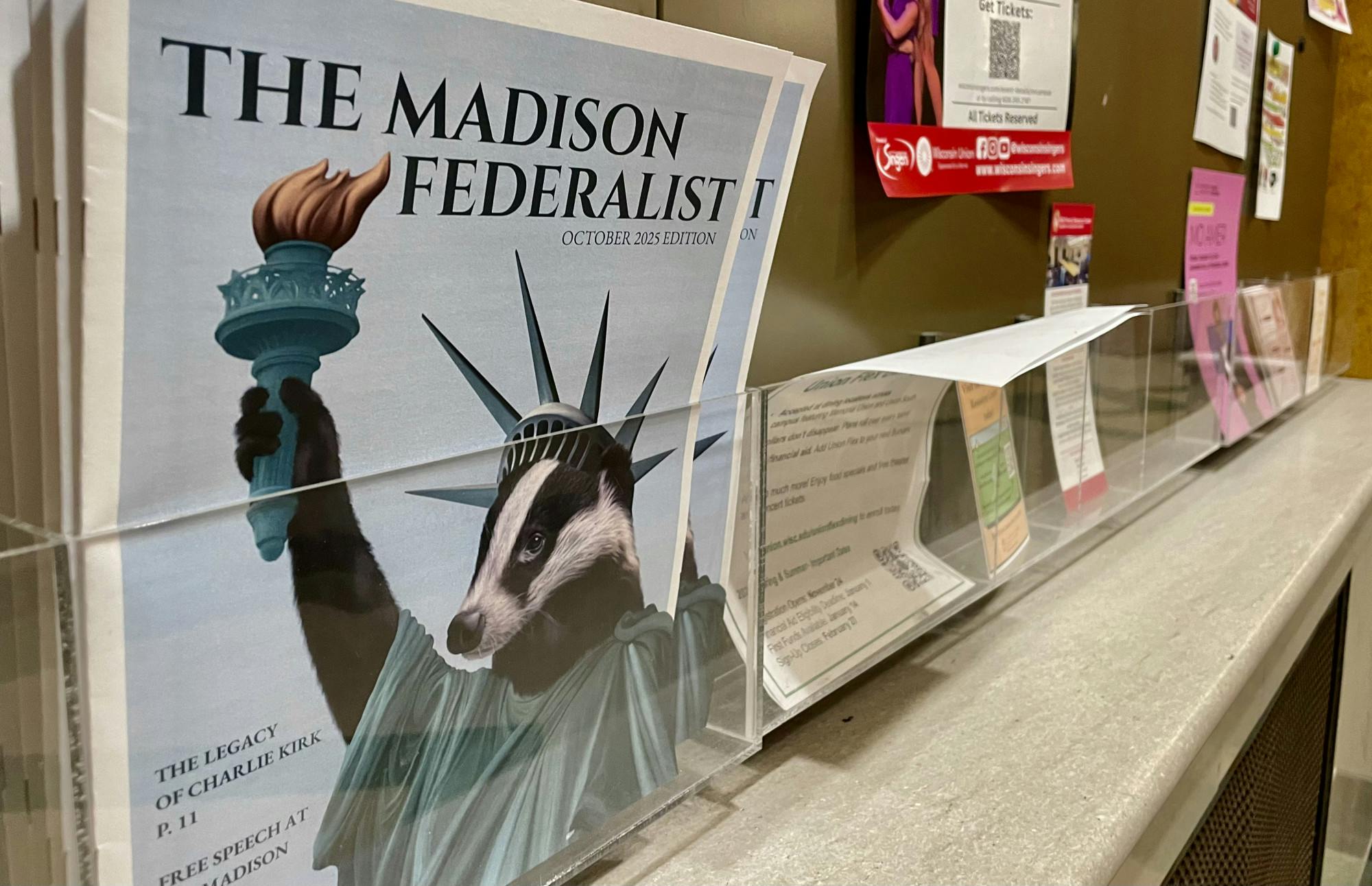
Recently, I came across an article in the Madison Federalist critiquing Marxism. I engaged with it, hoping for an informed discussion on Marxist concepts, but I was met with disappointment. The author, Aiden Wirth, claimed they “became interested in Marxist thought through TikTok videos” and heavily relied on quotes from various Catholic Popes, without actually quoting Karl Marx or any Marxist work.
After I commented these thoughts at the end of the article in disbelief, Federalist Editor-in-Chief Benjamin Rothove (also Madison College Republicans President and YAF co-chair) invited me to submit a written response. I’m not interested in doing so because the Federalist is a newspaper whose editorial practices repeatedly harm marginalized students. So I’ll make my position clear in The Daily Cardinal, detailing the Federalist’s tremendous editorial neglect.
At nearly every paper, including the Cardinal, the editors ensure writing passes scrutiny. They check sources, theses, and statements, recommending any necessary changes. There’s an expectation for writers to use a variety of credible sources, particularly primary sources, to support their claims. What they initially submit is checked for accuracy before it’s published, and if a writer doesn't have a source, it isn’t published. That’s the editorial process.
In that context, no competent editor would have given the Federalist’s Marxism critique a green light, regardless of political affiliation, because it refuses primary sourcing and relies entirely on the author’s own idea of what Marxism is. Marxism is not a vague internet trend; it’s an established set of scholarly concepts developed by Karl Marx and Friedrich Engels to analyze history, society, and political economy.
As a Marxist, I’d love to respond to the critiques in-depth. However, the Federalist offers little substance. Wirth relies on anti-communist quotes from Pope Pius XI without engaging in Marxist theory itself. If he believes we should trust the Pope’s authority, then it becomes unclear why other papal statements, such as Pope Francis’s 2015 remark calling financial greed “the dung of the devil,” are excluded. Nonetheless, it’s intellectually indefensible to assume that papal authority automatically qualifies someone to critique Marxist theory.
Marx, Engels, and subsequent Marxist scholars have spent decades rigorously developing and defending these concepts. Yet in a single sentence, ignoring Marx’s written work, Wirth presents himself as an authority on Marx, saying, “‘dialectical materialism’ sounds complex and academic, but it really just means that economic conditions can affect history.”
Immediately, the critique falls flat. That isn’t a definition of dialectical materialism, but instead a shallow description of historical materialism.
Dialectical materialism is Marxism’s lens for understanding how contradictions in material reality, society, and thought drive change, not how economics shapes history: Engels explains dialectical materialism on page 132 of his 1878 Anti-Dühring as “the science of the general laws of motion and development of nature, human society and thought.” It’s not as simple as just economics or history. To reduce these well-researched ideas to vague impressions is unserious.
The rest of the article largely consists of papal quotations and cultural critique. Wirth never engages with Marx other than to use an image of him as a thumbnail, instead mentioning “social media” five times and making meandering claims about how Marxism “almost seems like it was created for social media” and is “a viral and accessible ideology.”
Alternatively, Wirth should have claimed a stronger “essential flaw in Marxism” than “to deny the owner of that property [that is their own] is to deny the owner of their ability to use their wages to better their position in life.” Marx explicitly rejects this claim, writing in his Communist Manifesto, “[w]e by no means intend to abolish this personal appropriation of the products of labour,” making clear that Marxism does not deny the use of wages, but instead targets private ownership that allows the exploitative buying and selling of others’ labor.
I wouldn’t expect the Federalist to recognize the valid points Marxism makes, though, because it functions less as a reliable reporting outlet than as a tool spreading prejudiced, anti-education ideas on campus and within the national conservative media apparatus.
The Federalist has regularly tried to push minor campus activities into conservative culture war narratives, like when Fox News amplified Federalist reporting about a series of stickers on campus calling for the death of ICE agents, an agency with a well-documented record of deaths in custody and a pattern of extrajudicial killings.
Fox’s coverage prompted an outreach to UW-Madison, which responded by condemning violence. This article failed to explain how unsanctioned Sharpie drawings posed any kind of threat. The "About" page of the Federalist’s website boasts that their “reporting has been picked up by Fox News, National Review, The New York Post, and more,” showing how their campus stories are often weaponized into fodder for national conservative outrage campaigns.
The Federalist has also consistently opposed students’ autonomy in healthcare, criticizing University Health Services for providing gender-affirming care and referral to necessary abortion resources and birth control. When UW Health stopped offering these essential medical services last week, the Federalist framed the decision as a halt to “transgender services to minors,” a characterization that lacked context and clarity.
Gender-affirming care is often used to treat different conditions in people who are not transgender and is rarely prescribed to adolescents. Research by the University of Massachusetts indicates that when it is administered to teens, gender-affirming care can be life-saving. It found an association with hormone replacement therapy, a type of gender affirming care, and “a 14.4% decrease in the risk of ever attempting suicide if treatment started between the ages of 14 and 17.” To oppose gender-affirming care is to disregard the wealth of evidence and scientific consensus that indicates otherwise, but that seems to be the Federalist’s raison d’être.
So then, does the Federalist exist to manufacture consent to target students, their well-being, and education, or to report on pressing campus matters?
It’s for these reasons that I declined to publish my critique in the Federalist. It’s a platform used for hate and outrage on a national level against those who are most vulnerable to it, particularly on our own campus. This is not journalism. Students deserve better, and campus discourse demands higher standards.
Roman Fritz is a Senior studying political science. Do you agree that student newspapers have a responsibility to uphold fact-checking? Send all comments to opinion@dailycardinal.com