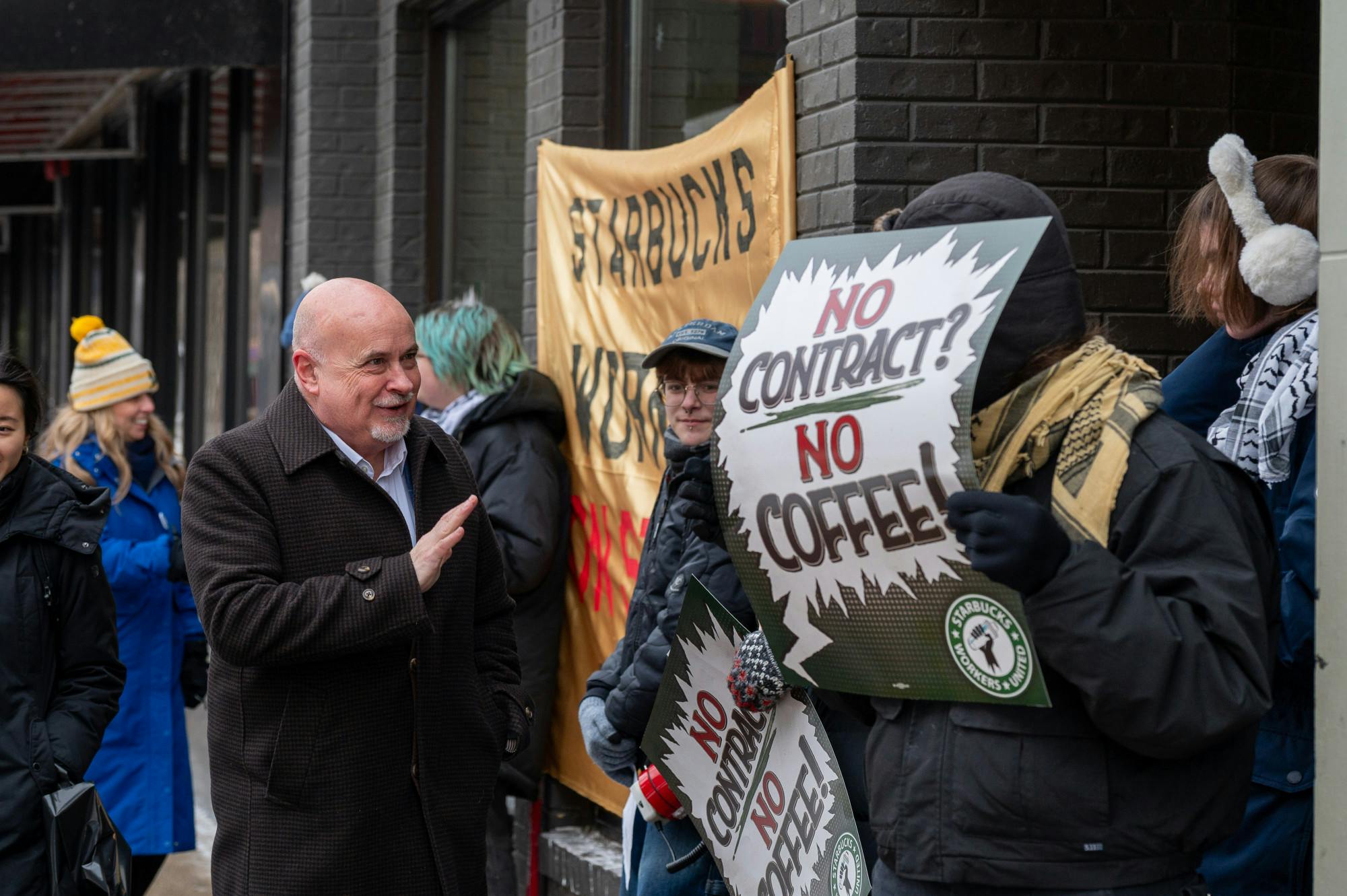
Unionized Starbucks workers picketed at Madison’s various union locations this weekend as a part of the ongoing Red Cup Rebellion nation-wide strike for a new labor contract.
“We want stores to be better staffed, we want workers to get better hours and we need better pay,” Madison strike organizer Allie Kerr told The Daily Cardinal, adding that Starbucks’ robust employee benefits are typically only available to employees who work at least 20 hours a week, while many workers are intentionally scheduled less.
The State Street location remained closed during the strike, but Kerr warned Starbucks could bring in non-union workers to reopen the location “within the next week.”
Starbucks’ labor union, Starbucks Workers United, has struggled to make substantial negotiations with the coffee giant, Kerr said. “Starbucks has been bargaining in bad faith and they haven’t been coming to the table with serious proposals,” she said.
The Red Cup Rebellion strike, which started on Nov. 13, is now the longest in company history. Over 1,000 Starbucks employees nationwide joined the strikes, criticizing the corporations’ union busting and “failure to finalize a fair union contract.” The union and Starbucks have been working on negotiations for over 18 months, according to Starbucks Workers United.
Other employees shared frustrated sentiments. “I would essentially be doing the job of three, four baristas by myself,” Kate Feltman, a State Street employee told the Cardinal, adding that wages aren’t enough to make up for the workload that comes with the location’s uniquely busy college student crowd.
“Wages aren’t livable, and that’s a really frustrating thing,” Feltman said. “It’s also frustrating when wages are only increased by a very small percentage every year.”
After the union voted to strike, Starbucks released a statement saying they remained committed to negotiating and believed they could move “quickly to a reasonable deal” with the union. They felt the union walked away from the negotiations.
“For months, we were at the bargaining table, working in good faith with Workers United and delegates from across the country to reach agreements that make sense for partners and for the long-term success of Starbucks,” the statement said.
University of Wisconsin-Madison student and District 8 alder candidate Bobby Gronert and Democratic Congressman Mark Pocan were among the non-Starbucks employees at the strike. Pocan is the co-chair of the Congressional Labor Caucus and a member of a labor union.
“It’s the federal law that allows the right to organize,” Pocan told The Daily Cardinal, stressing the importance of federal politicians supporting labor unions. “Unfortunately, some companies, like Starbucks, fight those very legal efforts.”
Despite struggles to get Starbucks to sit down at the negotiation table, Kerr said the union has no plans to end the strike. “Some of our strikes have been one day strikes or two day strikes,” she said. “This is a longer haul.”
“We don’t want to be out here,” strike organizer Olivia Lerche told the Cardinal. “I’m just hoping that Starbucks will come to the table and negotiate.”
Kerr said she feels the strike continues to build in momentum despite the company’s stonewalling efforts. “Week by week, we’re noticing more workers are starting to join,” she said.
“This is a historic contract battle,” Kerr said. “If we’re able to negotiate a contract, that can make a huge difference for service workers everywhere.”
Organizers said the strike will continue until Starbucks negotiates conditions including better hours, higher pay and resolutions for their unfair labor practice and encouraged residents to avoid purchasing Starbucks until the strike ends, instead directing patrons to Colectivo, a unionized coffee shop.